

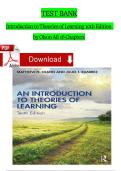
TEST BANK
Introduction to Theories of Learning 10th Edition
by Olson All 16 Chapters
,Table of Contents
PART I Introduction to Learning
Chapter 1: What Is Learning?
Chapter 2: Approaches to the Study of Learning
Chapter 3: Early Notions about Learning Chapter 4:
Edward Lee Thorndike
PART II Predominantly Functionalistic Theories
Chapter 5: Burrhus Frederic Skinner
Chapter 6: Clark Leonard Hull
PART III Predominantly Associationistic Theories
Chapter 7: Ivan Petrovich Pavlov Chapter 8:
Edwin Ray Guthrie Chapter 9: William
Kaye Estes
PART IV Predominantly Cognitive Theories
Chapter 10: Gestalt Theory Chapter 11:
Jean Piaget
Chapter 12: Edward Chace Tolman Chapter
13: Albert Bandura
PART V A Predominantly Neurophysiological Theory
Chapter214:2Donald2Olding2Hebb
Chapter215:2Robert2C.2Bolles2and2Evolutionary2Psychology2Chapter216:2A2 Fi
nal2Word
,CHAPTER212(*2-2Correct2Answer)
, 1. Most2psychologists2reject2dictionary2definitions2of2learning2because:
a. the2definitions2are2too2objective
b. the2definitions2tend2to2be2behavioristic
c. *2the2definitions2are2nebulous
d. learning2is2not2definable
2. The2Skinnerians2oppose2equating2the2terms2"reward"2and2"reinforcement"2because:
a. *2reinforcers2strengthen2behavior2whereas2rewards2do2not
b. organisms2must2invest2considerable2time2and2energy2to2obtain
2 reinforcers2but2notto2obtain2rewards
c. only2reinforcers2are2given2or2received2in2recognition2of2worthy2behavior
d. rewards2strengthen2behavior2whereas2reinforcers2do2not
3. To2attribute2a2behavioral2change2to2learning,2the2change2must2be2all2of2the
2 followingexcept:
a. relatively2permanent
b. the2result2of2experience
c. observed2in2performance
d. *2the2result2of2maturation
4. We2can2make2inferences2concerning2the2learning2process2by2studying:
a. *2changes2in2behavior
b. the2mind
c. acquired2knowledge
d. motivational2states
5. According2to2most2learning2theorists2the2learning2process:
a. cannot2be2studied2objectively
b. cannot2be2studied2at2all
c. *2can2 be2studied2only2indirectly2through2changes2in2behavior
d. can2be2studied2directly
6. For2most2learning2theorists,2learning2is2thought2of2as2a(n):
a. independent2variable
b. dependent2variable
c. *2intervening2variable
d. extraneous2variable
7. Short2term2memory2refers2to:
a. learning2that2occurs2very2rapidly
Introduction to Theories of Learning 10th Edition
by Olson All 16 Chapters
,Table of Contents
PART I Introduction to Learning
Chapter 1: What Is Learning?
Chapter 2: Approaches to the Study of Learning
Chapter 3: Early Notions about Learning Chapter 4:
Edward Lee Thorndike
PART II Predominantly Functionalistic Theories
Chapter 5: Burrhus Frederic Skinner
Chapter 6: Clark Leonard Hull
PART III Predominantly Associationistic Theories
Chapter 7: Ivan Petrovich Pavlov Chapter 8:
Edwin Ray Guthrie Chapter 9: William
Kaye Estes
PART IV Predominantly Cognitive Theories
Chapter 10: Gestalt Theory Chapter 11:
Jean Piaget
Chapter 12: Edward Chace Tolman Chapter
13: Albert Bandura
PART V A Predominantly Neurophysiological Theory
Chapter214:2Donald2Olding2Hebb
Chapter215:2Robert2C.2Bolles2and2Evolutionary2Psychology2Chapter216:2A2 Fi
nal2Word
,CHAPTER212(*2-2Correct2Answer)
, 1. Most2psychologists2reject2dictionary2definitions2of2learning2because:
a. the2definitions2are2too2objective
b. the2definitions2tend2to2be2behavioristic
c. *2the2definitions2are2nebulous
d. learning2is2not2definable
2. The2Skinnerians2oppose2equating2the2terms2"reward"2and2"reinforcement"2because:
a. *2reinforcers2strengthen2behavior2whereas2rewards2do2not
b. organisms2must2invest2considerable2time2and2energy2to2obtain
2 reinforcers2but2notto2obtain2rewards
c. only2reinforcers2are2given2or2received2in2recognition2of2worthy2behavior
d. rewards2strengthen2behavior2whereas2reinforcers2do2not
3. To2attribute2a2behavioral2change2to2learning,2the2change2must2be2all2of2the
2 followingexcept:
a. relatively2permanent
b. the2result2of2experience
c. observed2in2performance
d. *2the2result2of2maturation
4. We2can2make2inferences2concerning2the2learning2process2by2studying:
a. *2changes2in2behavior
b. the2mind
c. acquired2knowledge
d. motivational2states
5. According2to2most2learning2theorists2the2learning2process:
a. cannot2be2studied2objectively
b. cannot2be2studied2at2all
c. *2can2 be2studied2only2indirectly2through2changes2in2behavior
d. can2be2studied2directly
6. For2most2learning2theorists,2learning2is2thought2of2as2a(n):
a. independent2variable
b. dependent2variable
c. *2intervening2variable
d. extraneous2variable
7. Short2term2memory2refers2to:
a. learning2that2occurs2very2rapidly


