HC1: Perception and motor control
Neurological damages
Brain damages has long provided insights to the relation between brain and behaviors
1. Vascular disorders (stroke) sudden onset cerebrovascular events
a. Cerebral hemorrhage: bleeding in the brain
b. Cerebral ischemia: disruption of blood supply (thrombosis, embolism,
arteriosclerosis)
2. Tumors a mass of cells, which grows independent of the rest of the body
3. Trauma injuries of the brain (close- or open-head)
4. Epilepsy excessive and abnormal pattern of activity in the brain, it induces a
transient loss of consciousness.
5. Degenerative disorders entails the death of neurons, motor or cognitive difficulties
often noticed by family members
Anatomical organization
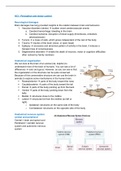
We can look at the brain of an animal (rat, dolphin) to
understand more of the brain of humans. You can see a lot of
differences sulci and gyrus. However, as you can see is that
the organization or the structure can be quite conserved.
Because of this conservative structure we can use the brain in
animals to explore some mechanisms in the human brain.
Rostral/anterior parts of the body toward the nose
Caudal/posterior parts of the body toward the tail
Dorsal parts of the body pointing up from the back
Ventral parts of the body pointing down from the
belly
Medial structures close to the midline
Lateral structures far from the midline (so left or
right)
o Ipsilateral: structures on the same side of the body
o Contralateral: structures on the opposite side of the body
Anatomical nervous system:
central and peripheral
Central = brain and spinal cord
Peripheral = somatic nervous
system and autonomic nervous
system
, 1. Myelencephalon (or medulla) : connects the
brain with the spinal cord (blue)
2. Metencephalon (or hindbrain): consists of
pons and cerebellum, somatosensory
structure (lilac)
3. Mesencephalon (or midbrain): consists of
tegmentum, periaqueductal grey (PAG),
visuomotor structure
4. Diencephalon: consists of hypothalamus and
thalamus, referred as gateway to the cortex
5. Telencephalon: consists of the cerebral cortex
and sub-cortical structures (basal ganglia,
limbic system)
In the brain there are hollow spaces filled
with spinal fluid. So, the brain is floating in
our heads. Cerebrospinal fluid has the
crucial role of protecting our brain. In
simple words, the fluid work as a pillow for
our brain. In case we bust our head,
because of the floating, the brain isn’t
damaged that much. There are four
ventricles (hollow spaces). These are an
indirect measure reduce the brain shock
caused by sudden movements of the head.
The other part of the nervous system is the spinal
cord. And it can be divided in four sections.
Neurological damages
Brain damages has long provided insights to the relation between brain and behaviors
1. Vascular disorders (stroke) sudden onset cerebrovascular events
a. Cerebral hemorrhage: bleeding in the brain
b. Cerebral ischemia: disruption of blood supply (thrombosis, embolism,
arteriosclerosis)
2. Tumors a mass of cells, which grows independent of the rest of the body
3. Trauma injuries of the brain (close- or open-head)
4. Epilepsy excessive and abnormal pattern of activity in the brain, it induces a
transient loss of consciousness.
5. Degenerative disorders entails the death of neurons, motor or cognitive difficulties
often noticed by family members
Anatomical organization
We can look at the brain of an animal (rat, dolphin) to
understand more of the brain of humans. You can see a lot of
differences sulci and gyrus. However, as you can see is that
the organization or the structure can be quite conserved.
Because of this conservative structure we can use the brain in
animals to explore some mechanisms in the human brain.
Rostral/anterior parts of the body toward the nose
Caudal/posterior parts of the body toward the tail
Dorsal parts of the body pointing up from the back
Ventral parts of the body pointing down from the
belly
Medial structures close to the midline
Lateral structures far from the midline (so left or
right)
o Ipsilateral: structures on the same side of the body
o Contralateral: structures on the opposite side of the body
Anatomical nervous system:
central and peripheral
Central = brain and spinal cord
Peripheral = somatic nervous
system and autonomic nervous
system
, 1. Myelencephalon (or medulla) : connects the
brain with the spinal cord (blue)
2. Metencephalon (or hindbrain): consists of
pons and cerebellum, somatosensory
structure (lilac)
3. Mesencephalon (or midbrain): consists of
tegmentum, periaqueductal grey (PAG),
visuomotor structure
4. Diencephalon: consists of hypothalamus and
thalamus, referred as gateway to the cortex
5. Telencephalon: consists of the cerebral cortex
and sub-cortical structures (basal ganglia,
limbic system)
In the brain there are hollow spaces filled
with spinal fluid. So, the brain is floating in
our heads. Cerebrospinal fluid has the
crucial role of protecting our brain. In
simple words, the fluid work as a pillow for
our brain. In case we bust our head,
because of the floating, the brain isn’t
damaged that much. There are four
ventricles (hollow spaces). These are an
indirect measure reduce the brain shock
caused by sudden movements of the head.
The other part of the nervous system is the spinal
cord. And it can be divided in four sections.