
MARYLAND CHIROPRACTIC JURISPRUDENCE
FINAL PAPER 2026 QUESTIONS WITH
ANSWERS GRADED A+
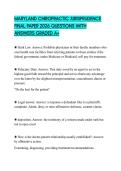
◉ Stark Law. Answer: Prohibits physicians or their family members who
own health care facilities from referring patients to those entities if the
federal government, under Medicare or Medicaid, will pay for treatment.
◉ Fiduciary Duty. Answer: That duty owed by an agent to act in the
highest good faith toward the principal and not to obtain any advantage
over the latter by the slightest misrepresentation, concealment, duress or
pressure.
"Do the best for the patient"
◉ Legal answer. Answer: a response a defendant files to a plaintiff's
complaint. Admit, deny, or raise affirmative defenses, counter-claims
◉ deposition. Answer: the testimony of a witness made under oath but
not in open court
◉ How is the doctor-patient relationship usually established?. Answer:
by affirmative action:
Examining, diagnosing, providing treatment/recommendations.
, Exceptions for independant medical examiners
◉ abandonment. Answer: Leaving a patient after care has been initiated
and before the patient has been transferred to someone with equal or
greater medical training.
◉ Fully informed consent. Answer: gives information to the patient
involving their diagnosis, plan of management, prognosis.
PARQ
Procedures, alternatives, risks, questions
costs
right to revoke consent at anytime
◉ Maryland scope of practice: Chiro. Answer: (1) "Practice
chiropractic" means to use a drugless system of health care based on the
principle that interference with the transmission of nerve impulses may
cause disease.
(2) "Practice chiropractic" includes the diagnosing and locating of
misaligned or displaced vertebrae and, through the manual manipulation
and adjustment of the spine and other skeletal structures, treating
disorders of the human body.
(3) Except as otherwise provided in this title, "practice chiropractic"
does not include the use of drugs or surgery, or the practice of
osteopathy, obstetrics, or any other branch of medicine.
FINAL PAPER 2026 QUESTIONS WITH
ANSWERS GRADED A+
◉ Stark Law. Answer: Prohibits physicians or their family members who
own health care facilities from referring patients to those entities if the
federal government, under Medicare or Medicaid, will pay for treatment.
◉ Fiduciary Duty. Answer: That duty owed by an agent to act in the
highest good faith toward the principal and not to obtain any advantage
over the latter by the slightest misrepresentation, concealment, duress or
pressure.
"Do the best for the patient"
◉ Legal answer. Answer: a response a defendant files to a plaintiff's
complaint. Admit, deny, or raise affirmative defenses, counter-claims
◉ deposition. Answer: the testimony of a witness made under oath but
not in open court
◉ How is the doctor-patient relationship usually established?. Answer:
by affirmative action:
Examining, diagnosing, providing treatment/recommendations.
, Exceptions for independant medical examiners
◉ abandonment. Answer: Leaving a patient after care has been initiated
and before the patient has been transferred to someone with equal or
greater medical training.
◉ Fully informed consent. Answer: gives information to the patient
involving their diagnosis, plan of management, prognosis.
PARQ
Procedures, alternatives, risks, questions
costs
right to revoke consent at anytime
◉ Maryland scope of practice: Chiro. Answer: (1) "Practice
chiropractic" means to use a drugless system of health care based on the
principle that interference with the transmission of nerve impulses may
cause disease.
(2) "Practice chiropractic" includes the diagnosing and locating of
misaligned or displaced vertebrae and, through the manual manipulation
and adjustment of the spine and other skeletal structures, treating
disorders of the human body.
(3) Except as otherwise provided in this title, "practice chiropractic"
does not include the use of drugs or surgery, or the practice of
osteopathy, obstetrics, or any other branch of medicine.


