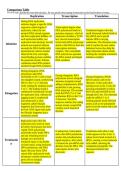
Comparison Table
For each stage, describe the events that take place. Be very specific about naming all molecules involved and locations of events.
Replication Transcription Translation
During DNA replication,
initiation begins at specific DNA
sequences called origins of Transcription begins when
replication, where the two RNA polymerase binds to a Translation begins when the
parental DNA strands separate promoter sequence, which in small ribosomal subunit binds to
and form replication bubbles. At eukaryotes includes a TATA the mRNA and a special
each replication bubble, two box. Several transcription initiator tRNA carrying
replication forks develop. Several factors help RNA polymerase methionine. The ribosome scans
Initiation proteins are required: helicase attach to the DNA to form the until it reaches the start codon.
unwinds the DNA double helix, transcription initiation Initiation factors then help the
topoisomerase relieves tension complex. Once assembled, large ribosomal subunit attach,
ahead of the fork, and single- RNA polymerase separates forming the complete translation
strand binding proteins stabilize the DNA strands and begins initiation complex.
the separated strands. Primase RNA synthesis.
synthesizes short RNA primers
needed to begin DNA synthesis.
During elongation, DNA
polymerase adds DNA
During elongation, RNA
nucleotides to the 3′ end of each During elongation, tRNAs
polymerase moves along the
new daughter strand, synthesizing deliver amino acids to the
antisense (template) strand,
DNA in the 5′ to 3′ direction ribosome. Codon-anticodon
adding complementary RNA
while reading the template strand pairing occurs at the A site, the
nucleotides to the growing
3′ to 5′. The leading strand is growing polypeptide is held at
RNA transcript. The enzyme
synthesized continuously toward the P site and used tRNAs exit
Elongation the replication fork, whereas the
reads the DNA 3′ to 5′ and
through the E site. The ribosome
synthesizes RNA in the 5′ to
lagging strand is synthesized reads the mRNA 5′ to 3′,
3′ direction. The RNA
discontinuously in short forming peptide bonds between
sequence matches the coding
fragments called Okazaki amino acids as the polypeptide
(sense) strand, except RNA
fragments that form away from grows from the amino end to the
contains uracil instead of
the fork. DNA ligase later joins carboxyl end.
thymine.
the Okazaki fragments into a
continuous strand.
Replication ends when the
replication forks meet or when
the entire chromosome has been
copied. DNA polymerase
In eukaryotes, transcription Translation ends when a stop
proofreads newly made DNA,
ends when RNA polymerase codon appears in the A site. A
and any remaining errors or
reaches the polyadenylation release factor binds instead of a
damage are corrected by
Terminatio signal sequence, after which tRNA, causing a water molecule
mismatch repair or nucleotide
n excision repair, using nucleases,
it releases the pre-mRNA and to be added, releasing the
detaches from the DNA. The completed polypeptide. The
DNA polymerase, and DNA
transcription factors also ribosomal subunits then
ligase. Because linear DNA
dissociate. separate.
cannot fully replicate the ends,
telomerase extends telomeres in
germ cells to maintain
chromosome length.
For each stage, describe the events that take place. Be very specific about naming all molecules involved and locations of events.
Replication Transcription Translation
During DNA replication,
initiation begins at specific DNA
sequences called origins of Transcription begins when
replication, where the two RNA polymerase binds to a Translation begins when the
parental DNA strands separate promoter sequence, which in small ribosomal subunit binds to
and form replication bubbles. At eukaryotes includes a TATA the mRNA and a special
each replication bubble, two box. Several transcription initiator tRNA carrying
replication forks develop. Several factors help RNA polymerase methionine. The ribosome scans
Initiation proteins are required: helicase attach to the DNA to form the until it reaches the start codon.
unwinds the DNA double helix, transcription initiation Initiation factors then help the
topoisomerase relieves tension complex. Once assembled, large ribosomal subunit attach,
ahead of the fork, and single- RNA polymerase separates forming the complete translation
strand binding proteins stabilize the DNA strands and begins initiation complex.
the separated strands. Primase RNA synthesis.
synthesizes short RNA primers
needed to begin DNA synthesis.
During elongation, DNA
polymerase adds DNA
During elongation, RNA
nucleotides to the 3′ end of each During elongation, tRNAs
polymerase moves along the
new daughter strand, synthesizing deliver amino acids to the
antisense (template) strand,
DNA in the 5′ to 3′ direction ribosome. Codon-anticodon
adding complementary RNA
while reading the template strand pairing occurs at the A site, the
nucleotides to the growing
3′ to 5′. The leading strand is growing polypeptide is held at
RNA transcript. The enzyme
synthesized continuously toward the P site and used tRNAs exit
Elongation the replication fork, whereas the
reads the DNA 3′ to 5′ and
through the E site. The ribosome
synthesizes RNA in the 5′ to
lagging strand is synthesized reads the mRNA 5′ to 3′,
3′ direction. The RNA
discontinuously in short forming peptide bonds between
sequence matches the coding
fragments called Okazaki amino acids as the polypeptide
(sense) strand, except RNA
fragments that form away from grows from the amino end to the
contains uracil instead of
the fork. DNA ligase later joins carboxyl end.
thymine.
the Okazaki fragments into a
continuous strand.
Replication ends when the
replication forks meet or when
the entire chromosome has been
copied. DNA polymerase
In eukaryotes, transcription Translation ends when a stop
proofreads newly made DNA,
ends when RNA polymerase codon appears in the A site. A
and any remaining errors or
reaches the polyadenylation release factor binds instead of a
damage are corrected by
Terminatio signal sequence, after which tRNA, causing a water molecule
mismatch repair or nucleotide
n excision repair, using nucleases,
it releases the pre-mRNA and to be added, releasing the
detaches from the DNA. The completed polypeptide. The
DNA polymerase, and DNA
transcription factors also ribosomal subunits then
ligase. Because linear DNA
dissociate. separate.
cannot fully replicate the ends,
telomerase extends telomeres in
germ cells to maintain
chromosome length.