

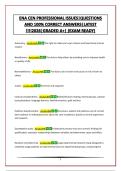
AND 100% CORRECT ANSWERS|LATEST
Autonomy - ANSWER The right to make one's own choices and have those choices
respect
Beneficence - ANSWER The duty to help others by providing care to improve health
or quality of life
Nonmaleficence - ANSWER The duty to do no harm and cause no risk of harm to
others
Justice - ANSWER To be fair and impartial
Cultural considerations - ANSWER Beliefs/decision-making, diverse groups, cultural
issues/practices, language barriers, familial presence, grief and loss
Evidence based practice - ANSWER Conscious, explicit and judicious use of current
best evidence in making decisions about the care of patience, based on clinical experience
and research
Quantitative study - ANSWER A deductive process that uses numeric findings for
qualification, examines relationships between variables and determines cause and effect
Random controlled trial - ANSWER Large experimental research study designed to
randomly assign patients to experimental and non-experimental groups, comparing the
1
, results of one form of treatment against a control group that receives the current standard
of care, often considered gold standard
Systematic review and meta-analysis - ANSWER Review of multiple studies on a
particular topic that identifies in critically analyzes the best research and makes practice
recommendations based on that analysis
Cohort study - ANSWER Subjects who have a certain condition or receive a
particular treatment or followed overtime and compared with another group not affected by
that condition
Qualitative study - ANSWER An inductive process involving reviews where words,
not numbers, are used to give meaning to Data, involves interaction between the researcher
and the subject
Case study - ANSWER A study that generally highlights an unusual or interesting
case a practitioner has encountered
Critical incident stress - ANSWER A normal reaction by the body in mind to a very
abnormal event, reactions may interfere with a person's ability to function or cope at the
scene or later
Critical incident stress behavioral clinical manifestations - ANSWER Restlessness,
irritability and moodiness, antisocial behavior, increased alcohol consumption
Critical incident stress cognitive clinical manifestations - ANSWER Poor
concentration, confusion or uncertainty, nightmares
Critical incident stress physical clinical manifestations - ANSWER Vomiting, chills,
headaches, disrupted sleep, muscle, tremors, chest pain
2
Autonomy - ANSWER The right to make one's own choices and have those choices
respect
Beneficence - ANSWER The duty to help others by providing care to improve health
or quality of life
Nonmaleficence - ANSWER The duty to do no harm and cause no risk of harm to
others
Justice - ANSWER To be fair and impartial
Cultural considerations - ANSWER Beliefs/decision-making, diverse groups, cultural
issues/practices, language barriers, familial presence, grief and loss
Evidence based practice - ANSWER Conscious, explicit and judicious use of current
best evidence in making decisions about the care of patience, based on clinical experience
and research
Quantitative study - ANSWER A deductive process that uses numeric findings for
qualification, examines relationships between variables and determines cause and effect
Random controlled trial - ANSWER Large experimental research study designed to
randomly assign patients to experimental and non-experimental groups, comparing the
1
, results of one form of treatment against a control group that receives the current standard
of care, often considered gold standard
Systematic review and meta-analysis - ANSWER Review of multiple studies on a
particular topic that identifies in critically analyzes the best research and makes practice
recommendations based on that analysis
Cohort study - ANSWER Subjects who have a certain condition or receive a
particular treatment or followed overtime and compared with another group not affected by
that condition
Qualitative study - ANSWER An inductive process involving reviews where words,
not numbers, are used to give meaning to Data, involves interaction between the researcher
and the subject
Case study - ANSWER A study that generally highlights an unusual or interesting
case a practitioner has encountered
Critical incident stress - ANSWER A normal reaction by the body in mind to a very
abnormal event, reactions may interfere with a person's ability to function or cope at the
scene or later
Critical incident stress behavioral clinical manifestations - ANSWER Restlessness,
irritability and moodiness, antisocial behavior, increased alcohol consumption
Critical incident stress cognitive clinical manifestations - ANSWER Poor
concentration, confusion or uncertainty, nightmares
Critical incident stress physical clinical manifestations - ANSWER Vomiting, chills,
headaches, disrupted sleep, muscle, tremors, chest pain
2


