
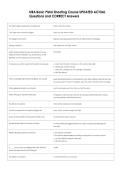
NRA Basic Pistol Shooting Course UPDATED ACTUAL
Questions and CORRECT Answers
The three major components of a pistol are: frame, barrel and action
Your finger may contact the trigger: when you are ready to shoot
The trigger mechanism: releases a spring-powered hammer or striker to fire the cartridge.
Aiming consists of: sight alignment and sight picture.
When aiming a pistol, the eye can only focus on one front sight
object at a time; therefore, you should focus on the
(BLANK) so that it appears clear and sharp.
To ensure you use the correct ammunition for your gun: a. check the information stamped on the barrel and/or slide.
b. check your owner's manual.
c. check the cartridge box and cartridge headstamp.
d. all of the above.
When a cartridge fails to fire immediately, you should: keep the pistol pointed in a safe direction and, after waiting at least 30 seconds
(as a precaution in case of a hangfire), open the action and remove the cartridge.
When gripping the pistol, you should: use the same grip each time that you hold the pistol.
Follow-through is important because: it integrates, maintains and continues all shooting fundamentals before, during
and immediately after firing the shot.
The frame of a pistol is: is the central component of most pistols.
The four components of a pistol cartridge are: case, primer, powder charge and bullet.
Some of the benefits of the Isosceles Position are: it is natural and easy to assume.
Double-action refers to the type of action: in which pulling the trigger performs two tasks: cocking and releasing the
hammer.
Before cleaning a pistol, be sure that: a. the pistol is unloaded.
b. The pistol is disassembled according to instructions in owner's manual.
c. no ammunition is present in the area.
d. all of the above.
A ____ occurs when a cartridge fails to fire after the misfire
primer has been struck by the firing pin.
The safety on a pistol is: a mechanical device, and can fail.
Questions and CORRECT Answers
The three major components of a pistol are: frame, barrel and action
Your finger may contact the trigger: when you are ready to shoot
The trigger mechanism: releases a spring-powered hammer or striker to fire the cartridge.
Aiming consists of: sight alignment and sight picture.
When aiming a pistol, the eye can only focus on one front sight
object at a time; therefore, you should focus on the
(BLANK) so that it appears clear and sharp.
To ensure you use the correct ammunition for your gun: a. check the information stamped on the barrel and/or slide.
b. check your owner's manual.
c. check the cartridge box and cartridge headstamp.
d. all of the above.
When a cartridge fails to fire immediately, you should: keep the pistol pointed in a safe direction and, after waiting at least 30 seconds
(as a precaution in case of a hangfire), open the action and remove the cartridge.
When gripping the pistol, you should: use the same grip each time that you hold the pistol.
Follow-through is important because: it integrates, maintains and continues all shooting fundamentals before, during
and immediately after firing the shot.
The frame of a pistol is: is the central component of most pistols.
The four components of a pistol cartridge are: case, primer, powder charge and bullet.
Some of the benefits of the Isosceles Position are: it is natural and easy to assume.
Double-action refers to the type of action: in which pulling the trigger performs two tasks: cocking and releasing the
hammer.
Before cleaning a pistol, be sure that: a. the pistol is unloaded.
b. The pistol is disassembled according to instructions in owner's manual.
c. no ammunition is present in the area.
d. all of the above.
A ____ occurs when a cartridge fails to fire after the misfire
primer has been struck by the firing pin.
The safety on a pistol is: a mechanical device, and can fail.


