
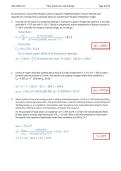
UBC CHEM 123 PS03: Calorimetry and Enthalpy Page 1 of 11
For all questions, assume that the given values are good to 4 significant figures. Assume that the heat
capacities for a compound in a particular phase are constant over the given temperature ranges.
1. A sample of 3.74 moles of a monatomic ideal gas is confined in a piston. The gas (the system) is in an initial
state with Pi = 0.73 atm and Vi = 119 L. The gas is compressed, and the temperature of the gas increases to
Tf = 39°C. Calculate the change in internal energy, ∆E, for the gas.
Initial state:
𝑃𝑃𝑖𝑖 𝑉𝑉𝑖𝑖 (0.73 atm)(119 L)
𝑇𝑇𝑖𝑖 = =
𝑛𝑛𝑛𝑛 (3.74 mol)�0.08206 L atm mol–1 K–1 �
= 283 K
Final state:
∆E = +1353 J
𝑇𝑇𝑓𝑓 = 39 + 273 = 312 K
For a closed system (fixed n) of monatomic ideal gas:
3 3
∆E = nR∆T = (3.74 mol)(8.314 J mol–1 K–1)(312 – 283 K) = +1353 J
2 2
2. A piece of copper metal (the system) with a mass of 6.21 kg is heated from Ti = 21°C to Tf = 325°C under a
constant external pressure of 1.0 atm. The specific heat capacity of copper under these conditions is
Csp = 0.385 J g–1 K–1. Calculate qsys (in kJ).
∆T = Tf – Ti = 325°C – 21°C = 304°C = 304 K
qcopper = mCsp∆T = (6210 g)(0.385 J g–1 K–1)(304 K) = 727 kJ qsys = +727 kJ
3. Steam systems serve as an energy source in various industrial processes. In the U.S., 37% of the fossil fuels
burned are used to generate steam. The generated steam is used for heating processes, concentrating and
distilling liquids, or as a feedstock.1 Fortunately, water presents a more sustainable alternative for steam
production, offering a cleaner, non-hazardous, and waste-free resource.
A 3.51 kg sample of liquid water is in equilibrium at Ti = 20°C and Pi = 1.0 atm. The sample absorbs 250 kJ
of heat under a constant external pressure of Pext = 1.0 atm. What is the final temperature of the water?
The specific heat capacity of liquid water under these conditions is 4.184 J g–1 K–1.
qwater = mCsp∆T
qwater (+250,000 J)
∆T = = = +17 K = 17℃
mCsp (3510 g)�4.184 Jg–1 K–1 �
Tf = 37°C
Tf = Ti + ∆T = 20°C + 17°C = 37°C
, UBC CHEM 123 PS03: Calorimetry and Enthalpy Page 2 of 11
4. Sodium hydroxide, NaOH(s), is a strong base. Dissolving NaOH(s) in water is an exothermic process with
∆Hsolution° = –44.51 kJ/mol. How much heat does dissolving 13.5 g NaOH(s) in water generate, assuming a
constant pressure process? Give your answer in kJ.
13.5 g NaOH
= 0.3375 mol NaOH
40 g mol–1
From the given enthalpy of solution, dissolving 1.00 mole of NaOH will
give off 44.51 kJ of heat. Calculate how much heat will be generated
by dissolving 0.3375 moles of NaOH.
(0.3375 mol NaOH) × (–44.51 kJ/mol) = –15.0 kJ qNaOH = −15.0 kJ
5. A nutritional scientist is curious to know the caloric value of an unusual food combination: pickles dipped
in peanut butter. Bomb calorimeters are used to measure the heat produced by a sample burned. The
resulting value is then corrected to account for how the body metabolizes the food.
A 0.0150 mole sample of the pickles dipped in peanut butter is burned inside a bomb calorimeter which
increases the temperature of 2.00 kg of water by 3.86ºC. The heat capacity of the water is 4.184 J g–1 K–1.
Calculate the qpickles of the food combination for this process.
qwater = mCsp∆T = (2000 g)×(4.184 J g–1 K–1)×(3.86 K) = 32,300 J = 32.3 kJ
All the heat that went into heating the water came from the combustion of the
pickles dipped in peanut butter:
qpickles = – qwater = – 32.3 kJ
qpickles = −32.3 kJ
6. (a) A sample of 0.3167 g of cyclohexane, C6H12(l), was burned in a constant pressure calorimeter. The
combustion raised the temperature of the calorimeter from 22.31°C to 27.33°C. The enthalpy of
combustion of cyclohexane is –3920 kJ/mol. What is the heat capacity (in units of J/°C) of the calorimeter?
0.3167 g C6 H12
= 0.003763 mol C6H12
84.16 g mol–1
(0.003763 mol C6H12) × (–3920 kJ/mol) = –14.75 kJ
Burning 0.003763 moles of cyclohexane will give off 14.75 kJ of heat. All of this heat
will be absorbed by the calorimeter.
qcalorimeter = –qcyclohexane = +14.75 kJ
qcalorimeter = CcalΔTcal
qcalorimeter +14.75 kJ
Ccal = = (27.33℃ = 2938 J/°C Ccal = 2938 J/°C
∆Tcal – 22.31℃)
For all questions, assume that the given values are good to 4 significant figures. Assume that the heat
capacities for a compound in a particular phase are constant over the given temperature ranges.
1. A sample of 3.74 moles of a monatomic ideal gas is confined in a piston. The gas (the system) is in an initial
state with Pi = 0.73 atm and Vi = 119 L. The gas is compressed, and the temperature of the gas increases to
Tf = 39°C. Calculate the change in internal energy, ∆E, for the gas.
Initial state:
𝑃𝑃𝑖𝑖 𝑉𝑉𝑖𝑖 (0.73 atm)(119 L)
𝑇𝑇𝑖𝑖 = =
𝑛𝑛𝑛𝑛 (3.74 mol)�0.08206 L atm mol–1 K–1 �
= 283 K
Final state:
∆E = +1353 J
𝑇𝑇𝑓𝑓 = 39 + 273 = 312 K
For a closed system (fixed n) of monatomic ideal gas:
3 3
∆E = nR∆T = (3.74 mol)(8.314 J mol–1 K–1)(312 – 283 K) = +1353 J
2 2
2. A piece of copper metal (the system) with a mass of 6.21 kg is heated from Ti = 21°C to Tf = 325°C under a
constant external pressure of 1.0 atm. The specific heat capacity of copper under these conditions is
Csp = 0.385 J g–1 K–1. Calculate qsys (in kJ).
∆T = Tf – Ti = 325°C – 21°C = 304°C = 304 K
qcopper = mCsp∆T = (6210 g)(0.385 J g–1 K–1)(304 K) = 727 kJ qsys = +727 kJ
3. Steam systems serve as an energy source in various industrial processes. In the U.S., 37% of the fossil fuels
burned are used to generate steam. The generated steam is used for heating processes, concentrating and
distilling liquids, or as a feedstock.1 Fortunately, water presents a more sustainable alternative for steam
production, offering a cleaner, non-hazardous, and waste-free resource.
A 3.51 kg sample of liquid water is in equilibrium at Ti = 20°C and Pi = 1.0 atm. The sample absorbs 250 kJ
of heat under a constant external pressure of Pext = 1.0 atm. What is the final temperature of the water?
The specific heat capacity of liquid water under these conditions is 4.184 J g–1 K–1.
qwater = mCsp∆T
qwater (+250,000 J)
∆T = = = +17 K = 17℃
mCsp (3510 g)�4.184 Jg–1 K–1 �
Tf = 37°C
Tf = Ti + ∆T = 20°C + 17°C = 37°C
, UBC CHEM 123 PS03: Calorimetry and Enthalpy Page 2 of 11
4. Sodium hydroxide, NaOH(s), is a strong base. Dissolving NaOH(s) in water is an exothermic process with
∆Hsolution° = –44.51 kJ/mol. How much heat does dissolving 13.5 g NaOH(s) in water generate, assuming a
constant pressure process? Give your answer in kJ.
13.5 g NaOH
= 0.3375 mol NaOH
40 g mol–1
From the given enthalpy of solution, dissolving 1.00 mole of NaOH will
give off 44.51 kJ of heat. Calculate how much heat will be generated
by dissolving 0.3375 moles of NaOH.
(0.3375 mol NaOH) × (–44.51 kJ/mol) = –15.0 kJ qNaOH = −15.0 kJ
5. A nutritional scientist is curious to know the caloric value of an unusual food combination: pickles dipped
in peanut butter. Bomb calorimeters are used to measure the heat produced by a sample burned. The
resulting value is then corrected to account for how the body metabolizes the food.
A 0.0150 mole sample of the pickles dipped in peanut butter is burned inside a bomb calorimeter which
increases the temperature of 2.00 kg of water by 3.86ºC. The heat capacity of the water is 4.184 J g–1 K–1.
Calculate the qpickles of the food combination for this process.
qwater = mCsp∆T = (2000 g)×(4.184 J g–1 K–1)×(3.86 K) = 32,300 J = 32.3 kJ
All the heat that went into heating the water came from the combustion of the
pickles dipped in peanut butter:
qpickles = – qwater = – 32.3 kJ
qpickles = −32.3 kJ
6. (a) A sample of 0.3167 g of cyclohexane, C6H12(l), was burned in a constant pressure calorimeter. The
combustion raised the temperature of the calorimeter from 22.31°C to 27.33°C. The enthalpy of
combustion of cyclohexane is –3920 kJ/mol. What is the heat capacity (in units of J/°C) of the calorimeter?
0.3167 g C6 H12
= 0.003763 mol C6H12
84.16 g mol–1
(0.003763 mol C6H12) × (–3920 kJ/mol) = –14.75 kJ
Burning 0.003763 moles of cyclohexane will give off 14.75 kJ of heat. All of this heat
will be absorbed by the calorimeter.
qcalorimeter = –qcyclohexane = +14.75 kJ
qcalorimeter = CcalΔTcal
qcalorimeter +14.75 kJ
Ccal = = (27.33℃ = 2938 J/°C Ccal = 2938 J/°C
∆Tcal – 22.31℃)


