
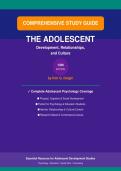
COMPREHENSIVE STUDY GUIDE
THE ADOLESCENT
Development, Relationships,
and Culture
14th
EDITION
by Kim G. Dolgin
✓ Complete Adolescent Psychology Coverage
■ Physical, Cognitive & Social Development
■ Perfect for Psychology & Education Students
■ Identity, Relationships & Cultural Context
■ Research-Based & Contemporary Issues
Essential Resource for Adolescent Development Studies
Psychology • Education • Social Work • Counseling
,Complete Adolescent Development Coverage
■ Comprehensive Topic Coverage:
✓ Biological Development & Puberty
✓ Cognitive Development & Brain Changes
✓ Identity Formation & Self-Concept
✓ Moral Development & Values
✓ Gender & Sexual Identity
✓ Family Relationships & Dynamics
✓ Peer Relationships & Friendships
✓ Romantic Relationships & Dating
✓ Education & Academic Achievement
✓ Cultural & Ethnic Identity
✓ Social Media & Technology Impact
✓ Mental Health & Psychopathology
✓ Risk Behaviors & Decision-Making
✓ Career Development & Future Planning
■ Perfect For:
• Psychology Students (Developmental, Child, Adolescent)
• Education Majors & Teachers
• Social Work & Counseling Students
• Human Development Programs
• Youth Workers & Program Coordinators
• Parents & Caregivers
• Anyone Working with Adolescents
■ Why This Study Guide Stands Out:
• 14th Edition with latest research and contemporary issues
• Integrates biological, psychological, and social perspectives
• Cultural diversity and multicultural perspectives throughout
• Real-world applications and case studies
Educational Study Material • Copyright-Free Content • For Academic Use
, Chapter 1
Dolgin Test Bank
MULTIPLE CHOICE
1. Human growth from the stages of childhood to adulthood is
a. consistent and fluid.
b. inconsistent and fluid.
c. gradual and uncertain.
d. gradual and certain.
Answer: c
Topic: Terminology Applied to Adolescence
Learning Objective: LO 1.1: Differentiate the terms used to describe adolescents
Skill Level: Analyze It
Difficulty Level: Easy
2. The term “juvenile” typically signifies a person
a. not considered an adult in the eyes of the law.
b. not yet able to procreate.
c. who has not yet developed secondary sexual characteristics.
d. under the age of 12.
Answer: a
Topic: Terminology Applied to Adolescence
Learning Objective: LO 1.1: Differentiate the terms used to describe adolescents
Skill Level: Understand the Concepts
Difficulty Level: Easy
3. Which common approach to understanding adolescence is taken by the text?
a. The biological approach
b. The cognitive approach
c. The evolutionary approach
d. The interdisciplinary approach
Answer: d
Topic: Approaches to Studying Adolescents
Learning Objective: LO 1.2: Identify the approaches used to study adolescence
Skill Level: Understand the Concepts
Difficulty Level: Easy
4. If a researcher were to study an adolescent’s growth by applying the cognitive perspective,
she would most likely be interested in the adolescent’s
Copyright © 2018, 2011, 2008 Pearson Education, Inc. All Rights Reserved
, a. reasoning.
b. biological functioning.
c. sexual development.
d. social development.
Answer: a
Topic: Approaches to Studying Adolescents
Learning Objective: LO 1.2: Identify the approaches used to study adolescence
Skill Level: Analyze It
Difficulty Level: Moderate
5. Karen is an adolescent researcher who studies the roles of self-concept, gender, and identity
in adolescent growth. Karen most likely uses which perspective to conduct her research?
a. The biological perspective
b. The cognitive perspective
c. The psychosexual perspective
d. The social relationship perspective
Answer: c
Topic: Approaches to Studying Adolescents
Learning Objective: LO 1.2: Identify the approaches used to study adolescence
Skill Level: Understand the Concepts
Difficulty Level: Easy
6. The stage between adolescence and adulthood is referred to as
a. extended adolescence.
b. emerging adulthood.
c. delayed adulthood.
d. juvenile adolescence.
Answer: b
Topic: Approaches to Studying Adolescents
Learning Objective: LO 1.2: Identify the approaches used to study adolescence
Skill Level: Understand the Concepts
Difficulty Level: Easy
7. Suppose a researcher studying adolescence wanted to collect the largest sample possible of
youth for her study. Based upon statistics indicating the largest population of youth, which
country would she visit to collect her data?
a. The United States
b. Russia
c. Africa
d. China
Copyright © 2018, 2011, 2008 Pearson Education, Inc. All Rights Reserved
THE ADOLESCENT
Development, Relationships,
and Culture
14th
EDITION
by Kim G. Dolgin
✓ Complete Adolescent Psychology Coverage
■ Physical, Cognitive & Social Development
■ Perfect for Psychology & Education Students
■ Identity, Relationships & Cultural Context
■ Research-Based & Contemporary Issues
Essential Resource for Adolescent Development Studies
Psychology • Education • Social Work • Counseling
,Complete Adolescent Development Coverage
■ Comprehensive Topic Coverage:
✓ Biological Development & Puberty
✓ Cognitive Development & Brain Changes
✓ Identity Formation & Self-Concept
✓ Moral Development & Values
✓ Gender & Sexual Identity
✓ Family Relationships & Dynamics
✓ Peer Relationships & Friendships
✓ Romantic Relationships & Dating
✓ Education & Academic Achievement
✓ Cultural & Ethnic Identity
✓ Social Media & Technology Impact
✓ Mental Health & Psychopathology
✓ Risk Behaviors & Decision-Making
✓ Career Development & Future Planning
■ Perfect For:
• Psychology Students (Developmental, Child, Adolescent)
• Education Majors & Teachers
• Social Work & Counseling Students
• Human Development Programs
• Youth Workers & Program Coordinators
• Parents & Caregivers
• Anyone Working with Adolescents
■ Why This Study Guide Stands Out:
• 14th Edition with latest research and contemporary issues
• Integrates biological, psychological, and social perspectives
• Cultural diversity and multicultural perspectives throughout
• Real-world applications and case studies
Educational Study Material • Copyright-Free Content • For Academic Use
, Chapter 1
Dolgin Test Bank
MULTIPLE CHOICE
1. Human growth from the stages of childhood to adulthood is
a. consistent and fluid.
b. inconsistent and fluid.
c. gradual and uncertain.
d. gradual and certain.
Answer: c
Topic: Terminology Applied to Adolescence
Learning Objective: LO 1.1: Differentiate the terms used to describe adolescents
Skill Level: Analyze It
Difficulty Level: Easy
2. The term “juvenile” typically signifies a person
a. not considered an adult in the eyes of the law.
b. not yet able to procreate.
c. who has not yet developed secondary sexual characteristics.
d. under the age of 12.
Answer: a
Topic: Terminology Applied to Adolescence
Learning Objective: LO 1.1: Differentiate the terms used to describe adolescents
Skill Level: Understand the Concepts
Difficulty Level: Easy
3. Which common approach to understanding adolescence is taken by the text?
a. The biological approach
b. The cognitive approach
c. The evolutionary approach
d. The interdisciplinary approach
Answer: d
Topic: Approaches to Studying Adolescents
Learning Objective: LO 1.2: Identify the approaches used to study adolescence
Skill Level: Understand the Concepts
Difficulty Level: Easy
4. If a researcher were to study an adolescent’s growth by applying the cognitive perspective,
she would most likely be interested in the adolescent’s
Copyright © 2018, 2011, 2008 Pearson Education, Inc. All Rights Reserved
, a. reasoning.
b. biological functioning.
c. sexual development.
d. social development.
Answer: a
Topic: Approaches to Studying Adolescents
Learning Objective: LO 1.2: Identify the approaches used to study adolescence
Skill Level: Analyze It
Difficulty Level: Moderate
5. Karen is an adolescent researcher who studies the roles of self-concept, gender, and identity
in adolescent growth. Karen most likely uses which perspective to conduct her research?
a. The biological perspective
b. The cognitive perspective
c. The psychosexual perspective
d. The social relationship perspective
Answer: c
Topic: Approaches to Studying Adolescents
Learning Objective: LO 1.2: Identify the approaches used to study adolescence
Skill Level: Understand the Concepts
Difficulty Level: Easy
6. The stage between adolescence and adulthood is referred to as
a. extended adolescence.
b. emerging adulthood.
c. delayed adulthood.
d. juvenile adolescence.
Answer: b
Topic: Approaches to Studying Adolescents
Learning Objective: LO 1.2: Identify the approaches used to study adolescence
Skill Level: Understand the Concepts
Difficulty Level: Easy
7. Suppose a researcher studying adolescence wanted to collect the largest sample possible of
youth for her study. Based upon statistics indicating the largest population of youth, which
country would she visit to collect her data?
a. The United States
b. Russia
c. Africa
d. China
Copyright © 2018, 2011, 2008 Pearson Education, Inc. All Rights Reserved


