

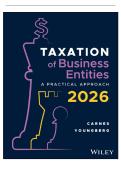
, SOLUTION MANUAL FOR Taxation for Business
Entities A Practical Approach, 2026 Edition Gregory
A. Carnes
Notes
1- The file is chapter after chapter.
2- We have shown you few pages sample.
3- The file contains all Appendix and Excel sheet
if it exists.
4- We have all what you need, we make update
at every time. There are many new editions
waiting you.
5- If you think you purchased the wrong file You
can contact us at every time, we can replace it
with true one.
Our email:
, Carnes/Youngberg: Taxation of Business Entities, 2026 Edition
Chapter 1: Basics of Business Entity Taxation
End-of-Chapter Solutions
Discussion Questions
1. Describe the entity theory.
Title: Discussion Question 1
Difficulty: Easy
Learning Objective 1: 1.1
Standard 1: AACSB || Knowledge
Standard 2: AICPA || AC: Reporting
Standard 3: Bloom's || Knowledge
Section Reference 1: 1.1
Solution:
The entity theory provides that a business is a distinct entity from its owners. Thus, any time
that cash or property passes between the entity and the owners, there are potential tax
consequences.
Time on Task: 2 minutes
2. Explain the difference between an operating distribution and a liquidating distribution.
Title: Discussion Question 2
Difficulty: Easy
Learning Objective 1: 1.1
Standard 1: AACSB || Knowledge
Standard 2: AICPA || AC: Reporting
Standard 3: Bloom's || Knowledge
Section Reference 1: 1.1
Solution:
If an operating distribution is made to the owners, then the recipient continues to be an owner
after the distribution. If a liquidating distribution is received, then the recipient is no longer an
owner after the distribution. The entity will remain in existence as long as it has other owners. If
all owners receive liquidating distributions, then the entity is dissolved.
Time on Task: 2 minutes
3. What is the due date for partnerships and S corporations to file their income tax returns?
Title: Discussion Question 3
Difficulty: Easy
Learning Objective 1: 1.2
Standard 1: AACSB || Knowledge
Standard 2: AICPA || AC: Reporting
Standard 3: Bloom's || Knowledge
,Section Reference 1: 1.2
Solution:
Partnership tax returns and S corporation tax returns are due two and one-half months after the
end of the tax year, which is March 15 for a calendar-year business. Extensions for partnership
and S corporations are for six months, which is September 15 for a calendar-year business.
4. Define statute of limitations and explain how it applies to tax assessment and refunds.
Title: Discussion Question 4
Difficulty: Medium
Learning Objective 1: 1.2
Standard 1: AACSB || Knowledge
Standard 2: AICPA || AC: Reporting
Standard 3: Bloom's || Knowledge
Section Reference 1: 1.2
Solution:
The statute of limitations sets the period during which one party can pursue a cause of action
against another party. The statute of limitations regarding tax assessment runs for three years
from the later of (1) the due date of the return, or (2) the date the return was filed.
Time On Task: 3 minutes
5. Describe the failure to pay penalty and the failure to file a tax return penalty.
Title: Discussion Question 5
Difficulty: Hard
Learning Objective 1: 1.2
Standard 1: AACSB || Knowledge
Standard 2: AICPA || AC: Reporting
Standard 3: Bloom's || Knowledge
Section Reference 1: 1.2
Solution:
The failure to file a tax return penalty is imposed on the tax balance due at 5% per month (up to
25%) with a minimum penalty amount of the lesser of $525 (2025) or the amount of tax due. If
there is no balance due with the tax return, there is no failure to file penalty imposed. The
minimum penalty applies only if the taxpayer does not file the tax return within 60 days of the
due date and the computed penalty amount is less than the minimum penalty.
Additionally, S corporations and partnerships must also pay a penalty equal to $255 (2025) per
shareholder/partner for each month, or part of a month, that the return is late. The penalty is
assessed for no more than 12 months.
The failure to pay the tax due penalty is imposed on the tax balance due at 0.5% per month (up to
25%). If there is no balance due with the tax return, there is no failure to pay penalty imposed. A
fraction of a month counts as a full month for both penalties. If both the failure to pay penalty
,and the failure to file penalty potentially apply, the maximum penalty for both is limited to 5% of
the tax due per month.
Time On Task: 8 minutes
6. What is meant by the term substantial authority?
Title: Discussion Question 6
Difficulty: Medium
Learning Objective 1: 1.2
Standard 1: AACSB || Knowledge
Standard 2: AICPA || AC: Reporting
Standard 3: Bloom's || Knowledge
Section Reference 1: 1.2
Solution:
Substantial authority is based upon weighing the supporting evidence and authority for taking a
position on the tax return. Substantial authority indicates a probability that the taxpayer’s
position will be sustained upon audit or litigation and is generally held to be 40% or less. The
“more likely than not” standard is defined as a greater than 50% chance of a position being
sustained on its merits.
Time On Task: 4 minutes
7. Provide two examples of an accuracy-related penalty.
Title: Discussion Question 7
Difficulty: Medium
Learning Objective 1: 1.2
Standard 1: AACSB || Knowledge
Standard 2: AICPA || AC: Reporting
Standard 3: Bloom's || Knowledge
Section Reference 1: 1.2
Solution:
Examples of an accuracy related penalty include errors from negligence, substantial
understatement of a taxpayer’s tax liability, as well as substantial or gross misvaluation. The
most serious civil accuracy penalty the IRS can assess a taxpayer is for fraud.
Time On Task: 4 minutes
8. What does the tax law include in amount realized?
Title: Discussion Question 8
Difficulty: Medium
Learning Objective 1: 1.3
Standard 1: AACSB || Knowledge
Standard 2: AICPA || AC: Reporting
Standard 3: Bloom's || Knowledge
Section Reference 1: 1.3
Solution:
,Conceptually, amount realized represents the value that the owner of the property receives
because of the disposition. Computing amount realized is a four-step process:
Step 1. Cash received
Step 2. Plus: Fair market value of any property and services received
Step 3. Plus: Liabilities assumed by the buyer, reduced by debts of buyer assumed by
seller
Step 4. Less: Selling or disposition expenses
Time On Task: 4 minutes
9. What is the difference between realized gain or loss and recognized gain or loss?
Title: Discussion Question 9
Difficulty: Medium
Learning Objective 1: 1.3
Standard 1: AACSB || Knowledge
Standard 2: AICPA || AC: Reporting
Standard 3: Bloom's || Knowledge
Section Reference 1: 1.3
Solution:
The taxpayer must compute a realized gain or loss every time there is a sale or disposition of
property. Realized gain or loss is amount realized less adjusted basis. A recognized gain or loss
is one that the taxpayer includes in the computation of taxable income.
Time On Task: 4 minutes
10. Provide two reasons why realized gain might be deferred for tax purposes.
Title: Discussion Question 10
Difficulty: Hard
Learning Objective 1: 1.3
Standard 1: AACSB || Knowledge
Standard 2: AICPA || AC: Reporting
Standard 3: Bloom's || Knowledge
Section Reference 1: 1.3
Solutions:
Two reasons why Congress allows gains to be deferred are:
1. The transaction did not generate any cash for the taxpayer, so if the taxpayer did have
to pay taxes, the cash must come from other sources.
2. The taxpayer’s economic situation has not changed significantly because of the
transaction, so Congress does not believe it is appropriate to tax gains at that time
Time On Task: 4 minutes
11. Provide a definition for boot.
Title: Discussion Question 11
Difficulty: Easy
,Learning Objective 1: 1.3
Standard 1: AACSB || Knowledge
Standard 2: AICPA || AC: Reporting
Standard 3: Bloom's || Knowledge
Section Reference 1: 1.3
Solution:
The law defines boot as any property exchanged that is not qualified property, including cash.
Time On Task: 2 minutes
12. How does a tax-deferred transaction impact the holding period of an asset?
Title: Discussion Question 12
Difficulty: Medium
Learning Objective 1: 1.3
Standard 1: AACSB || Knowledge
Standard 2: AICPA || AC: Reporting
Standard 3: Bloom's || Knowledge
Section Reference 1: 1.3
Solution:
For a tax-deferred transaction, the holding period of property received always includes the
holding period of the property transferred. Because the taxpayer is deferring gain or loss that has
accrued on the asset transferred, then the holding period of the asset received should include the
time period during which the deferred gain or loss accrued.
Time On Task: 4 minutes
13. Define related-party transaction.
Title: Discussion Question 13
Difficulty: Easy
Learning Objective 1: 1.3
Standard 1: AACSB || Knowledge
Standard 2: AICPA || AC: Reporting
Standard 3: Bloom's || Knowledge
Section Reference 1: 1.3
Solution:
A related-party transaction is an agreement between two parties that have a preexisting business
relationship or familial relationship. The term related party includes the following family
members: spouse, children, grandchildren/other descendants, parents, grandparents/other
ancestors, and brothers and sisters. Aunts, uncles, and cousins are not related parties, and neither
are in-laws. A business relationship can include ownership of more than 50% (directly or
indirectly) of a corporation or partnership.
Time On Task: 2 min
14. Does the related-party loss disallowance rule apply even when the selling price is equal to the
fair market value and can be substantiated by a qualified appraisal?
,Title: Discussion Question 14
Difficulty: Medium
Learning Objective 1: 1.3
Standard 1: AACSB || Knowledge
Standard 2: AICPA || AC: Reporting
Standard 3: Bloom's || Knowledge
Section Reference 1: 1.3
Solution:
Yes, the related party loss rule applies regardless of whether the selling price and fair market
value are the same or different amounts. The disallowance rule applies if a loss is realized, even
if a qualified appraisal verifies the taxpayer sold the asset for its actual value.
Time On Task: 3 min
15. Why is it important to differentiate among ordinary assets, Section 1231 assets, and capital
assets?
Title: Discussion Question 15
Difficulty: Medium
Learning Objective 1: 1.3
Standard 1: AACSB || Knowledge
Standard 2: AICPA || AC: Reporting
Standard 3: Bloom's || Knowledge
Section Reference 1: 1.3
Solution:
It is important to identify an asset as ordinary, Section 1231, or capital because each category is
treated differently for tax purposes. The character of the asset determines whether the asset is
depreciable, whether gain is taxed at ordinary or preferential rates, and whether losses can be
deducted.
Time On Task: 3 minutes
16. Distinguish between realty and personalty.
Title: Discussion Question 16
Difficulty: Easy
Learning Objective 1: 1.3
Standard 1: AACSB || Knowledge
Standard 2: AICPA || AC: Reporting
Standard 3: Bloom's || Knowledge
Section Reference 1: 1.3
Solution:
Realty is land and any structure that is permanently attached to the land. The most common type
of asset that is permanently attached to land is buildings. Individuals often refer to realty as real
property. Personalty is any asset that is not realty. Taxpayers often refer to personalty as
personal property.
Time On Task: 3 minutes
,17. When is an asset deemed long-term for holding-period purposes? Why is this important?
Title: Discussion Question 17
Difficulty: Easy
Learning Objective 1: 1.3
Standard 1: AACSB || Knowledge
Standard 2: AICPA || AC: Reporting
Standard 3: Bloom's || Knowledge
Section Reference 1: 1.3
Solution:
The tax law treats an asset as long-term when the asset has been held for more than one year. It is
important because if the taxpayer sells an asset and generates a long-term capital gain, then the
individual uses a preferential long-term capital gain rate when calculating liability. Corporations
do not have a preferential rate for long-term capital gains. It is also important in a trade or
business because a long-term asset is characterized as a Section 1231 asset.
Time On Task: 3 minutes
18. If a business-use asset held long-term is sold at a loss, and it is the only business-use asset
sold during the year, what is the character of that loss?
Title: Discussion Question 18
Difficulty: Medium
Learning Objective 1: 1.4
Standard 1: AACSB || Knowledge
Standard 2: AICPA || AC: Reporting
Standard 3: Bloom's || Knowledge
Section Reference 1: 1.4
Solution:
A business-use asset held long-term is a Section 1231 asset. If this is the only asset sold in the
current year, a Section 1231 asset sold at a loss is characterized as an ordinary loss.
Time On Task: 3 minutes
19. Explain the five-year lookback rule regarding Section 1231 net gains.
Title: Discussion Question 19
Difficulty: Hard
Learning Objective 1: 1.4
Standard 1: AACSB || Knowledge
Standard 2: AICPA || AC: Reporting
Standard 3: Bloom's || Knowledge
Section Reference 1: 1.4
Solution:
When a taxpayer sells business-use assets, recognized gains and losses occur. The taxpayer nets
all Section 1231 gains and losses. If a net Section 1231 gain results, the taxpayer must look back
five years to determine if any net Section 1231 losses occurred that were treated as ordinary
, losses. To the extent of those previous ordinary losses, the current Section 1231 gain is treated as
ordinary. Any remaining Section 1231 gain is treated as a long-term capital gain.
Time On Task: 4 minutes
20. Does the lookback rule apply to both net Section 1231 gains and losses generated in the
current year?
Title: Discussion Question 20
Difficulty: Medium
Learning Objective 1: 1.4
Standard 1: AACSB || Knowledge
Standard 2: AICPA || AC: Reporting
Standard 3: Bloom's || Knowledge
Section Reference 1: 1.4
Solution:
The five-year lookback rule applies only to net Section 1231 gains generated in the current year.
A net Section 1231 loss is always an ordinary loss in the current year.
Time On Task: 2 minutes
21. What is a Section 1245 asset?
Title: Discussion Question 21
Difficulty: Medium
Learning Objective 1: 1.4
Standard 1: AACSB || Knowledge
Standard 2: AICPA || AC: Reporting
Standard 3: Bloom's || Knowledge
Section Reference 1: 1.4
Solution:
A Section 1245 asset is tangible, depreciable, or amortizable property other than land or
buildings that is used in a trade or business and has been owned for more than one year. If a
Section 1245 asset is sold at a gain, the amount is characterized as ordinary to the extent of the
accumulated depreciation taken, but not to exceed the recognized gain. This is referred to as
Section 1245 depreciation recapture. If the gain is in excess of the accumulated depreciation, the
remaining amount would be considered Section 1231, long-term capital gain. If a Section 1245
asset is sold at a loss, the recapture rules do not apply, and the loss is a Section 1231 loss.
Time On Task: 5 minutes
22. If Section 197 intangible assets are purchased as part of an acquisition of a business, how are
they treated when they are sold?
Title: Discussion Question 22
Difficulty: Medium
Learning Objective 1: 1.4
Entities A Practical Approach, 2026 Edition Gregory
A. Carnes
Notes
1- The file is chapter after chapter.
2- We have shown you few pages sample.
3- The file contains all Appendix and Excel sheet
if it exists.
4- We have all what you need, we make update
at every time. There are many new editions
waiting you.
5- If you think you purchased the wrong file You
can contact us at every time, we can replace it
with true one.
Our email:
, Carnes/Youngberg: Taxation of Business Entities, 2026 Edition
Chapter 1: Basics of Business Entity Taxation
End-of-Chapter Solutions
Discussion Questions
1. Describe the entity theory.
Title: Discussion Question 1
Difficulty: Easy
Learning Objective 1: 1.1
Standard 1: AACSB || Knowledge
Standard 2: AICPA || AC: Reporting
Standard 3: Bloom's || Knowledge
Section Reference 1: 1.1
Solution:
The entity theory provides that a business is a distinct entity from its owners. Thus, any time
that cash or property passes between the entity and the owners, there are potential tax
consequences.
Time on Task: 2 minutes
2. Explain the difference between an operating distribution and a liquidating distribution.
Title: Discussion Question 2
Difficulty: Easy
Learning Objective 1: 1.1
Standard 1: AACSB || Knowledge
Standard 2: AICPA || AC: Reporting
Standard 3: Bloom's || Knowledge
Section Reference 1: 1.1
Solution:
If an operating distribution is made to the owners, then the recipient continues to be an owner
after the distribution. If a liquidating distribution is received, then the recipient is no longer an
owner after the distribution. The entity will remain in existence as long as it has other owners. If
all owners receive liquidating distributions, then the entity is dissolved.
Time on Task: 2 minutes
3. What is the due date for partnerships and S corporations to file their income tax returns?
Title: Discussion Question 3
Difficulty: Easy
Learning Objective 1: 1.2
Standard 1: AACSB || Knowledge
Standard 2: AICPA || AC: Reporting
Standard 3: Bloom's || Knowledge
,Section Reference 1: 1.2
Solution:
Partnership tax returns and S corporation tax returns are due two and one-half months after the
end of the tax year, which is March 15 for a calendar-year business. Extensions for partnership
and S corporations are for six months, which is September 15 for a calendar-year business.
4. Define statute of limitations and explain how it applies to tax assessment and refunds.
Title: Discussion Question 4
Difficulty: Medium
Learning Objective 1: 1.2
Standard 1: AACSB || Knowledge
Standard 2: AICPA || AC: Reporting
Standard 3: Bloom's || Knowledge
Section Reference 1: 1.2
Solution:
The statute of limitations sets the period during which one party can pursue a cause of action
against another party. The statute of limitations regarding tax assessment runs for three years
from the later of (1) the due date of the return, or (2) the date the return was filed.
Time On Task: 3 minutes
5. Describe the failure to pay penalty and the failure to file a tax return penalty.
Title: Discussion Question 5
Difficulty: Hard
Learning Objective 1: 1.2
Standard 1: AACSB || Knowledge
Standard 2: AICPA || AC: Reporting
Standard 3: Bloom's || Knowledge
Section Reference 1: 1.2
Solution:
The failure to file a tax return penalty is imposed on the tax balance due at 5% per month (up to
25%) with a minimum penalty amount of the lesser of $525 (2025) or the amount of tax due. If
there is no balance due with the tax return, there is no failure to file penalty imposed. The
minimum penalty applies only if the taxpayer does not file the tax return within 60 days of the
due date and the computed penalty amount is less than the minimum penalty.
Additionally, S corporations and partnerships must also pay a penalty equal to $255 (2025) per
shareholder/partner for each month, or part of a month, that the return is late. The penalty is
assessed for no more than 12 months.
The failure to pay the tax due penalty is imposed on the tax balance due at 0.5% per month (up to
25%). If there is no balance due with the tax return, there is no failure to pay penalty imposed. A
fraction of a month counts as a full month for both penalties. If both the failure to pay penalty
,and the failure to file penalty potentially apply, the maximum penalty for both is limited to 5% of
the tax due per month.
Time On Task: 8 minutes
6. What is meant by the term substantial authority?
Title: Discussion Question 6
Difficulty: Medium
Learning Objective 1: 1.2
Standard 1: AACSB || Knowledge
Standard 2: AICPA || AC: Reporting
Standard 3: Bloom's || Knowledge
Section Reference 1: 1.2
Solution:
Substantial authority is based upon weighing the supporting evidence and authority for taking a
position on the tax return. Substantial authority indicates a probability that the taxpayer’s
position will be sustained upon audit or litigation and is generally held to be 40% or less. The
“more likely than not” standard is defined as a greater than 50% chance of a position being
sustained on its merits.
Time On Task: 4 minutes
7. Provide two examples of an accuracy-related penalty.
Title: Discussion Question 7
Difficulty: Medium
Learning Objective 1: 1.2
Standard 1: AACSB || Knowledge
Standard 2: AICPA || AC: Reporting
Standard 3: Bloom's || Knowledge
Section Reference 1: 1.2
Solution:
Examples of an accuracy related penalty include errors from negligence, substantial
understatement of a taxpayer’s tax liability, as well as substantial or gross misvaluation. The
most serious civil accuracy penalty the IRS can assess a taxpayer is for fraud.
Time On Task: 4 minutes
8. What does the tax law include in amount realized?
Title: Discussion Question 8
Difficulty: Medium
Learning Objective 1: 1.3
Standard 1: AACSB || Knowledge
Standard 2: AICPA || AC: Reporting
Standard 3: Bloom's || Knowledge
Section Reference 1: 1.3
Solution:
,Conceptually, amount realized represents the value that the owner of the property receives
because of the disposition. Computing amount realized is a four-step process:
Step 1. Cash received
Step 2. Plus: Fair market value of any property and services received
Step 3. Plus: Liabilities assumed by the buyer, reduced by debts of buyer assumed by
seller
Step 4. Less: Selling or disposition expenses
Time On Task: 4 minutes
9. What is the difference between realized gain or loss and recognized gain or loss?
Title: Discussion Question 9
Difficulty: Medium
Learning Objective 1: 1.3
Standard 1: AACSB || Knowledge
Standard 2: AICPA || AC: Reporting
Standard 3: Bloom's || Knowledge
Section Reference 1: 1.3
Solution:
The taxpayer must compute a realized gain or loss every time there is a sale or disposition of
property. Realized gain or loss is amount realized less adjusted basis. A recognized gain or loss
is one that the taxpayer includes in the computation of taxable income.
Time On Task: 4 minutes
10. Provide two reasons why realized gain might be deferred for tax purposes.
Title: Discussion Question 10
Difficulty: Hard
Learning Objective 1: 1.3
Standard 1: AACSB || Knowledge
Standard 2: AICPA || AC: Reporting
Standard 3: Bloom's || Knowledge
Section Reference 1: 1.3
Solutions:
Two reasons why Congress allows gains to be deferred are:
1. The transaction did not generate any cash for the taxpayer, so if the taxpayer did have
to pay taxes, the cash must come from other sources.
2. The taxpayer’s economic situation has not changed significantly because of the
transaction, so Congress does not believe it is appropriate to tax gains at that time
Time On Task: 4 minutes
11. Provide a definition for boot.
Title: Discussion Question 11
Difficulty: Easy
,Learning Objective 1: 1.3
Standard 1: AACSB || Knowledge
Standard 2: AICPA || AC: Reporting
Standard 3: Bloom's || Knowledge
Section Reference 1: 1.3
Solution:
The law defines boot as any property exchanged that is not qualified property, including cash.
Time On Task: 2 minutes
12. How does a tax-deferred transaction impact the holding period of an asset?
Title: Discussion Question 12
Difficulty: Medium
Learning Objective 1: 1.3
Standard 1: AACSB || Knowledge
Standard 2: AICPA || AC: Reporting
Standard 3: Bloom's || Knowledge
Section Reference 1: 1.3
Solution:
For a tax-deferred transaction, the holding period of property received always includes the
holding period of the property transferred. Because the taxpayer is deferring gain or loss that has
accrued on the asset transferred, then the holding period of the asset received should include the
time period during which the deferred gain or loss accrued.
Time On Task: 4 minutes
13. Define related-party transaction.
Title: Discussion Question 13
Difficulty: Easy
Learning Objective 1: 1.3
Standard 1: AACSB || Knowledge
Standard 2: AICPA || AC: Reporting
Standard 3: Bloom's || Knowledge
Section Reference 1: 1.3
Solution:
A related-party transaction is an agreement between two parties that have a preexisting business
relationship or familial relationship. The term related party includes the following family
members: spouse, children, grandchildren/other descendants, parents, grandparents/other
ancestors, and brothers and sisters. Aunts, uncles, and cousins are not related parties, and neither
are in-laws. A business relationship can include ownership of more than 50% (directly or
indirectly) of a corporation or partnership.
Time On Task: 2 min
14. Does the related-party loss disallowance rule apply even when the selling price is equal to the
fair market value and can be substantiated by a qualified appraisal?
,Title: Discussion Question 14
Difficulty: Medium
Learning Objective 1: 1.3
Standard 1: AACSB || Knowledge
Standard 2: AICPA || AC: Reporting
Standard 3: Bloom's || Knowledge
Section Reference 1: 1.3
Solution:
Yes, the related party loss rule applies regardless of whether the selling price and fair market
value are the same or different amounts. The disallowance rule applies if a loss is realized, even
if a qualified appraisal verifies the taxpayer sold the asset for its actual value.
Time On Task: 3 min
15. Why is it important to differentiate among ordinary assets, Section 1231 assets, and capital
assets?
Title: Discussion Question 15
Difficulty: Medium
Learning Objective 1: 1.3
Standard 1: AACSB || Knowledge
Standard 2: AICPA || AC: Reporting
Standard 3: Bloom's || Knowledge
Section Reference 1: 1.3
Solution:
It is important to identify an asset as ordinary, Section 1231, or capital because each category is
treated differently for tax purposes. The character of the asset determines whether the asset is
depreciable, whether gain is taxed at ordinary or preferential rates, and whether losses can be
deducted.
Time On Task: 3 minutes
16. Distinguish between realty and personalty.
Title: Discussion Question 16
Difficulty: Easy
Learning Objective 1: 1.3
Standard 1: AACSB || Knowledge
Standard 2: AICPA || AC: Reporting
Standard 3: Bloom's || Knowledge
Section Reference 1: 1.3
Solution:
Realty is land and any structure that is permanently attached to the land. The most common type
of asset that is permanently attached to land is buildings. Individuals often refer to realty as real
property. Personalty is any asset that is not realty. Taxpayers often refer to personalty as
personal property.
Time On Task: 3 minutes
,17. When is an asset deemed long-term for holding-period purposes? Why is this important?
Title: Discussion Question 17
Difficulty: Easy
Learning Objective 1: 1.3
Standard 1: AACSB || Knowledge
Standard 2: AICPA || AC: Reporting
Standard 3: Bloom's || Knowledge
Section Reference 1: 1.3
Solution:
The tax law treats an asset as long-term when the asset has been held for more than one year. It is
important because if the taxpayer sells an asset and generates a long-term capital gain, then the
individual uses a preferential long-term capital gain rate when calculating liability. Corporations
do not have a preferential rate for long-term capital gains. It is also important in a trade or
business because a long-term asset is characterized as a Section 1231 asset.
Time On Task: 3 minutes
18. If a business-use asset held long-term is sold at a loss, and it is the only business-use asset
sold during the year, what is the character of that loss?
Title: Discussion Question 18
Difficulty: Medium
Learning Objective 1: 1.4
Standard 1: AACSB || Knowledge
Standard 2: AICPA || AC: Reporting
Standard 3: Bloom's || Knowledge
Section Reference 1: 1.4
Solution:
A business-use asset held long-term is a Section 1231 asset. If this is the only asset sold in the
current year, a Section 1231 asset sold at a loss is characterized as an ordinary loss.
Time On Task: 3 minutes
19. Explain the five-year lookback rule regarding Section 1231 net gains.
Title: Discussion Question 19
Difficulty: Hard
Learning Objective 1: 1.4
Standard 1: AACSB || Knowledge
Standard 2: AICPA || AC: Reporting
Standard 3: Bloom's || Knowledge
Section Reference 1: 1.4
Solution:
When a taxpayer sells business-use assets, recognized gains and losses occur. The taxpayer nets
all Section 1231 gains and losses. If a net Section 1231 gain results, the taxpayer must look back
five years to determine if any net Section 1231 losses occurred that were treated as ordinary
, losses. To the extent of those previous ordinary losses, the current Section 1231 gain is treated as
ordinary. Any remaining Section 1231 gain is treated as a long-term capital gain.
Time On Task: 4 minutes
20. Does the lookback rule apply to both net Section 1231 gains and losses generated in the
current year?
Title: Discussion Question 20
Difficulty: Medium
Learning Objective 1: 1.4
Standard 1: AACSB || Knowledge
Standard 2: AICPA || AC: Reporting
Standard 3: Bloom's || Knowledge
Section Reference 1: 1.4
Solution:
The five-year lookback rule applies only to net Section 1231 gains generated in the current year.
A net Section 1231 loss is always an ordinary loss in the current year.
Time On Task: 2 minutes
21. What is a Section 1245 asset?
Title: Discussion Question 21
Difficulty: Medium
Learning Objective 1: 1.4
Standard 1: AACSB || Knowledge
Standard 2: AICPA || AC: Reporting
Standard 3: Bloom's || Knowledge
Section Reference 1: 1.4
Solution:
A Section 1245 asset is tangible, depreciable, or amortizable property other than land or
buildings that is used in a trade or business and has been owned for more than one year. If a
Section 1245 asset is sold at a gain, the amount is characterized as ordinary to the extent of the
accumulated depreciation taken, but not to exceed the recognized gain. This is referred to as
Section 1245 depreciation recapture. If the gain is in excess of the accumulated depreciation, the
remaining amount would be considered Section 1231, long-term capital gain. If a Section 1245
asset is sold at a loss, the recapture rules do not apply, and the loss is a Section 1231 loss.
Time On Task: 5 minutes
22. If Section 197 intangible assets are purchased as part of an acquisition of a business, how are
they treated when they are sold?
Title: Discussion Question 22
Difficulty: Medium
Learning Objective 1: 1.4


