WGU C992 Task 4 |Passed on First Attempt |Latest
Update with Complete Solution
Performance Assessment 4
a. Demonstrate, using an example, that the result of performing two isometries—called
isometry P and isometry Q—is not always commutative (i.e., P○Q does not always equal
Q○P). Show and explain all steps.
The Commutative property is when the order of two combined actions does not
change the final answer.
Q○P:
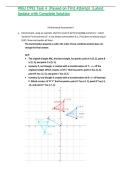
• The original triangle ABC, the blue triangle, has points: point A is (5, 2), point B
is (2, 3), and point C is (5, 5).
• Isometry P, red triangle, is created with a transformation of 𝑻(−𝟒,𝟐) off the
original triangle. Which creates ∆𝑨′𝑩′𝑪′ that has points: point A’ has (1, 4),
point B’ has (-2, 5), and point C’ has (1,7).
• Isometry Q, teal triangle is created with a transformation of 𝑹𝑶,𝟗𝟎° off Isometry
P. Which creates ∆𝑨"𝑩"𝑪" that has points: point A” has (-4, 1), point B” has (-5,
-2), and point C” has (-7, 1).
Update with Complete Solution
Performance Assessment 4
a. Demonstrate, using an example, that the result of performing two isometries—called
isometry P and isometry Q—is not always commutative (i.e., P○Q does not always equal
Q○P). Show and explain all steps.
The Commutative property is when the order of two combined actions does not
change the final answer.
Q○P:
• The original triangle ABC, the blue triangle, has points: point A is (5, 2), point B
is (2, 3), and point C is (5, 5).
• Isometry P, red triangle, is created with a transformation of 𝑻(−𝟒,𝟐) off the
original triangle. Which creates ∆𝑨′𝑩′𝑪′ that has points: point A’ has (1, 4),
point B’ has (-2, 5), and point C’ has (1,7).
• Isometry Q, teal triangle is created with a transformation of 𝑹𝑶,𝟗𝟎° off Isometry
P. Which creates ∆𝑨"𝑩"𝑪" that has points: point A” has (-4, 1), point B” has (-5,
-2), and point C” has (-7, 1).