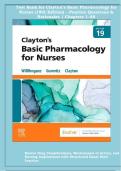
Test Bank for Clayton’s Basic Pharmacology for
Nurses (19th Edition) – Practice Questions &
Rationales | Chapters 1–48
Master Drug Classifications, Mechanisms of Action, and
Nursing Implications with Structured Exam-Style
Practice
,Resource Overview
This comprehensive pharmacology practice resource has been independently developed to support students
using Clayton’s Basic Pharmacology for Nurses, 19th Edition. It provides structured, exam-style practice
questions with detailed rationales aligned to the core concepts presented in Chapters 1–48.
The purpose of this guide is to strengthen understanding of drug classifications, mechanisms of action,
therapeutic uses, adverse effects, contraindications, drug interactions, and essential nursing implications.
Emphasis is placed on clinical reasoning and medication safety rather than rote memorization.
Each chapter includes carefully structured questions designed to reflect the format and difficulty level
commonly encountered in nursing pharmacology assessments. Detailed rationales accompany every item to
reinforce correct reasoning and address common exam errors.
Content Coverage
This resource includes practice questions covering:
• Foundations of pharmacology and drug regulation
• Pharmacokinetics and pharmacodynamics
• Autonomic nervous system medications
• Cardiovascular, respiratory, and renal drugs
• Central nervous system medications
• Endocrine and metabolic agents
• Anti-infectives and immune system drugs
• Gastrointestinal and nutritional therapies
• Oncology and specialized pharmacologic therapies
• Comprehensive review and mixed-practice assessments
How to Use This Study Guide
This resource is best used to:
• Reinforce lecture and textbook material
• Practice structured pharmacology exam preparation
• Identify weak areas in drug class understanding
• Improve clinical application and medication safety reasoning
• Prepare for quizzes, midterms, finals, and comprehensive nursing exams
For maximum benefit, students are encouraged to attempt questions independently before reviewing rationales.
Important Notice
This document is an independently created educational resource developed for exam preparation purposes. It is
not an official instructor test bank and is not affiliated with or endorsed by the authors or publisher of Clayton’s
Basic Pharmacology for Nurses, 19th Edition.
,Chapter 01: Drug Definitions, Standards, and Information Sources
Willihnganz: Clayton’s Basic Pharmacology for Nurses, 19th Edition
MULTIPLE CHOICE
1. Which name identifies a drug listed by the US Food and
Drug Administration (FDA)?
a. Brand
b. Nonproprietary
c. Official
d. Trademark
ANS: C
The official name is the name under which a drug is listed
by the FDA. The brand name, or trademark, is the name
given to a drug by its manufacturer. The nonproprietary, or
generic, name is provided by the United States Adopted
Names Council.
DIF: Cognitive Level: Knowledge REF: p. 9
OBJ: 1NAT: NCLEX Client Needs Category: Safe, Effective
Care Environment TOP: Nursing Process Step: Assessment
CON:
Patient Education
2. Which source contains information specific to nutritional supplements?
a. USP Dictionary of USAN & International Drug Names
b. Natural Medicines Comprehensive Database
c. United States Pharmacopoeia/National Formulary (USP NF)
d. Drug Interaction Facts
ANS: C
United States Pharmacopoeia/National Formulary contains information specific to
nutritional supplements. USP Dictionary of USAN & International Drug Names is a
compilation of drug names, pronunciation guide, and possible future FDA approved
drugs; it does not include nutritional supplements. Natural Medicines Comprehensive
Database contains
evidence-based information on herbal medicines and herbal combination products; it
does not include information specific to nutritional supplements. Drug Interaction
Facts contains comprehensive information on drug interaction facts; it does not
include nutritional supplements.
DIF: Cognitive Level: Knowledge REF: p. 4 OBJ:
3 NAT: NCLEX Client Needs Category: Physiological Integrity
TOP: Nursing Process Step: Assessment CON: Nutrition | Patient Education
3. Which drug reference contains drug monographs that describe all drugs in a therapeutic
class?
a. Drug Facts and Comparisons
, Test Bank For Clayton’s Basic Pharmacology for Nurses 19th Edition 3
b. Drug Interaction Facts
c. Handbook on Injectable Drugs
d. Martindale—The Complete Drug Reference
ANS: A
Drug Facts and Comparisons contains drug monographs that describe all
drugs in a therapeutic class. Monographs are formatted as tables to allow
comparison of similar products, brand names, manufacturers, cost indices,
and available dosage forms Online version is available.
DIF: Cognitive Level: Knowledge REF: p. 4 Table 1.2
OBJ: 3 NAT: NCLEX Client Needs Category: Physiological Integrity
TOP: Nursing Process Step: Assessment CON: Safety | Patient Education | Clinical Judgment
4. Which drug reference contains monographs about virtually every single-entity drug
available in the United States and describes therapeutic uses of drugs, including
approved and unapproved uses?
a. Martindale: The Complete Drug Reference
b. AHFS Drug Information
c. Drug Reference
d. Drug Facts and Comparisons
ANS: B
AHFS Drug Information contains monographs about virtually every single-entity drug
available in the United States and describes therapeutic uses of drugs, including
approved and unapproved uses.
DIF: Cognitive Level: Knowledge REF: p. 4 Table 1.2
OBJ: 3 NAT: NCLEX Client Needs Category: Physiological Integrity
TOP: Nursing Process Step: Planning CON: Safety | Patient Education | Clinical Judgment
5. Which online drug reference makes available to healthcare providers and the
public a standard, comprehensive, up-to-date look up and downloadable resource
about medicines?
a. American Drug Index
b. American Hospital Formulary
c. DailyMed
d. Drug Reference
ANS: C
DailyMed makes available to healthcare providers and the public a standard,
comprehensive, up-to-date look up and downloadable resource about medicines.
The American Drug Index is not appropriate for patient use. The American Hospital
Formulary is not appropriate for patient use. The drug reference is not appropriate
for patient use.
DIF: Cognitive Level: Knowledge REF: p. 3 | p. 4 OBJ:
3 NAT: NCLEX Client Needs Category: Physiological Integrity
TOP: Nursing Process Step: Implementation
CON: Safety | Patient Education | Clinical Judgment
6. Which legislation authorizes the FDA to determine the safety of a drug before its marketing?
a. Federal Food, Drug, and Cosmetic Act (1938)
b. Durham Humphrey Amendment (1952)
Nurses (19th Edition) – Practice Questions &
Rationales | Chapters 1–48
Master Drug Classifications, Mechanisms of Action, and
Nursing Implications with Structured Exam-Style
Practice
,Resource Overview
This comprehensive pharmacology practice resource has been independently developed to support students
using Clayton’s Basic Pharmacology for Nurses, 19th Edition. It provides structured, exam-style practice
questions with detailed rationales aligned to the core concepts presented in Chapters 1–48.
The purpose of this guide is to strengthen understanding of drug classifications, mechanisms of action,
therapeutic uses, adverse effects, contraindications, drug interactions, and essential nursing implications.
Emphasis is placed on clinical reasoning and medication safety rather than rote memorization.
Each chapter includes carefully structured questions designed to reflect the format and difficulty level
commonly encountered in nursing pharmacology assessments. Detailed rationales accompany every item to
reinforce correct reasoning and address common exam errors.
Content Coverage
This resource includes practice questions covering:
• Foundations of pharmacology and drug regulation
• Pharmacokinetics and pharmacodynamics
• Autonomic nervous system medications
• Cardiovascular, respiratory, and renal drugs
• Central nervous system medications
• Endocrine and metabolic agents
• Anti-infectives and immune system drugs
• Gastrointestinal and nutritional therapies
• Oncology and specialized pharmacologic therapies
• Comprehensive review and mixed-practice assessments
How to Use This Study Guide
This resource is best used to:
• Reinforce lecture and textbook material
• Practice structured pharmacology exam preparation
• Identify weak areas in drug class understanding
• Improve clinical application and medication safety reasoning
• Prepare for quizzes, midterms, finals, and comprehensive nursing exams
For maximum benefit, students are encouraged to attempt questions independently before reviewing rationales.
Important Notice
This document is an independently created educational resource developed for exam preparation purposes. It is
not an official instructor test bank and is not affiliated with or endorsed by the authors or publisher of Clayton’s
Basic Pharmacology for Nurses, 19th Edition.
,Chapter 01: Drug Definitions, Standards, and Information Sources
Willihnganz: Clayton’s Basic Pharmacology for Nurses, 19th Edition
MULTIPLE CHOICE
1. Which name identifies a drug listed by the US Food and
Drug Administration (FDA)?
a. Brand
b. Nonproprietary
c. Official
d. Trademark
ANS: C
The official name is the name under which a drug is listed
by the FDA. The brand name, or trademark, is the name
given to a drug by its manufacturer. The nonproprietary, or
generic, name is provided by the United States Adopted
Names Council.
DIF: Cognitive Level: Knowledge REF: p. 9
OBJ: 1NAT: NCLEX Client Needs Category: Safe, Effective
Care Environment TOP: Nursing Process Step: Assessment
CON:
Patient Education
2. Which source contains information specific to nutritional supplements?
a. USP Dictionary of USAN & International Drug Names
b. Natural Medicines Comprehensive Database
c. United States Pharmacopoeia/National Formulary (USP NF)
d. Drug Interaction Facts
ANS: C
United States Pharmacopoeia/National Formulary contains information specific to
nutritional supplements. USP Dictionary of USAN & International Drug Names is a
compilation of drug names, pronunciation guide, and possible future FDA approved
drugs; it does not include nutritional supplements. Natural Medicines Comprehensive
Database contains
evidence-based information on herbal medicines and herbal combination products; it
does not include information specific to nutritional supplements. Drug Interaction
Facts contains comprehensive information on drug interaction facts; it does not
include nutritional supplements.
DIF: Cognitive Level: Knowledge REF: p. 4 OBJ:
3 NAT: NCLEX Client Needs Category: Physiological Integrity
TOP: Nursing Process Step: Assessment CON: Nutrition | Patient Education
3. Which drug reference contains drug monographs that describe all drugs in a therapeutic
class?
a. Drug Facts and Comparisons
, Test Bank For Clayton’s Basic Pharmacology for Nurses 19th Edition 3
b. Drug Interaction Facts
c. Handbook on Injectable Drugs
d. Martindale—The Complete Drug Reference
ANS: A
Drug Facts and Comparisons contains drug monographs that describe all
drugs in a therapeutic class. Monographs are formatted as tables to allow
comparison of similar products, brand names, manufacturers, cost indices,
and available dosage forms Online version is available.
DIF: Cognitive Level: Knowledge REF: p. 4 Table 1.2
OBJ: 3 NAT: NCLEX Client Needs Category: Physiological Integrity
TOP: Nursing Process Step: Assessment CON: Safety | Patient Education | Clinical Judgment
4. Which drug reference contains monographs about virtually every single-entity drug
available in the United States and describes therapeutic uses of drugs, including
approved and unapproved uses?
a. Martindale: The Complete Drug Reference
b. AHFS Drug Information
c. Drug Reference
d. Drug Facts and Comparisons
ANS: B
AHFS Drug Information contains monographs about virtually every single-entity drug
available in the United States and describes therapeutic uses of drugs, including
approved and unapproved uses.
DIF: Cognitive Level: Knowledge REF: p. 4 Table 1.2
OBJ: 3 NAT: NCLEX Client Needs Category: Physiological Integrity
TOP: Nursing Process Step: Planning CON: Safety | Patient Education | Clinical Judgment
5. Which online drug reference makes available to healthcare providers and the
public a standard, comprehensive, up-to-date look up and downloadable resource
about medicines?
a. American Drug Index
b. American Hospital Formulary
c. DailyMed
d. Drug Reference
ANS: C
DailyMed makes available to healthcare providers and the public a standard,
comprehensive, up-to-date look up and downloadable resource about medicines.
The American Drug Index is not appropriate for patient use. The American Hospital
Formulary is not appropriate for patient use. The drug reference is not appropriate
for patient use.
DIF: Cognitive Level: Knowledge REF: p. 3 | p. 4 OBJ:
3 NAT: NCLEX Client Needs Category: Physiological Integrity
TOP: Nursing Process Step: Implementation
CON: Safety | Patient Education | Clinical Judgment
6. Which legislation authorizes the FDA to determine the safety of a drug before its marketing?
a. Federal Food, Drug, and Cosmetic Act (1938)
b. Durham Humphrey Amendment (1952)