Schachter and Singer
IV
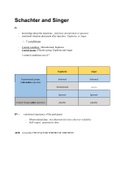
- knowledge about the injections : informed, misinformed or ignorant.
- emotional situation placement after injection : Euphoria, or Anger
∴ 7 conditions
- Control condition : Misinformed, Euphoria
- Control group : Placebo group, Euphoria and Anger
3 control conditions out of 7
Euphoria Anger
Experimental groups Informed Informed
(Adrenaline injection)
Misinformed -x-x-x-
Ignorant Ignorant
Control Group (saline injection) placebo placebo
DV : - emotional experience of the participant.
- Observational data : two observers for inter-observer reliability
- Self- report : quantitative data
AIM: to test the TWO FACTOR THEORY OF EMOTION.
, HYPOTHESES
1. If a person experiences a state of arousal for which they have no immediate explanation,
they will label this state and describe their feelings in terms of the cognitions available at
that time.
2. If a person experiences a state of arousal for which they have an appropriate explanation,
then they will be unlikely to label their feelings in terms of alternative cognitions
available
3. If a person is put in a situation, which in the past could have made them feel an emotion,
they will react emotionally or experience emotions only if they are in a state of
physiological arousal
BACKGROUND STUDIES
TWO FACTOR THEORY OF EMOTION
➔ Emotion can be defined as the body’s adaptive response to a particular situation
➔ Emotional Experience is a combination of physiological arousal and cognitive
interpretation
➔ Physiological arousal : due to the sympathetic nervous system
- Increased respiration rate
- Dilation of pupils
- Increased heart rate
- Palpitations
- Release of adrenalin
- ‘Fight or Flight response’
➔ Cognitive Interpretation : Labelling of the reason for the physiological arousal.
Dependent on situation
- Release of adrenalin due to gun at head = labels it as ‘fear’
- Increased heart rate due to surprise birthday cake = labels it as ‘happiness’
➔ When people become aroused they look for cues as to why they feel the way they do
from their surroundings and interpret their arousal in relation to this
➔ Epinephrine - adrenalin injection
➔ Placebo - a pill or injection given to the patient where he believes that it is a drug but, in
reality, has no effect.
➔ Saline solution as placebo
➔ To avoid demand characteristics, they were told that they would be injected with
Suproxin [not a real drug]
IV
- knowledge about the injections : informed, misinformed or ignorant.
- emotional situation placement after injection : Euphoria, or Anger
∴ 7 conditions
- Control condition : Misinformed, Euphoria
- Control group : Placebo group, Euphoria and Anger
3 control conditions out of 7
Euphoria Anger
Experimental groups Informed Informed
(Adrenaline injection)
Misinformed -x-x-x-
Ignorant Ignorant
Control Group (saline injection) placebo placebo
DV : - emotional experience of the participant.
- Observational data : two observers for inter-observer reliability
- Self- report : quantitative data
AIM: to test the TWO FACTOR THEORY OF EMOTION.
, HYPOTHESES
1. If a person experiences a state of arousal for which they have no immediate explanation,
they will label this state and describe their feelings in terms of the cognitions available at
that time.
2. If a person experiences a state of arousal for which they have an appropriate explanation,
then they will be unlikely to label their feelings in terms of alternative cognitions
available
3. If a person is put in a situation, which in the past could have made them feel an emotion,
they will react emotionally or experience emotions only if they are in a state of
physiological arousal
BACKGROUND STUDIES
TWO FACTOR THEORY OF EMOTION
➔ Emotion can be defined as the body’s adaptive response to a particular situation
➔ Emotional Experience is a combination of physiological arousal and cognitive
interpretation
➔ Physiological arousal : due to the sympathetic nervous system
- Increased respiration rate
- Dilation of pupils
- Increased heart rate
- Palpitations
- Release of adrenalin
- ‘Fight or Flight response’
➔ Cognitive Interpretation : Labelling of the reason for the physiological arousal.
Dependent on situation
- Release of adrenalin due to gun at head = labels it as ‘fear’
- Increased heart rate due to surprise birthday cake = labels it as ‘happiness’
➔ When people become aroused they look for cues as to why they feel the way they do
from their surroundings and interpret their arousal in relation to this
➔ Epinephrine - adrenalin injection
➔ Placebo - a pill or injection given to the patient where he believes that it is a drug but, in
reality, has no effect.
➔ Saline solution as placebo
➔ To avoid demand characteristics, they were told that they would be injected with
Suproxin [not a real drug]