

WGU D251 Advanced Auditing – Questions With
Complete Solutions
Save
Terms in this set (51)
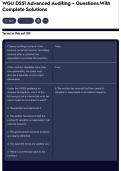
Channel stuffing is a fraud in the False
revenue cycle that involves recording
revenue after a customer has
requested to purchase the inventory.
If the contract stipulates more than True
one deliverable, the client must
allocate a separate price to each
deliverable.
Under the FASB's guidance on b. The auditor has ensured that the contract's
revenue recognition, which of the valuation is reasonable in all material respects.
following is not a criteria that must be
met in order for a contract to exist?
a. The parties have approved it.
b. The auditor has ensured that the
contract's valuation is reasonable in all
material respects.
c. The goods and/or services involved
are clearly identified.
d. The payment terms are spelled out.
e. There is commercial value to the
contract.
,Research indicates that a majority of True
financial statement frauds involve
inappropriate recording of revenue.
When assessing fraud risks, the auditor True
should consider the client's motivation
to increase revenue due to both
internal and external pressures.
Which of the following factors is not a c. Controls over revenue process are ineffective.
motivation for clients to fraudulently
misstate revenue?
a. Bankruptcy may be imminent.
b. Management bonuses are
contingent on a certain revenue goal.
c. Controls over revenue process are
ineffective.
d. Management wants to meet
publicly announced earnings
expectations.
, Which of the following explanations a. Lapping is a technique used by client personnel to
best describes the purpose of cover up the embezzlement of cash.
lapping?
a. Lapping is a technique used by
client personnel to cover up the
embezzlement of cash.
b. Lapping is an approach used by
client personnel to eliminate
differences between a customer's
records and the client's records
reported on confirmations.
c. Lapping is a procedure used by the
auditor to obtain evidence the client's
customer does return a positive
confirmation.
d. Lapping is an agreement containing
contract terms that are not part of a
formal sales contract.
It is not possible for internal controls False
to mitigate risks associated with the
valuation of accounts receivable.
Diageo made improper cash False
payments to government officials in
Mexico, Brazil, and Argentina during
the period 2003-2009, which violated
provisions of the Foreign Corrupt
Practices Act.
Complete Solutions
Save
Terms in this set (51)
Channel stuffing is a fraud in the False
revenue cycle that involves recording
revenue after a customer has
requested to purchase the inventory.
If the contract stipulates more than True
one deliverable, the client must
allocate a separate price to each
deliverable.
Under the FASB's guidance on b. The auditor has ensured that the contract's
revenue recognition, which of the valuation is reasonable in all material respects.
following is not a criteria that must be
met in order for a contract to exist?
a. The parties have approved it.
b. The auditor has ensured that the
contract's valuation is reasonable in all
material respects.
c. The goods and/or services involved
are clearly identified.
d. The payment terms are spelled out.
e. There is commercial value to the
contract.
,Research indicates that a majority of True
financial statement frauds involve
inappropriate recording of revenue.
When assessing fraud risks, the auditor True
should consider the client's motivation
to increase revenue due to both
internal and external pressures.
Which of the following factors is not a c. Controls over revenue process are ineffective.
motivation for clients to fraudulently
misstate revenue?
a. Bankruptcy may be imminent.
b. Management bonuses are
contingent on a certain revenue goal.
c. Controls over revenue process are
ineffective.
d. Management wants to meet
publicly announced earnings
expectations.
, Which of the following explanations a. Lapping is a technique used by client personnel to
best describes the purpose of cover up the embezzlement of cash.
lapping?
a. Lapping is a technique used by
client personnel to cover up the
embezzlement of cash.
b. Lapping is an approach used by
client personnel to eliminate
differences between a customer's
records and the client's records
reported on confirmations.
c. Lapping is a procedure used by the
auditor to obtain evidence the client's
customer does return a positive
confirmation.
d. Lapping is an agreement containing
contract terms that are not part of a
formal sales contract.
It is not possible for internal controls False
to mitigate risks associated with the
valuation of accounts receivable.
Diageo made improper cash False
payments to government officials in
Mexico, Brazil, and Argentina during
the period 2003-2009, which violated
provisions of the Foreign Corrupt
Practices Act.


