
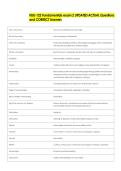
NSG 122 Fundamentals exam 2 UPDATED ACTUAL Questions
and CORRECT Answers
risk for tissue injury Dry mucous membranes poor skin turgor
Risk for tissue injury Advanced aging and dehydration
What are lacerations Produced by tearing of soft tissue, often irregular and jagged, often contaminated
with bacteria and debris from whatever object
What is a contusion? Blunt instrument, overlying skin remains intact with injury to underlying soft tissue
Irradiation Ultraviolet light or radiation exposure
incision Cutting or sharp instrument; wound edges in close approximation and aligned
Homeostasis Blood vessels constrict and blood clotting begins through platter activation liquid
exudate is formed. Increased profusion results in Cardinal signs in of ram motion
and stimulates other cells to migrate to cell injury
inflammation a localized response to an injury or to the destruction of tissues
Stages of wound healing Homeostasis, inflammation proliferation maturation
Signs of healthy would healing Granulation
Signs that wound is not healing Pressure, desiccation, maceration,trauma edema infection excessive bleeding
necrosis biofilm infection hemorrhage dehiscence
Desiccation drying out
Maceration softening or dissolution of tissue after lengthy exposure to fluid
Edema puffy swelling of tissue from the accumulation of fluid
infection Contamination or invasion of body tissue by pathogenic organisms
necrosis tissue death
Biofilms a surface coating colony of prokaryotic that engage in metabolic cooperation
hemorrhage Excessive or profuse bleeding
Dehiscence partial or total separation of wound layers
and CORRECT Answers
risk for tissue injury Dry mucous membranes poor skin turgor
Risk for tissue injury Advanced aging and dehydration
What are lacerations Produced by tearing of soft tissue, often irregular and jagged, often contaminated
with bacteria and debris from whatever object
What is a contusion? Blunt instrument, overlying skin remains intact with injury to underlying soft tissue
Irradiation Ultraviolet light or radiation exposure
incision Cutting or sharp instrument; wound edges in close approximation and aligned
Homeostasis Blood vessels constrict and blood clotting begins through platter activation liquid
exudate is formed. Increased profusion results in Cardinal signs in of ram motion
and stimulates other cells to migrate to cell injury
inflammation a localized response to an injury or to the destruction of tissues
Stages of wound healing Homeostasis, inflammation proliferation maturation
Signs of healthy would healing Granulation
Signs that wound is not healing Pressure, desiccation, maceration,trauma edema infection excessive bleeding
necrosis biofilm infection hemorrhage dehiscence
Desiccation drying out
Maceration softening or dissolution of tissue after lengthy exposure to fluid
Edema puffy swelling of tissue from the accumulation of fluid
infection Contamination or invasion of body tissue by pathogenic organisms
necrosis tissue death
Biofilms a surface coating colony of prokaryotic that engage in metabolic cooperation
hemorrhage Excessive or profuse bleeding
Dehiscence partial or total separation of wound layers


