

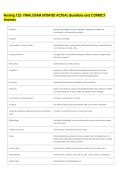
Nursing 122- FINAL EXAM UPDATED ACTUAL Questions and CORRECT
Answers
Profession Requires a specialized body of knowledge and training and applies that
knowledge to solving specific problems
Discipline Generates knowledge
The discipline of nursing includes: Interdisciplinary roles, nursing theories, teaching and learning, nursing informatics
and technology, scholarly writing
Nursing informatics The application of computer technology to all fields of nursing- nursing services,
education, research
Behaviorism Learnt behavior as a result of stimulus
Cognitivism Learning is a mental, intellectual or thinking process based on the learner's
personal characteristics and experience; emphasis on the importance of social,
emotional and physical context in which learning takes place
Humanism Learning is self motivated, self initiative and self evaluated
Philosophy Systemic formulation of a body of knowledge that allows the profession to further
its understanding of the values, beliefs, assumptions and knowledge
3 main areas of nursing philosophy: Ontological, epistemology and ethics
Ontology The nature of being "what is the purpose of life" or "why does nursing exist"
Nursing knowledge is organized and communicated by Concepts, conceptual frameworks, theories and models
using:
Epistemology The nature of knowledge "how do we know what we know and how do we share
that information"
3 different concepts: Concrete ideas, inferential ideas, abstract ideas
Theory Creates relationships among 2 or more concepts to form a detailed view of a
phenomenon. Helps define nursing practice and the goals and function of nursing
and helps define the scope of practice
Concrete idea Something that is readily observable (ex. respiratory rate, vital signs, rash...)
Inferential idea Something that is indirectly observable (ex. pain, nausea, dyspnea, temperature...)
Abstract idea Something that is not observable at all
, Grand theory Distinguishes nursing as its own body of knowledge and language
Mid- range theory Relevant to empirical world, less abstract- more specific, concerned with specific
phenomena found in nursing practice
4 concepts in the meta paradigm of nursing: Person, environment, health and nursing
What are the components of a theory? Concepts, assumptions, context, relationships
Meta- theory a theory about a theory...or a theory designed to analyze theoretical system
Ethics How one has to act as a nurse...how we make decisions for patients
Why do we need theory in nursing? To distinguish nursing as its own body of language, describes nursing, provides
the foundation of nursing practice, generates knowledge, distinguishes nursing
from other disciplines
Conceptual framework A group of related concepts (more abstract than a theory)
Empirical knowing Knowledge generated through research and theory from within and beyond the
discipline of nursing
Personal knowing The nurse's knowledge of himself or herself
Aesthetic knowing The art of nursing, the unique interpretation and particularizing of nursing science
in the momentary encounter experience by the nurse in relationships with others
Ethical knowing Essential in decision making, central to nursing practice
Emancipatory knowing Supports nurses to engage with issues of justice and equity in nursing practice
Peplau's Interprofessional Model Interpersonal process and therapeutic relationships between the person needing
healthcare and the nurse. Emphasizes the need for a partnership
Henderson's Definition of Nursing The unique function of the nurse is to assist the individual, sick or well, in the
performance of those activities contributing to health or its recovery (or to
peaceful death) that he would perform unaided if he had the necessary strength,
will, or knowledge (14 fundamental needs)
Parse's Man-Living- Health Theory "Human Becoming Theory" - Focus on quality of life. Being truly present with your
patient. Include attentive listening, meaningful conversation and silent immersion
Betty Newman's Health as Expanding Consciousness The person is a complete system, with interrelated parts. Maintains balance and
harmony between internal and external environment by adjusting to stress and
defending against tension-producing stimuli: Focuses on stress and stress
reduction; Primarily concerned with effects of stress on health; Stressors are any
forces that alter the system's stability
Answers
Profession Requires a specialized body of knowledge and training and applies that
knowledge to solving specific problems
Discipline Generates knowledge
The discipline of nursing includes: Interdisciplinary roles, nursing theories, teaching and learning, nursing informatics
and technology, scholarly writing
Nursing informatics The application of computer technology to all fields of nursing- nursing services,
education, research
Behaviorism Learnt behavior as a result of stimulus
Cognitivism Learning is a mental, intellectual or thinking process based on the learner's
personal characteristics and experience; emphasis on the importance of social,
emotional and physical context in which learning takes place
Humanism Learning is self motivated, self initiative and self evaluated
Philosophy Systemic formulation of a body of knowledge that allows the profession to further
its understanding of the values, beliefs, assumptions and knowledge
3 main areas of nursing philosophy: Ontological, epistemology and ethics
Ontology The nature of being "what is the purpose of life" or "why does nursing exist"
Nursing knowledge is organized and communicated by Concepts, conceptual frameworks, theories and models
using:
Epistemology The nature of knowledge "how do we know what we know and how do we share
that information"
3 different concepts: Concrete ideas, inferential ideas, abstract ideas
Theory Creates relationships among 2 or more concepts to form a detailed view of a
phenomenon. Helps define nursing practice and the goals and function of nursing
and helps define the scope of practice
Concrete idea Something that is readily observable (ex. respiratory rate, vital signs, rash...)
Inferential idea Something that is indirectly observable (ex. pain, nausea, dyspnea, temperature...)
Abstract idea Something that is not observable at all
, Grand theory Distinguishes nursing as its own body of knowledge and language
Mid- range theory Relevant to empirical world, less abstract- more specific, concerned with specific
phenomena found in nursing practice
4 concepts in the meta paradigm of nursing: Person, environment, health and nursing
What are the components of a theory? Concepts, assumptions, context, relationships
Meta- theory a theory about a theory...or a theory designed to analyze theoretical system
Ethics How one has to act as a nurse...how we make decisions for patients
Why do we need theory in nursing? To distinguish nursing as its own body of language, describes nursing, provides
the foundation of nursing practice, generates knowledge, distinguishes nursing
from other disciplines
Conceptual framework A group of related concepts (more abstract than a theory)
Empirical knowing Knowledge generated through research and theory from within and beyond the
discipline of nursing
Personal knowing The nurse's knowledge of himself or herself
Aesthetic knowing The art of nursing, the unique interpretation and particularizing of nursing science
in the momentary encounter experience by the nurse in relationships with others
Ethical knowing Essential in decision making, central to nursing practice
Emancipatory knowing Supports nurses to engage with issues of justice and equity in nursing practice
Peplau's Interprofessional Model Interpersonal process and therapeutic relationships between the person needing
healthcare and the nurse. Emphasizes the need for a partnership
Henderson's Definition of Nursing The unique function of the nurse is to assist the individual, sick or well, in the
performance of those activities contributing to health or its recovery (or to
peaceful death) that he would perform unaided if he had the necessary strength,
will, or knowledge (14 fundamental needs)
Parse's Man-Living- Health Theory "Human Becoming Theory" - Focus on quality of life. Being truly present with your
patient. Include attentive listening, meaningful conversation and silent immersion
Betty Newman's Health as Expanding Consciousness The person is a complete system, with interrelated parts. Maintains balance and
harmony between internal and external environment by adjusting to stress and
defending against tension-producing stimuli: Focuses on stress and stress
reduction; Primarily concerned with effects of stress on health; Stressors are any
forces that alter the system's stability


