
CMN 2152 Midterm #1 – Questions With A+
Solutions
Save
Terms in this set (51)
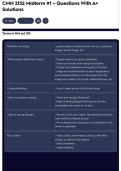
Definition of society - power relations influences how we can...censor an
image, view an image...etc
When people deliver/tell a story: - People need to be good storytellers
- There can be bias when people tell stories
- People can emphasize wrong parts of stories
- Image and communication is about appearance
and expression/there is so many layers-how the
image was created, why it was created that way...etc
Commodification: - How to make money off of these things
There is a power in seeing: - Vision and visuality (textbook)
- Ways of seeing (berger)-talks about how the
sexualisation of women is not new
Ways of seeing (Berger): - Women, in art, are a "sight". She presents herself as
such and she is treated as such
- The nudeness is an expression of submission to the
owner or spectator
Pop culture: - Mass culture, an everyday culture, a well-liked
culture, a culture of the people
- Mass consumed
- Mass mediated
, Culture: - Denoted all knowledge, technologies, values,
beliefs, customs, and behaviors common to people
- Simple societies: may have only a single integrated
culture that is shared by everyone
- Complex societies: accommodate many layers and
levels of cultures and subcultures
High culture: - Includes things like classical music, serious novels,
poetry, dance, high or "fine" art, and other cultural
products which are usually appreciated by only a
relatively small number of educated people
- Versus popular culture which normally means "low",
"base", "vulgar", or "common people"
Cultural studies: - Developed as an attempt to assess, understand,
and explore the role of culture in everyday life
- This new approach analyzes the emergence of mass
mediated pop-culture and interrogates the
connection between culture and society
Richard Hoggart's The Uses of - Chronicles the existence- and eventually the
Literacy: demise-of a strong working-class culture in the early
20th century
- He examines the interconnections between these
and the structures of individuals everyday lives,
especially what he calls the working class
Solutions
Save
Terms in this set (51)
Definition of society - power relations influences how we can...censor an
image, view an image...etc
When people deliver/tell a story: - People need to be good storytellers
- There can be bias when people tell stories
- People can emphasize wrong parts of stories
- Image and communication is about appearance
and expression/there is so many layers-how the
image was created, why it was created that way...etc
Commodification: - How to make money off of these things
There is a power in seeing: - Vision and visuality (textbook)
- Ways of seeing (berger)-talks about how the
sexualisation of women is not new
Ways of seeing (Berger): - Women, in art, are a "sight". She presents herself as
such and she is treated as such
- The nudeness is an expression of submission to the
owner or spectator
Pop culture: - Mass culture, an everyday culture, a well-liked
culture, a culture of the people
- Mass consumed
- Mass mediated
, Culture: - Denoted all knowledge, technologies, values,
beliefs, customs, and behaviors common to people
- Simple societies: may have only a single integrated
culture that is shared by everyone
- Complex societies: accommodate many layers and
levels of cultures and subcultures
High culture: - Includes things like classical music, serious novels,
poetry, dance, high or "fine" art, and other cultural
products which are usually appreciated by only a
relatively small number of educated people
- Versus popular culture which normally means "low",
"base", "vulgar", or "common people"
Cultural studies: - Developed as an attempt to assess, understand,
and explore the role of culture in everyday life
- This new approach analyzes the emergence of mass
mediated pop-culture and interrogates the
connection between culture and society
Richard Hoggart's The Uses of - Chronicles the existence- and eventually the
Literacy: demise-of a strong working-class culture in the early
20th century
- He examines the interconnections between these
and the structures of individuals everyday lives,
especially what he calls the working class


