

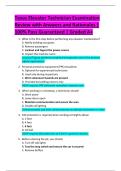
Texas Elevator Technician Examination
Review with Answers and Rationales |
100% Pass Guaranteed | Graded A+
1. What is the first step before performing any elevator maintenance?
A. Notify building occupants
B. Remove passengers
C. Lockout and tagout the power source
D. Inspect the machine room
Lockout/Tagout prevents accidental energization and is the primary
safety requirement.
2. Personal protective equipment (PPE) should be:
A. Optional for experienced technicians
B. Used only during inspections
C. Worn whenever hazards are present
D. Provided by building owners only
OSHA requires PPE whenever workplace hazards exist.
3. When working in a hoistway, a technician should:
A. Work alone
B. Leave doors open
C. Maintain communication and secure the area
D. Disable all lighting
Communication and area control prevent accidental movement or entry.
4. Fall protection is required when working at heights above:
A. 2 feet
B. 4 feet
C. 6 feet
D. 10 feet
OSHA requires fall protection at 6 feet in general industry.
5. Before entering the pit, you should:
A. Turn off cab lights
B. Test the stop switch and ensure the car is secured
C. Remove buffers
, D. Close machine room access
Ensuring the car cannot move is critical for pit safety.
Codes and Regulations
6. The primary safety code for elevators in Texas is:
A. NEC only
B. OSHA 1926
C. ASME A17.1 / CSA B44
D. NFPA 70E only
ASME A17.1 is the governing elevator safety code.
7. Texas elevator regulation is administered by:
A. OSHA
B. Texas Department of Licensing and Regulation (TDLR)
C. NFPA
D. Department of Transportation
TDLR oversees licensing, inspections, and enforcement.
8. How often must most elevators be inspected in Texas?
A. Monthly
B. Annually
C. Every 5 years
D. Only after installation
Annual inspections are required for operational safety.
9. The National Electrical Code (NEC) is also known as:
A. ASME A17.2
B. NFPA 70
C. NFPA 13
D. OSHA 1910
NEC is published as NFPA 70.
10.A Category 5 test refers to:
A. Door operation test
B. Annual inspection
C. Full load safety test (typically every 5 years)
D. Fire service test
Category 5 tests verify safety systems under full load conditions.
, Electrical Fundamentals
11.Voltage is defined as:
A. Current flow
B. Resistance
C. Electrical potential difference
D. Power consumption
Voltage represents the force that pushes current.
12.Ohm’s Law states:
A. P = VI
B. V = IR
C. I = RP
D. V = P/R
Ohm’s Law relates voltage, current, and resistance.
13.A short circuit results in:
A. High resistance
B. Excessive current flow
C. No current
D. Reduced voltage only
Short circuits allow current to bypass resistance.
14.Grounding is used to:
A. Increase voltage
B. Reduce current
C. Provide a safe path for fault current
D. Power equipment
Grounding protects people and equipment from electrical faults.
15.A blown fuse indicates:
A. Low voltage
B. Overcurrent condition
C. Low resistance
D. Open ground
Fuses open when current exceeds rated limits.
Motors and Drives
Review with Answers and Rationales |
100% Pass Guaranteed | Graded A+
1. What is the first step before performing any elevator maintenance?
A. Notify building occupants
B. Remove passengers
C. Lockout and tagout the power source
D. Inspect the machine room
Lockout/Tagout prevents accidental energization and is the primary
safety requirement.
2. Personal protective equipment (PPE) should be:
A. Optional for experienced technicians
B. Used only during inspections
C. Worn whenever hazards are present
D. Provided by building owners only
OSHA requires PPE whenever workplace hazards exist.
3. When working in a hoistway, a technician should:
A. Work alone
B. Leave doors open
C. Maintain communication and secure the area
D. Disable all lighting
Communication and area control prevent accidental movement or entry.
4. Fall protection is required when working at heights above:
A. 2 feet
B. 4 feet
C. 6 feet
D. 10 feet
OSHA requires fall protection at 6 feet in general industry.
5. Before entering the pit, you should:
A. Turn off cab lights
B. Test the stop switch and ensure the car is secured
C. Remove buffers
, D. Close machine room access
Ensuring the car cannot move is critical for pit safety.
Codes and Regulations
6. The primary safety code for elevators in Texas is:
A. NEC only
B. OSHA 1926
C. ASME A17.1 / CSA B44
D. NFPA 70E only
ASME A17.1 is the governing elevator safety code.
7. Texas elevator regulation is administered by:
A. OSHA
B. Texas Department of Licensing and Regulation (TDLR)
C. NFPA
D. Department of Transportation
TDLR oversees licensing, inspections, and enforcement.
8. How often must most elevators be inspected in Texas?
A. Monthly
B. Annually
C. Every 5 years
D. Only after installation
Annual inspections are required for operational safety.
9. The National Electrical Code (NEC) is also known as:
A. ASME A17.2
B. NFPA 70
C. NFPA 13
D. OSHA 1910
NEC is published as NFPA 70.
10.A Category 5 test refers to:
A. Door operation test
B. Annual inspection
C. Full load safety test (typically every 5 years)
D. Fire service test
Category 5 tests verify safety systems under full load conditions.
, Electrical Fundamentals
11.Voltage is defined as:
A. Current flow
B. Resistance
C. Electrical potential difference
D. Power consumption
Voltage represents the force that pushes current.
12.Ohm’s Law states:
A. P = VI
B. V = IR
C. I = RP
D. V = P/R
Ohm’s Law relates voltage, current, and resistance.
13.A short circuit results in:
A. High resistance
B. Excessive current flow
C. No current
D. Reduced voltage only
Short circuits allow current to bypass resistance.
14.Grounding is used to:
A. Increase voltage
B. Reduce current
C. Provide a safe path for fault current
D. Power equipment
Grounding protects people and equipment from electrical faults.
15.A blown fuse indicates:
A. Low voltage
B. Overcurrent condition
C. Low resistance
D. Open ground
Fuses open when current exceeds rated limits.
Motors and Drives


