

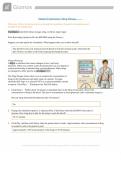
Student Exploration: Drug Dosage
Directions: Follow the instructions to go through the simulation. Respond to the questions and
prompts in the orange boxes.
Vocabulary: controlled release, dosage, drug, overdose, target organ
Prior Knowledge Question (Do this BEFORE using the Gizmo.)
Suppose you take aspirin for a headache. What happens after you swallow the pill?
The pill flows into your stomach and will dissolve from the stomach acids, which then the
pill will have an effect on the body (reducing the headache pain).
Gizmo Warm-up
Adrug is a substance that causes changes in how your body
functions. When you swallow a pill, the pill dissolves in your digestive
system and the drug is absorbed into your bloodstream. Many drugs
are designed to affect specific target organs.
The Drug Dosage Gizmo allows you to monitor the concentration of
drugs in the bloodstream and target organ of a patient. To begin,
check that Pill Type A is selected. Pill A is a general painkiller similar
to aspirin. Click Play ( ) and press the Take Pill button.
1. Click Pause ( ) after about 10 minutes of simulated time. In the Drug levels panel, observe the
concentration of drug in the blood. The unit of concentration is micrograms per cubic centimeter (mcg/cc).
Has any drug entered the bloodstream after 10 minutes?
No.
2. Change the simulation speed to 2, and press Play. Click Pause when the BLOOD value starts to
increase. How long does it take for the drug to reach the blood?
30-31 minutes.
3. Click Play, and then click Pause when the patient starts to smile. Approximately what concentration of drug
is needed to relieve the patient’s pain?
Approximately 15.00 (concentration of the drug) at 39-40 minutes.
Reproduction for educational use only. Public sharing or posting prohibited. © 2020 ExploreLearning™ All rights reserved
, Get the Gizmo ready:
Activity A:
● Click Reset ( ).
Dosage
● Check that Pill Type A is selected.
Question: The dosage of a drug is the quantity of drug that is taken in a given time period. How can
you determine the ideal dosage of a drug?
1. Observe: Click Play and press the Take Pill button. Set the simulation speed to 20, and click Pause after
eight simulated hours have passed. Select the GRAPH tab.
A. What was the maximum blood concentration of the 28.17
drug?
B. What is the general shape of the graph? It is experiencing an inverse relationship
type graph (de-accelerating curved graph).
C. Why do you think the graph has the shape it has? The pill will slowly not have as much effect
on the body as it is losing its concentration
over time.
D. Most drugs are eliminated from the bloodstream by the The drug is diminishing as time passes.
kidneys and pass out of the body in urine. How does this
fact explain the shape of the graph?
2. Experiment: Click Reset. Set the simulation speed to 2. Click Play, and click Take Pill two times quickly.
Watch the facial expressions of the patient for about one simulated hour. What do you notice?
He is drooling, which we assume he is not feeling well.
The patient frowns when the blood concentration of the drug is too low or too high. Ingesting too much of a
drug can result in a dangerous overdose.
3. Gather data: Click Reset. Click Play, and then click Take Pill twice as you did before.
While the blood concentration is decreasing, click Pause when the patient starts to smile. Record the blood
concentration and time below. Click Play, and then click Pause and record when the patient stops smiling.
(Adjust the simulation speed if necessary.)
Maximum recommended concentration: 2 Time: 36 minutes
Maximum recommended concentration: 2 Time: 7 hours and 54
minutes (8 hours
essentially).
4. Calculate: How long does it take for the blood concentration to go from the maximum recommended value
to the minimum recommended value?
Reproduction for educational use only. Public sharing or posting prohibited. © 2020 ExploreLearning™ All rights reserved
Directions: Follow the instructions to go through the simulation. Respond to the questions and
prompts in the orange boxes.
Vocabulary: controlled release, dosage, drug, overdose, target organ
Prior Knowledge Question (Do this BEFORE using the Gizmo.)
Suppose you take aspirin for a headache. What happens after you swallow the pill?
The pill flows into your stomach and will dissolve from the stomach acids, which then the
pill will have an effect on the body (reducing the headache pain).
Gizmo Warm-up
Adrug is a substance that causes changes in how your body
functions. When you swallow a pill, the pill dissolves in your digestive
system and the drug is absorbed into your bloodstream. Many drugs
are designed to affect specific target organs.
The Drug Dosage Gizmo allows you to monitor the concentration of
drugs in the bloodstream and target organ of a patient. To begin,
check that Pill Type A is selected. Pill A is a general painkiller similar
to aspirin. Click Play ( ) and press the Take Pill button.
1. Click Pause ( ) after about 10 minutes of simulated time. In the Drug levels panel, observe the
concentration of drug in the blood. The unit of concentration is micrograms per cubic centimeter (mcg/cc).
Has any drug entered the bloodstream after 10 minutes?
No.
2. Change the simulation speed to 2, and press Play. Click Pause when the BLOOD value starts to
increase. How long does it take for the drug to reach the blood?
30-31 minutes.
3. Click Play, and then click Pause when the patient starts to smile. Approximately what concentration of drug
is needed to relieve the patient’s pain?
Approximately 15.00 (concentration of the drug) at 39-40 minutes.
Reproduction for educational use only. Public sharing or posting prohibited. © 2020 ExploreLearning™ All rights reserved
, Get the Gizmo ready:
Activity A:
● Click Reset ( ).
Dosage
● Check that Pill Type A is selected.
Question: The dosage of a drug is the quantity of drug that is taken in a given time period. How can
you determine the ideal dosage of a drug?
1. Observe: Click Play and press the Take Pill button. Set the simulation speed to 20, and click Pause after
eight simulated hours have passed. Select the GRAPH tab.
A. What was the maximum blood concentration of the 28.17
drug?
B. What is the general shape of the graph? It is experiencing an inverse relationship
type graph (de-accelerating curved graph).
C. Why do you think the graph has the shape it has? The pill will slowly not have as much effect
on the body as it is losing its concentration
over time.
D. Most drugs are eliminated from the bloodstream by the The drug is diminishing as time passes.
kidneys and pass out of the body in urine. How does this
fact explain the shape of the graph?
2. Experiment: Click Reset. Set the simulation speed to 2. Click Play, and click Take Pill two times quickly.
Watch the facial expressions of the patient for about one simulated hour. What do you notice?
He is drooling, which we assume he is not feeling well.
The patient frowns when the blood concentration of the drug is too low or too high. Ingesting too much of a
drug can result in a dangerous overdose.
3. Gather data: Click Reset. Click Play, and then click Take Pill twice as you did before.
While the blood concentration is decreasing, click Pause when the patient starts to smile. Record the blood
concentration and time below. Click Play, and then click Pause and record when the patient stops smiling.
(Adjust the simulation speed if necessary.)
Maximum recommended concentration: 2 Time: 36 minutes
Maximum recommended concentration: 2 Time: 7 hours and 54
minutes (8 hours
essentially).
4. Calculate: How long does it take for the blood concentration to go from the maximum recommended value
to the minimum recommended value?
Reproduction for educational use only. Public sharing or posting prohibited. © 2020 ExploreLearning™ All rights reserved


