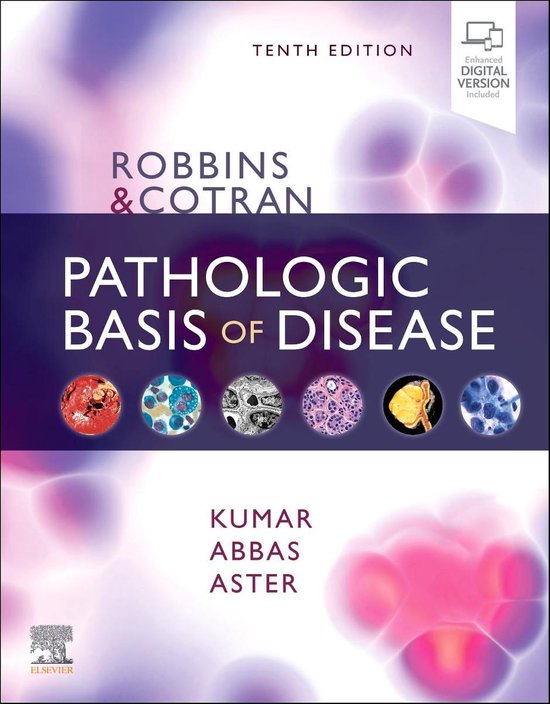
Robbins & Cotran Pathologic Basis of
Disease
10th Edition
• Author(s)Vinay Kumar; Abul K.
Abbas; Jon C. Aster
TEST BANK
1
Reference
Ch. 1 — The Genome — DNA Damage Response and
Consequences
Stem
A 45-year-old man with a long history of cigarette smoking
develops progressive dysplasia in bronchial epithelium. Biopsy
shows abundant cytologic atypia and increased mitoses. A
molecular assay reveals p53 missense mutations and loss of
heterozygosity at the TP53 locus. Mechanistically, how does loss
of p53 function most directly promote clonal expansion of
dysplastic epithelial cells?
,A. Increased telomerase activity allowing bypass of replicative
senescence
B. Failure of cell-cycle arrest and impaired apoptosis despite
DNA damage
C. Upregulation of growth factor receptors causing ligand-
independent proliferation
D. Enhanced mismatch repair leading to microsatellite
instability
Correct Answer: B
Rationale — Correct (B)
p53 is a central sensor of DNA damage that induces cell-cycle
arrest and apoptosis when damage is irreparable. Loss of p53
prevents checkpoint-mediated arrest and apoptosis, allowing
cells with DNA damage to continue dividing and accumulate
additional mutations that drive clonal expansion. Robbins
emphasizes p53’s role in genomic integrity and tumor
suppression.
Rationale — Incorrect (A)
Telomerase activation can contribute to immortalization but is
neither the primary consequence of TP53 loss nor the
immediate mechanism enabling expansion of damaged clones.
It’s a later step in neoplastic progression.
Rationale — Incorrect (C)
Upregulation of growth factor receptors can drive proliferation,
but this is not the canonical direct effect of TP53 loss; p53 loss
primarily abrogates checkpoints and apoptosis.
,Rationale — Incorrect (D)
Enhanced mismatch repair would reduce mutation
accumulation; loss of p53 is associated with genomic instability,
not improved repair.
Teaching Point:
p53 loss permits replication of DNA-damaged cells by disabling
checkpoints and apoptosis.
Citation:
Kumar, V., Abbas, A. K., & Aster, J. C. (2024). Robbins & Cotran
Pathologic Basis of Disease (10th ed.). Ch. 1.
2
Reference
Ch. 1 — The Genome — Epigenetic Alterations
Stem
A patient’s tumor shows silencing of a tumor-suppressor gene
without sequence mutation; methylation-specific PCR identifies
promoter hypermethylation. Which downstream cellular
consequence most plausibly explains how promoter
hypermethylation promotes tumorigenesis?
A. Increased transcriptional elongation of the gene’s mRNA
B. Recruitment of methyl-binding proteins and chromatin
condensation reducing transcription
C. Enhanced histone acetylation leading to euchromatin
formation
, D. Activation of alternative splice variants that generate
truncated proteins
Correct Answer: B
Rationale — Correct (B)
Promoter CpG hypermethylation recruits methyl-CpG–binding
proteins and histone deacetylases that establish condensed
chromatin and transcriptional silencing. This epigenetic
inactivation phenocopies loss-of-function mutations in tumor
suppressors and is described in Robbins as a key nonmutational
mechanism of gene silencing.
Rationale — Incorrect (A)
Hypermethylation suppresses, not increases, transcriptional
elongation.
Rationale — Incorrect (C)
Histone acetylation correlates with open chromatin and
increased transcription; hypermethylation typically associates
with deacetylation and repression.
Rationale — Incorrect (D)
Silencing by methylation affects transcription initiation; it does
not directly produce alternative splicing variants.
Teaching Point:
Promoter hypermethylation silences genes via methyl-binding
proteins and chromatin compaction.
Disease
10th Edition
• Author(s)Vinay Kumar; Abul K.
Abbas; Jon C. Aster
TEST BANK
1
Reference
Ch. 1 — The Genome — DNA Damage Response and
Consequences
Stem
A 45-year-old man with a long history of cigarette smoking
develops progressive dysplasia in bronchial epithelium. Biopsy
shows abundant cytologic atypia and increased mitoses. A
molecular assay reveals p53 missense mutations and loss of
heterozygosity at the TP53 locus. Mechanistically, how does loss
of p53 function most directly promote clonal expansion of
dysplastic epithelial cells?
,A. Increased telomerase activity allowing bypass of replicative
senescence
B. Failure of cell-cycle arrest and impaired apoptosis despite
DNA damage
C. Upregulation of growth factor receptors causing ligand-
independent proliferation
D. Enhanced mismatch repair leading to microsatellite
instability
Correct Answer: B
Rationale — Correct (B)
p53 is a central sensor of DNA damage that induces cell-cycle
arrest and apoptosis when damage is irreparable. Loss of p53
prevents checkpoint-mediated arrest and apoptosis, allowing
cells with DNA damage to continue dividing and accumulate
additional mutations that drive clonal expansion. Robbins
emphasizes p53’s role in genomic integrity and tumor
suppression.
Rationale — Incorrect (A)
Telomerase activation can contribute to immortalization but is
neither the primary consequence of TP53 loss nor the
immediate mechanism enabling expansion of damaged clones.
It’s a later step in neoplastic progression.
Rationale — Incorrect (C)
Upregulation of growth factor receptors can drive proliferation,
but this is not the canonical direct effect of TP53 loss; p53 loss
primarily abrogates checkpoints and apoptosis.
,Rationale — Incorrect (D)
Enhanced mismatch repair would reduce mutation
accumulation; loss of p53 is associated with genomic instability,
not improved repair.
Teaching Point:
p53 loss permits replication of DNA-damaged cells by disabling
checkpoints and apoptosis.
Citation:
Kumar, V., Abbas, A. K., & Aster, J. C. (2024). Robbins & Cotran
Pathologic Basis of Disease (10th ed.). Ch. 1.
2
Reference
Ch. 1 — The Genome — Epigenetic Alterations
Stem
A patient’s tumor shows silencing of a tumor-suppressor gene
without sequence mutation; methylation-specific PCR identifies
promoter hypermethylation. Which downstream cellular
consequence most plausibly explains how promoter
hypermethylation promotes tumorigenesis?
A. Increased transcriptional elongation of the gene’s mRNA
B. Recruitment of methyl-binding proteins and chromatin
condensation reducing transcription
C. Enhanced histone acetylation leading to euchromatin
formation
, D. Activation of alternative splice variants that generate
truncated proteins
Correct Answer: B
Rationale — Correct (B)
Promoter CpG hypermethylation recruits methyl-CpG–binding
proteins and histone deacetylases that establish condensed
chromatin and transcriptional silencing. This epigenetic
inactivation phenocopies loss-of-function mutations in tumor
suppressors and is described in Robbins as a key nonmutational
mechanism of gene silencing.
Rationale — Incorrect (A)
Hypermethylation suppresses, not increases, transcriptional
elongation.
Rationale — Incorrect (C)
Histone acetylation correlates with open chromatin and
increased transcription; hypermethylation typically associates
with deacetylation and repression.
Rationale — Incorrect (D)
Silencing by methylation affects transcription initiation; it does
not directly produce alternative splicing variants.
Teaching Point:
Promoter hypermethylation silences genes via methyl-binding
proteins and chromatin compaction.