

MEDSTUDY.COM
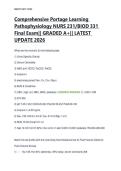
Comprehensive Portage Learning
Pathophysiology NURS 231/BIOD 331
Final Exam|| GRADED A+|| LATEST
UPDATE 2026
What are the normal's for the following labs
1) Urine Specific Gravity
2) Serum Osmolality
3) ABG (pH, HCO3, PaCO2, PaO2)
4) troponin I
5) electrolyte panel( Na+, K+, Ca+, Mg+)
6) BUN & Creatinine
7) CBC ( hgb, hct, RBC, WBC, platelets) -CORRECTANSWER 1) 1.000-1.030
2) 270-300
3) pH 7.35-7.45// HC03 22-26// PaCO2 35-45// Pa02 80-100
4) troponin I <0.03 ng/mL
5) Na+ 135-145//K+ 3.5-5// Ca+ 9-10.5//Mg+ 1.2-2
6) BUN 10-20//Creat 0.5-1.2
7) hgb 12-18// hct 37-52%// rbc 4.2-6.1// wbc 5,000-10,000// platelets 150,000-400,000
Match the lab profile with the most likely fluid imbalance like A) Fluid Volume Deficit 2)
Fluid Volume Excess
1) Na 148; Hct 40% yesterday, 49% today; serum osmolarity 308
,MEDSTUDY.COM
2) Hgb 13.2 yesterday, 10.1 today; Urine specific gravity 1.001
3) BUN 45; Cr 0.7 -CORRECTANSWER 1) A
2) B
3) A
The nurse is preparing to administer lisinopril (Zestril) to a patient with acute coronary
syndrome. Which of the following findings should prompt the nurse to hold the
medication and consult the healthcare provider?
a) Serum sodium level 134
b) Serum potassium 5.6
c) Heart rate 58
d) Blood pressure 125/78 -CORRECTANSWER b) Serum potassium 5.6
*ACE inhibitors can cause/exacerbate hyperkalemia.
The nurse is caring for a patient who is in hypovolemic shock following an extensive
burn injury. What is the intravenous fluid of choice for this patient in the emergent phase
of treatment?
a) Lactated Ringers
b) 0.45 NS with 20 mEq potassium chloride
c) Fresh Frozen Plasma
d) 5% Dextrose in saline -CORRECTANSWER a) Lactated Ringers
*Isotonic solutions (crystalloids) are used to restore fluid volume in patients with shock.
Lactated Ringers is isotonic. Normal saline is also isotonic.
,MEDSTUDY.COM
The client on a ventilator is assessed for untoward responses to the therapy. Which of
the following would indicate a possible complication of ventilator therapy?
a) Blood pressure has increased 5mmHg in the last 24 hours
b) Lung sounds absent on one side.
c) Forceful cough periodically
d) Broncho-vesicular breath sounds throughout peripheral lung fields. -
CORRECTANSWER b) Lung sounds absent on one side.
*This may indicate a pneumothorax--a complication caused by barotrauma.
The pressure reading during inspiration on the ventilator of a client receiving mechanical
ventilation is high and alarming intermittently. What is the nurse's first action?
a) Assess the client's oxygenation.
b) Call the RT to check the ventilator settings.
c) Listen for bilateral lung sounds.
d) Determine whether an air leak is present in the client's endotracheal tube cuff. -
CORRECTANSWER a) Assess the client's oxygenation.
Which assessment finding best indicates that fluid resuscitation therapy for the patient
with hypertonic dehydration has acheived the desired effect?
a) Peripheral pulses changed from 1+ to 3+
b) Neck veins slightly distended @ 30 degrees
c) Serum sodium level has changed from 151 to 143.
, MEDSTUDY.COM
d) Pulse oximetry shows oxygen saturation of 95% -CORRECTANSWER c) Serum
sodium level has changed from 151 to 143.
Which intravenous solution should you be prepared to administer to a patient with
isotonic dehydration?
a) 0.45% saline
b) Dextrose 5% in water
c) Dextrose 10% in water
d) 0.9% saline -CORRECTANSWER d) 0.9% saline
A patient is receiving dobutamine [Dobutrex] as a continuous infusion in the immediate
postoperative period. The patient also is receiving a diuretic. What adverse drug
reactions are possible in this patient? (select all that apply)
a) Angina
b) Hypotension
c) Dysrhythmias
d) Oliguria
e) Tachycardia -CORRECTANSWER a)Angina
c)Dysrhythmias
e)Tachycardia
*Is a beta1 aderenergic agonist; general anesthetics can increase the likelihood of
dysrhythmias. Dobutamine elevates BP by increasing CO. Diuretics complement the
Comprehensive Portage Learning
Pathophysiology NURS 231/BIOD 331
Final Exam|| GRADED A+|| LATEST
UPDATE 2026
What are the normal's for the following labs
1) Urine Specific Gravity
2) Serum Osmolality
3) ABG (pH, HCO3, PaCO2, PaO2)
4) troponin I
5) electrolyte panel( Na+, K+, Ca+, Mg+)
6) BUN & Creatinine
7) CBC ( hgb, hct, RBC, WBC, platelets) -CORRECTANSWER 1) 1.000-1.030
2) 270-300
3) pH 7.35-7.45// HC03 22-26// PaCO2 35-45// Pa02 80-100
4) troponin I <0.03 ng/mL
5) Na+ 135-145//K+ 3.5-5// Ca+ 9-10.5//Mg+ 1.2-2
6) BUN 10-20//Creat 0.5-1.2
7) hgb 12-18// hct 37-52%// rbc 4.2-6.1// wbc 5,000-10,000// platelets 150,000-400,000
Match the lab profile with the most likely fluid imbalance like A) Fluid Volume Deficit 2)
Fluid Volume Excess
1) Na 148; Hct 40% yesterday, 49% today; serum osmolarity 308
,MEDSTUDY.COM
2) Hgb 13.2 yesterday, 10.1 today; Urine specific gravity 1.001
3) BUN 45; Cr 0.7 -CORRECTANSWER 1) A
2) B
3) A
The nurse is preparing to administer lisinopril (Zestril) to a patient with acute coronary
syndrome. Which of the following findings should prompt the nurse to hold the
medication and consult the healthcare provider?
a) Serum sodium level 134
b) Serum potassium 5.6
c) Heart rate 58
d) Blood pressure 125/78 -CORRECTANSWER b) Serum potassium 5.6
*ACE inhibitors can cause/exacerbate hyperkalemia.
The nurse is caring for a patient who is in hypovolemic shock following an extensive
burn injury. What is the intravenous fluid of choice for this patient in the emergent phase
of treatment?
a) Lactated Ringers
b) 0.45 NS with 20 mEq potassium chloride
c) Fresh Frozen Plasma
d) 5% Dextrose in saline -CORRECTANSWER a) Lactated Ringers
*Isotonic solutions (crystalloids) are used to restore fluid volume in patients with shock.
Lactated Ringers is isotonic. Normal saline is also isotonic.
,MEDSTUDY.COM
The client on a ventilator is assessed for untoward responses to the therapy. Which of
the following would indicate a possible complication of ventilator therapy?
a) Blood pressure has increased 5mmHg in the last 24 hours
b) Lung sounds absent on one side.
c) Forceful cough periodically
d) Broncho-vesicular breath sounds throughout peripheral lung fields. -
CORRECTANSWER b) Lung sounds absent on one side.
*This may indicate a pneumothorax--a complication caused by barotrauma.
The pressure reading during inspiration on the ventilator of a client receiving mechanical
ventilation is high and alarming intermittently. What is the nurse's first action?
a) Assess the client's oxygenation.
b) Call the RT to check the ventilator settings.
c) Listen for bilateral lung sounds.
d) Determine whether an air leak is present in the client's endotracheal tube cuff. -
CORRECTANSWER a) Assess the client's oxygenation.
Which assessment finding best indicates that fluid resuscitation therapy for the patient
with hypertonic dehydration has acheived the desired effect?
a) Peripheral pulses changed from 1+ to 3+
b) Neck veins slightly distended @ 30 degrees
c) Serum sodium level has changed from 151 to 143.
, MEDSTUDY.COM
d) Pulse oximetry shows oxygen saturation of 95% -CORRECTANSWER c) Serum
sodium level has changed from 151 to 143.
Which intravenous solution should you be prepared to administer to a patient with
isotonic dehydration?
a) 0.45% saline
b) Dextrose 5% in water
c) Dextrose 10% in water
d) 0.9% saline -CORRECTANSWER d) 0.9% saline
A patient is receiving dobutamine [Dobutrex] as a continuous infusion in the immediate
postoperative period. The patient also is receiving a diuretic. What adverse drug
reactions are possible in this patient? (select all that apply)
a) Angina
b) Hypotension
c) Dysrhythmias
d) Oliguria
e) Tachycardia -CORRECTANSWER a)Angina
c)Dysrhythmias
e)Tachycardia
*Is a beta1 aderenergic agonist; general anesthetics can increase the likelihood of
dysrhythmias. Dobutamine elevates BP by increasing CO. Diuretics complement the


