
Weeds study guide for PCA exam
Study online at https://quizlet.com/_bt3alr
1. Summer Annual Weeds: Emerge in the spring or early summer, grow during the summer, produce seed
in mid to late summer, and are killed by frost in fall/early winter.
2. Winter Annual Weeds: Typically emerge late summer or fall, survive through the winter by growing into
small rosettes, then resume their growth and produce seeds in late spring or early summer the following year.
3. Perennials: Plants that live 3 or more years, repeating the vegetative growth and reproductive cycles each year.
4. Biennials: Angiosperms that complete their life cycle in two years, usually don't flower or reproduce until the
second season.
5. Dicot: angiosperm with two cotyledons inside its seed, flower parts in multiples of four or five, and vascular
bundles in rings
6. Monocot: angiosperm with one seed leaf in its ovary
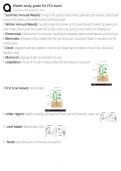
7. cotyledon: first leaf or first pair of leaves produced by the embryo of a seed plant
8. first true leaves: primary leaves
9. collar region: Region consisting, leaf blade, leaf sheath, auricles (if present), a ligule, and connective collar
10. Leaf blade: flattened part of leaf
11. Node: point where one or more leaves are attached
, Weeds study guide for PCA exam
Study online at https://quizlet.com/_bt3alr
12. Internode: A segment of a plant stem between the points where leaves are attached.
13. leaf sheath: the base of a leaf that wraps around the stem; typical in grasses and some other monocots.
14. Petiole: The stalk of a leaf, which joins the leaf to a node of the stem.
15. Auricle: Claw like appendages on collar
16. Ligule: A membranous or hairy structure on the inside of a leaf at the junction of the leaf blade and sheath
17. Awn: bristlelike appendage of certain grasses
18. Hypocotyl: The part of a plant embryo directly below the cotyledons, forming a connection with the radicle.
, Weeds study guide for PCA exam
Study online at https://quizlet.com/_bt3alr
19. inflorescence: flowering part of a plant
20. coleoptile: The covering of the young shoot of the embryo of a grass seed.
21. Tuber: specialized food-storage stem that grows underground
22. rhizome: a horizontal, underground stem that produces new leaves, shoots, and roots (rootstock)
23. stolons/runners: horizontal, above the ground stems; asexual reproduction, new plants arise from stolons
24. Bulbs: the round parts of some plants that are underground
25. Weeds that are poisonous to animals: Jimsonweed, nightshades, common groundsel, coast
fiddleneck, yellow starthistle
26. Vegetative propagule: Any of various structures that can give rise to a new individual organism, especially
parts of a plant that serve as means of vegetative reproduction, such as corms, tubers, offsets, or runners. Seeds and
spores are also propagules.
Study online at https://quizlet.com/_bt3alr
1. Summer Annual Weeds: Emerge in the spring or early summer, grow during the summer, produce seed
in mid to late summer, and are killed by frost in fall/early winter.
2. Winter Annual Weeds: Typically emerge late summer or fall, survive through the winter by growing into
small rosettes, then resume their growth and produce seeds in late spring or early summer the following year.
3. Perennials: Plants that live 3 or more years, repeating the vegetative growth and reproductive cycles each year.
4. Biennials: Angiosperms that complete their life cycle in two years, usually don't flower or reproduce until the
second season.
5. Dicot: angiosperm with two cotyledons inside its seed, flower parts in multiples of four or five, and vascular
bundles in rings
6. Monocot: angiosperm with one seed leaf in its ovary
7. cotyledon: first leaf or first pair of leaves produced by the embryo of a seed plant
8. first true leaves: primary leaves
9. collar region: Region consisting, leaf blade, leaf sheath, auricles (if present), a ligule, and connective collar
10. Leaf blade: flattened part of leaf
11. Node: point where one or more leaves are attached
, Weeds study guide for PCA exam
Study online at https://quizlet.com/_bt3alr
12. Internode: A segment of a plant stem between the points where leaves are attached.
13. leaf sheath: the base of a leaf that wraps around the stem; typical in grasses and some other monocots.
14. Petiole: The stalk of a leaf, which joins the leaf to a node of the stem.
15. Auricle: Claw like appendages on collar
16. Ligule: A membranous or hairy structure on the inside of a leaf at the junction of the leaf blade and sheath
17. Awn: bristlelike appendage of certain grasses
18. Hypocotyl: The part of a plant embryo directly below the cotyledons, forming a connection with the radicle.
, Weeds study guide for PCA exam
Study online at https://quizlet.com/_bt3alr
19. inflorescence: flowering part of a plant
20. coleoptile: The covering of the young shoot of the embryo of a grass seed.
21. Tuber: specialized food-storage stem that grows underground
22. rhizome: a horizontal, underground stem that produces new leaves, shoots, and roots (rootstock)
23. stolons/runners: horizontal, above the ground stems; asexual reproduction, new plants arise from stolons
24. Bulbs: the round parts of some plants that are underground
25. Weeds that are poisonous to animals: Jimsonweed, nightshades, common groundsel, coast
fiddleneck, yellow starthistle
26. Vegetative propagule: Any of various structures that can give rise to a new individual organism, especially
parts of a plant that serve as means of vegetative reproduction, such as corms, tubers, offsets, or runners. Seeds and
spores are also propagules.


