

Chapter 14.2: Polypeptide synthesis – transcription and splicing
Proteins are made up of polypeptides. Proteins, especially enzymes, are essential to all aspects of life.
Every organism needs to make its own proteins that are sometimes unique to its species. The
biochemical machinery in the cytoplasm of each cell has the capacity to make every protein from just
20 amino acids. Exactly which proteins it manufactures depends on the instructions that are provided,
at any given time, by the DNA in the cell’s nucleus. The basic process is as follows:
DNA provides the instruction in the form of a long sequence of nucleotides and the bases they
possess.
A complementary section of part of this sequence is made in the form of a molecule called pre-
mRNA in a process called transcription.
The pre-mRNA is spliced to form mRNA
The mRNA is used as a template to which complementary tRNA molecules attach and the
amino acids they carry are linked to form a polypeptide – a process called translation
This process can be likened to a bakery, where the basic equipment and ovens (cell organelles) can
manufacture any type of cake (protein) from a few basic ingredients (amino acids). Which particular
cake is made depends on the recipe (genetic code). By choosing different recipes at different times,
rather than making everything all the time, the baker can meet seasonal demands, adapt to changing
customer needs and avoid waste.
DNA replication can be likened to the publication of many copies of a recipe book (genome); making a
photocopy of a recipe to use in the bakery is therefore transcription. Making the cakes, using the
photocopied recipe, is translation. If the book is not removed from the library, many copies of the
recipe can be made and the same cakes can be made in several different places or over several years.
Transcription
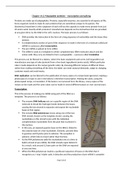
This is the process of making pre-mRNA using part of the DNA as a
template. The process is as follows:
The enzyme DNA helicase acts on a specific region of the DNA
molecule to break the hydrogen bonds between the bases,
causing the two strands to separate and expose the nucleotide
bases in that region.
The enzyme RNA polymerase moves along one of the two
DNA strands, known as the template strand, causing the
nucleotides on this strand to join with the individual
complementary nucleotides from the pool that is present in
the nucleus.
In this way, an exposed guanine base on the DNA is linked to
the cytosine base of a free nucleotide. Similarly, cytosine links
to guanine and thymine joins to adenine. The exception is
adenine, which links to Uracil rather than thymine.
As the RNA polymerase adds the nucleotides one at a time to
build a strand of pre-mRNA, the DNA strands rejoin behind it.
As a result, only around 12 base pairs on the DNA are exposed
at any one time.
When the RNA polymerase reaches a particular sequence of bases on the DNA that it
recognises as a ‘stop’ triplet code, it detaches and the production of pre-mRNA is complete
Page 1 of 2
Proteins are made up of polypeptides. Proteins, especially enzymes, are essential to all aspects of life.
Every organism needs to make its own proteins that are sometimes unique to its species. The
biochemical machinery in the cytoplasm of each cell has the capacity to make every protein from just
20 amino acids. Exactly which proteins it manufactures depends on the instructions that are provided,
at any given time, by the DNA in the cell’s nucleus. The basic process is as follows:
DNA provides the instruction in the form of a long sequence of nucleotides and the bases they
possess.
A complementary section of part of this sequence is made in the form of a molecule called pre-
mRNA in a process called transcription.
The pre-mRNA is spliced to form mRNA
The mRNA is used as a template to which complementary tRNA molecules attach and the
amino acids they carry are linked to form a polypeptide – a process called translation
This process can be likened to a bakery, where the basic equipment and ovens (cell organelles) can
manufacture any type of cake (protein) from a few basic ingredients (amino acids). Which particular
cake is made depends on the recipe (genetic code). By choosing different recipes at different times,
rather than making everything all the time, the baker can meet seasonal demands, adapt to changing
customer needs and avoid waste.
DNA replication can be likened to the publication of many copies of a recipe book (genome); making a
photocopy of a recipe to use in the bakery is therefore transcription. Making the cakes, using the
photocopied recipe, is translation. If the book is not removed from the library, many copies of the
recipe can be made and the same cakes can be made in several different places or over several years.
Transcription
This is the process of making pre-mRNA using part of the DNA as a
template. The process is as follows:
The enzyme DNA helicase acts on a specific region of the DNA
molecule to break the hydrogen bonds between the bases,
causing the two strands to separate and expose the nucleotide
bases in that region.
The enzyme RNA polymerase moves along one of the two
DNA strands, known as the template strand, causing the
nucleotides on this strand to join with the individual
complementary nucleotides from the pool that is present in
the nucleus.
In this way, an exposed guanine base on the DNA is linked to
the cytosine base of a free nucleotide. Similarly, cytosine links
to guanine and thymine joins to adenine. The exception is
adenine, which links to Uracil rather than thymine.
As the RNA polymerase adds the nucleotides one at a time to
build a strand of pre-mRNA, the DNA strands rejoin behind it.
As a result, only around 12 base pairs on the DNA are exposed
at any one time.
When the RNA polymerase reaches a particular sequence of bases on the DNA that it
recognises as a ‘stop’ triplet code, it detaches and the production of pre-mRNA is complete
Page 1 of 2


