

Written by students who passed Immediately available after payment Read online or as PDF Wrong document? Swap it for free 4.6 TrustPilot
logo-home
Document preview thumbnail
Preview 2 out of 10 pages
Exam (elaborations)

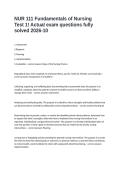
NUR 111 Fundamentals of Nursing Test 1! Actual exam questions fully solved 2026-10

Document preview thumbnail
Preview 2 out of 10 pages

1. Assessment 2.Diagnosis 3. Planning 4. implementation 5. Evalulation - correct answers Steps of the Nursing Process biographical data, chief complaint, hx of present illness, past hx, family hx, lifestyle, and social data. - correct answers Components of a health hx Collecting, organizing, and validating data; documenting the pt assessment data; the purpose is to establish a database about the patients response to health concerns or illness and their ability to manage their needs. - correct answers Assessment Analyzing and synthesizing data. The purpose is to identify a clients strengths and health problems that can be prevented or resolved by collaborative and nursing interventions. - correct answers Nursing Dx Determining how to prevent, reduce, or resolve the identified priority client problems; determine how to support the client's strengths; determine how to implement the nursing interventions in an organized, individualized, and goal directed manner. The purpose is to develop individualized plans of care that specifies a client's goals or desired outcomes that are related to the priority nursing interventions. - correct answers Planning carrying out or delegating and documenting the planned nursing interventions. The purpose is to assist the client to meet their desired goals or outcomes, to promote wellness, to prevent illness and disease, to restore health, and to facilitate the client with coping with altered functioning. - correct answers Implementation Measuring the degree to which the clients goals or outcomes have been met or have NOT been met. The purpose is to determine whether to modify, terminate, or continue the client's plan of care. - correct answers Evaluation Symptoms; the client's perception about their health problems. This information is only apparent to the client. Examples include pain, nausea, anxiety, itching. - correct answers Subjective Data Signs; observations or measurements made by the collector. Examples include vitals, wound size, vomiting, diarrhea, rash, edema. - correct answers Objective data Actual, risk, wellness, health promotion, and syndrome - correct answers Types of Nursing Dx Components of a nursing Dx; 1. Problem, 2. Etiology (R/T), 3. signs/symptoms (AEB) - correct answers PES The guidelines for writing goals or outcomes; Specific, Measurable, Attainable, Relevant, Time limited. - correct answers SMART Independent, dependent, collaborative - correct answers Types of nursing interventions Nurse initiated; I/O, Teaching, Vitals, Emotional support, Assessments, Turn, cough and deep breathing. - correct answers Independent intervention Physician initiated; Medications, IV, Dressings, Hot and Cold applications. - correct answers Dependent intervention interdependent; PT, OT, Respiratory therapist, social workers, dietitians. - correct answers Collaborative intervention Problems solving, critical thinking, decision making - correct answers Cognitive Skills good communication - correct answers Interpersonal skills psycho-motor; motor skills, coordination - correct answers Technical skills teach, administer, measure, obtain, institute - correct answers Implementation action words less than a week - correct answers Short term goal longer than a week - correct answers long term goal Standardized, concept mapping, critical pathway - correct answers Types of care plans 1. Sender 2. Message 3. Channel 4. Receiver 5. Response - correct answers Communication Process pace and intonation (Speed and tone), simplicity, clarity and brevity, congruence (verbal and nonverbal behaviors need to match), timing and relevance, adaptability, credibility, and humor (when appropriate). - correct answers Verbal communication guidelines Body language (gestures, movements, use of touch) - correct answers Nonverbal Communication Guidelines Observation, interpretation, and gestures. - correct answers Essential skills for Communication appropriate language and terminology, correct spelling, punctuation, and grammar, logical organization, and the appropriate use and citation of resources. - correct answers Effective Written Communication Development and gender, socioculture characteristics, values and perceptions, personal space and territoriality, roles and relationships, environment, congruence, and attitudes. - correct answers Factors that influence that communication process? Similar to baby talk; conveys disrespect. Making accommodations that include producing shorter, less complex sentences, using simpler vocabulary, filler words, fragmented sentences, lexical filters, and repetition. - correct answers Elderspeak space that an individual feels comfortable with; 1 to 4 feet. - correct answers Personal Space close and touching - correct answers Intimate Space the space that an individual is comfortable in during a social interaction with many people. Example: Teaching - correct answers Social Space what a personal is comfortable with in an area with those that he or she does not know. Example: Public concerts or parks. - correct answers Public Space stereotyping, agreeing and disagreeing, being defensive, challenging, probing, testing, rejecting, changing topics, unwarranted reassurance, passing judgement, and giving common advice. - correct answers Barriers to communication Aggressive, Passive, and Assertve - correct answers Types of communication focus on their own needs; loud, blaming, and demanding. - correct answers Aggressive communication focus on the needs of others; concealing, denying, and avoiding. - correct answers Passive communication declare and affirm opinions; respecting, balancing, and acknowledging. - correct answers Assertive communication "I" statements, fogging, negative assertion, repetition, confidence, management of nonverbal communication, avoid apologizing, preform post conversation evaluation. - correct answers Assertive communication techniques ability to see, hear, feel, and smell could be diminished. Check for medic alert bracelets, hearing aids, reading lips, and sign language. - correct answers Sensory deficits Diminished cognitive abilities. CVD, Alzheimer's disease, brain tumor or injury, medications that influence function. - correct answers Cognitive impairments cleft palate, artificial airways, extreme dyspnea - correct answers Structural deficits convey encouragement, let the client know if you don't understand, keep questions open ended, provide touch if it is appropriate. - correct answers Providing support for those with deficits or impairments speak 3-6 ft from client, speak into good ear, free enviroment from competing noise, make sure that the client can see you, speak at a natural rate. - correct answers Support for HOH accomplish goals, maintain cohesion, develop and modify structure to improve effectiveness. - correct answers Characteristics of Effective groups Therapeutic communication techniques; Sit facing the client, observe an open posture, Lean in towards the client, establish Eye contact, and Relax. - correct answers SOLER the ability to understand and accept another persons reality. - correct answers Empathy communication, planning care, auditing health agencies, research, education, reimbursement, legal documentation, health care analysis. - correct answers Purpose of client records Source-oriented record, Problem, interventions, and evaluation (PIE), Focus charting, Charting by exception, Electronic documentation, Case management, and Narrative documentation. - correct answers Documentation systems Used by MD and NP; Subjective information, Objective information, Assessment, and Plan - correct answers SOAP Evidence of client assessment, nursing Dx, nursing interventions, client outcomes, evidence of the current nursing care plan. - correct answers Nursing Care Plan Requirements consice method for organizing records. May or may not be a part of the perminate record, can be done in pencil, organized in sections: Perminate information, Medications and IV fluids, Tx and Procedures - correct answers Kardexes used for recording data quickly and concisely. Used for the graphic recording of I&O, MAR, SAR, and VS - correct answers Flow sheet used to record progress, interventions, assessments, and data. - correct answers Progressive notes Date and time, Timing, Legibility, Permanence, Accepted terminology, Correct spelling, Signature, Accuracy, Observations and Facts, appropriately record mistakes. - correct answers General guidelines for documentation 1. draw a line though it 2. write initials and date and time (done by an edit in computer charting.) - correct answers Recording a mistake chart changes, show follow-ups, read prior notes, be timely, objective and factual information, correct errors, chart teaching, use quotes for responses from patients - correct answers Do's of Charting leave blank spaces, use white out, chart in advance, use vague terms, chart for others, use "patient" or "client", alte

Content preview

NUR 111 Fundamentals of Nursing
Test 1! Actual exam questions fully
solved 2026-10

1. Assessment

2.Diagnosis

3. Planning

4. implementation

5. Evalulation - correct answers Steps of the Nursing Process


biographical data, chief complaint, hx of present illness, past hx, family hx, lifestyle, and social data. -
correct answers Components of a health hx


Collecting, organizing, and validating data; documenting the pt assessment data; the purpose is to
establish a database about the patients response to health concerns or illness and their ability to
manage their needs. - correct answers Assessment


Analyzing and synthesizing data. The purpose is to identify a clients strengths and health problems that
can be prevented or resolved by collaborative and nursing interventions. - correct answers Nursing Dx


Determining how to prevent, reduce, or resolve the identified priority client problems; determine how
to support the client's strengths; determine how to implement the nursing interventions in an
organized, individualized, and goal directed manner. The purpose is to develop individualized plans of
care that specifies a client's goals or desired outcomes that are related to the priority nursing
interventions. - correct answers Planning


carrying out or delegating and documenting the planned nursing interventions. The purpose is to assist
the client to meet their desired goals or outcomes, to promote wellness, to prevent illness and disease,
to restore health, and to facilitate the client with coping with altered functioning. - correct answers
Implementation

, Measuring the degree to which the clients goals or outcomes have been met or have NOT been met.
The purpose is to determine whether to modify, terminate, or continue the client's plan of care. -
correct answers Evaluation


Symptoms; the client's perception about their health problems. This information is only apparent to the
client. Examples include pain, nausea, anxiety, itching. - correct answers Subjective Data


Signs; observations or measurements made by the collector. Examples include vitals, wound size,
vomiting, diarrhea, rash, edema. - correct answers Objective data


Actual, risk, wellness, health promotion, and syndrome - correct answers Types of Nursing Dx


Components of a nursing Dx; 1. Problem, 2. Etiology (R/T), 3. signs/symptoms (AEB) - correct answers
PES


The guidelines for writing goals or outcomes; Specific, Measurable, Attainable, Relevant, Time limited. -
correct answers SMART


Independent, dependent, collaborative - correct answers Types of nursing interventions


Nurse initiated; I/O, Teaching, Vitals, Emotional support, Assessments, Turn, cough and deep breathing.
- correct answers Independent intervention


Physician initiated; Medications, IV, Dressings, Hot and Cold applications. - correct answers Dependent
intervention


interdependent; PT, OT, Respiratory therapist, social workers, dietitians. - correct answers Collaborative
intervention


Problems solving, critical thinking, decision making - correct answers Cognitive Skills


good communication - correct answers Interpersonal skills

Document information

Uploaded on
February 2, 2026
Number of pages
10
Written in
2025/2026
Type
Exam (elaborations)
Contains
Questions & answers
$15.49

Wrong document? Swap it for free Within 14 days of purchase and before downloading, you can choose a different document. You can simply spend the amount again.
Written by students who passed
Immediately available after payment
Read online or as PDF

Seller avatar
Reputation scores are based on the amount of documents a seller has sold for a fee and the reviews they have received for those documents. There are three levels: Bronze, Silver and Gold. The better the reputation, the more your can rely on the quality of the sellers work.
RealGrades
4.0
(26)
Sold
197
Followers
52
Items
12331
Last sold
3 weeks ago


Why students choose Stuvia

Created by fellow students, verified by reviews

Quality you can trust: written by students who passed their tests and reviewed by others who've used these notes.

Didn't get what you expected? Choose another document

No worries! You can instantly pick a different document that better fits what you're looking for.

Pay as you like, start learning right away

No subscription, no commitments. Pay the way you're used to via credit card and download your PDF document instantly.

Student with book image

“Bought, downloaded, and aced it. It really can be that simple.”

Alisha Student

Working on your references?

Create accurate citations in APA, MLA and Harvard with our free citation generator.

Working on your references?

Frequently asked questions
