
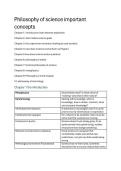
Philosophy of science important
concepts
Chapter 1: introduction (main theories explained)
Chapter 2: what makes science great
Chapter 3: the copernican revolution (looking at case-studies)
Chapter 4: how does science evolve (Kuhn vs Popper)
Chapter 5:how does science evolve (Lakatos)
Chapter 6: philosophy of maths
Chapter 7: feminist philosophy of science
Chapter 8: metaphysics
Chapter 9: Philosophy of mind Chapter
10: philosophy of technology
Chapter 1 the introduction
Metaphysics what entities exist? In what sense of
“existing” and what is their nature?
Epistemology dealing with knowledge, what is
knowledge, how to obtain, transmit, store
and compare knowledge?
Verificationism (layman) A statement is meaningful only if it can be
proven true by observation or experience.
Falsificationism (popper) For a theory to be scientific, there must be
some test that could prove it wrong
Historiscism (kuhn) Science doesn't just slowly grow; it has
quiet periods interrupted by big, sudden
revolutions that change everything
Rational reconstructions (Lakatos) Good science is a program that
consistently makes successful new
predictions, not just one that avoids being
wrong.
Methological anarchism (Feyerabend) Science has no fixed rules; scientists
should be free to try any method that works
,Sociological reductionism (Bloor) What scientists accept as true is shaped
by their society, politics, and culture, not
just by pure facts.
The practice-turn (starting with kuhn) • Anomalies and ad hoc fixes
• Underdetermination of theory of
data
• Theory-leadenness of observation
Chapter 2: what makes science great
• Helps understanding world
• Technology
• Special kind of knowledge
Hard and reliable knowledge Thrusworthy hard to deny
consensus Large-scale agreements on scientific facts
Justified true belief The traditional definition of knowledge,
meaning you can claim to know
something only if it is true, you believe it,
and you have good reasons or evidence
for that belief.
Empirical testing The process of collecting data through
direct observation, measurement, or
experiment to support or refute a
hypothesis
Aristolian model Explains things by describing their natural
purpose or final goal (e.g., an acorn's
purpose is to become an oak tree)
Armchair reflection Arriving at conclusions through pure
thinking and reasoning, without conducting
any experiments or gathering new
evidence.
creationism The belief that the universe and life were
created by a divine being, rather than
through natural processes like evolution
astrology The belief that the positions of the stars
and planets at the time of a person's birth
influence their personality and future
events.
Demarcation problem (lakatos) the challenge of finding a clear rule to
distinguish genuine science (like biology)
, from non-science or pseudoscience (like
astrology).
Geocentrism (copernicus) The ancient belief that the Earth is the
stationary center of the universe, which
Copernicus argued against with his sun-
centered model.
Mendalians (mendel) Followers of Gregor Mendel's work,
showing that traits are passed down from
parents to offspring through discrete,
predictable units (now called genes).
hypothesis A testable, educated guess or proposed
explanation for an observed phenomenon,
made before an experiment begins.
Deductive reasoning Starting with a general rule or theory and
reasoning down to a specific, certain
conclusion (e.g., All humans are mortal.
Socrates is human. Therefore, Socrates is
mortal.).
Inductive reasoning Starting with specific observations or
patterns and reasoning up to a general,
probable conclusion (e.g., Every swan I've
seen is white, so probably all swans are
white.).
Naive verificationism The simple but flawed idea that you can
prove a scientific theory is completely
true just by finding a few examples that
support it.
Marxism A social, political, and economic theory,
developed by Karl Marx, which analyzes
society as a conflict between classes over
material resources and the means of
production
psychoanalysis A theory and therapy, founded by Sigmund
Freud, that aims to treat mental disorders
by investigating the interaction of the
unconscious and conscious elements of
the mind
The “practice turn” How science is actually done in
communities and through material
practices.
Hume: Inductive reasoning can only be justified by inductive reasoning. This is circular!
concepts
Chapter 1: introduction (main theories explained)
Chapter 2: what makes science great
Chapter 3: the copernican revolution (looking at case-studies)
Chapter 4: how does science evolve (Kuhn vs Popper)
Chapter 5:how does science evolve (Lakatos)
Chapter 6: philosophy of maths
Chapter 7: feminist philosophy of science
Chapter 8: metaphysics
Chapter 9: Philosophy of mind Chapter
10: philosophy of technology
Chapter 1 the introduction
Metaphysics what entities exist? In what sense of
“existing” and what is their nature?
Epistemology dealing with knowledge, what is
knowledge, how to obtain, transmit, store
and compare knowledge?
Verificationism (layman) A statement is meaningful only if it can be
proven true by observation or experience.
Falsificationism (popper) For a theory to be scientific, there must be
some test that could prove it wrong
Historiscism (kuhn) Science doesn't just slowly grow; it has
quiet periods interrupted by big, sudden
revolutions that change everything
Rational reconstructions (Lakatos) Good science is a program that
consistently makes successful new
predictions, not just one that avoids being
wrong.
Methological anarchism (Feyerabend) Science has no fixed rules; scientists
should be free to try any method that works
,Sociological reductionism (Bloor) What scientists accept as true is shaped
by their society, politics, and culture, not
just by pure facts.
The practice-turn (starting with kuhn) • Anomalies and ad hoc fixes
• Underdetermination of theory of
data
• Theory-leadenness of observation
Chapter 2: what makes science great
• Helps understanding world
• Technology
• Special kind of knowledge
Hard and reliable knowledge Thrusworthy hard to deny
consensus Large-scale agreements on scientific facts
Justified true belief The traditional definition of knowledge,
meaning you can claim to know
something only if it is true, you believe it,
and you have good reasons or evidence
for that belief.
Empirical testing The process of collecting data through
direct observation, measurement, or
experiment to support or refute a
hypothesis
Aristolian model Explains things by describing their natural
purpose or final goal (e.g., an acorn's
purpose is to become an oak tree)
Armchair reflection Arriving at conclusions through pure
thinking and reasoning, without conducting
any experiments or gathering new
evidence.
creationism The belief that the universe and life were
created by a divine being, rather than
through natural processes like evolution
astrology The belief that the positions of the stars
and planets at the time of a person's birth
influence their personality and future
events.
Demarcation problem (lakatos) the challenge of finding a clear rule to
distinguish genuine science (like biology)
, from non-science or pseudoscience (like
astrology).
Geocentrism (copernicus) The ancient belief that the Earth is the
stationary center of the universe, which
Copernicus argued against with his sun-
centered model.
Mendalians (mendel) Followers of Gregor Mendel's work,
showing that traits are passed down from
parents to offspring through discrete,
predictable units (now called genes).
hypothesis A testable, educated guess or proposed
explanation for an observed phenomenon,
made before an experiment begins.
Deductive reasoning Starting with a general rule or theory and
reasoning down to a specific, certain
conclusion (e.g., All humans are mortal.
Socrates is human. Therefore, Socrates is
mortal.).
Inductive reasoning Starting with specific observations or
patterns and reasoning up to a general,
probable conclusion (e.g., Every swan I've
seen is white, so probably all swans are
white.).
Naive verificationism The simple but flawed idea that you can
prove a scientific theory is completely
true just by finding a few examples that
support it.
Marxism A social, political, and economic theory,
developed by Karl Marx, which analyzes
society as a conflict between classes over
material resources and the means of
production
psychoanalysis A theory and therapy, founded by Sigmund
Freud, that aims to treat mental disorders
by investigating the interaction of the
unconscious and conscious elements of
the mind
The “practice turn” How science is actually done in
communities and through material
practices.
Hume: Inductive reasoning can only be justified by inductive reasoning. This is circular!


