FINA 481 CLASS NOTES
Chapt.1: Why are financial institutions special?
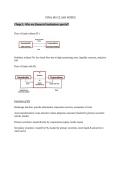
Flow of funds without FI’s
Problems without FIs: low funds flow due to high monitoring costs, liquidity concerns, and price
risk
Flow of funds with FIs
Functions of FIs
Brokerage function: provide information, transaction services, economies of scale
Asset transformation: issue attractive claims (deposits, insurance) backed by primary securities
(stocks, bonds)
Primary securities: issued directly by corporations (equity, bonds, loans)
Secondary securities: created by FIs, backed by primary securities, more liquid & attractive to
small savers
,Role of FIs in cost reduction
Information costs
Investors face agency costs when monitoring borrowers
- Delegated monitor:
FIs monitor on behalf of savers
Have stronger incentive + economies of scale in monitoring
- Information producer:
Create secondary securities (ex: bank loan) to improve monitoring
Use short-term contracts for more control
Reduce information asymmetry between borrowers and savers
In short: FIs cut costs by monitoring efficiently, producing information, and reducing asymmetry
Specialness of FIs
Liquidity & Price Risk
Secondary claims from FIs carry less price risk
Demand deposits & similar claims are highly liquid attractive to small investors
FIs can diversify better than households due to their larger size
In short: FIs make investments safer, more liquid, and more diversified
Other special services
Reduced transactions costs
Maturity intermediation
Monetary policy transmission
Credit allocation (areas of special need such as home mortgages)
Intergenerational transfers or time intermediation
Payment service (ex: interact)
Denomination intermediation
The Canadian Regulatory System
Office of the Superintendent of Financial Institutions (OSFI): Prudential regulator of banks
& federally regulated FI’s; enforces Basel rules
Bank of Canada (BoC): Canada’s central bank; sets monetary policy & ensures system stability
Department of finance: Designs laws & legislative framework for FIs
Canada Deposit Insurance Corporation (CDIC): Crown corporation (1967); insures deposits
up to $100,000; manage bank failures & resolution
Specialness and Regulation
, Why regulate FIs
Failures create negative externalities (system-wide damage)
They provide special services (pmts, credit, money supply)
Some functions are institution specific (bank monetary policy, credit allocation, pmts)
Net Regulatory Burden
Regulation = costs vs benefits for FI’s
Protects society, but comes at a cost for institutions
In short: FIs are regulated because their failure hurts everyone, but regulation isn’t free
Rules keep bank safe, help the economy, and protect both customers and investors
Ex:
- Safety and soundness regulation
- Monetary policy
- Credit allocation
- Consumer protection
- Investor protection
- Entry and chartering
Safety and soundness regulation
Purpose: Stop banks from failing
Diversification: don’t lend too much to one person (U.S. rule = max 15%)
Capital requirements: banks must keep some on their own money as a safety cushion
Deposit insurance: protects people’s money if a bank fails
- Canada CDIC
- U.S. FDIC
Monitoring: regulators check banks with exams + reports
- In Canada OSFI does this
After crises: Rules get stricter
Downside: following the rules costs banks money
In short: Safety rules = diversify, keep capital, insure deposits, monitor banks — but it costs
money.
Office of the Superintendent of financial Intuitions (OSFI)
OSFI – Who They Regulate (Sep 2023)
Banks → 81 (main job of OSFI)
Loan & Trust Companies → 57
Life Insurance Companies → 59
Chapt.1: Why are financial institutions special?
Flow of funds without FI’s
Problems without FIs: low funds flow due to high monitoring costs, liquidity concerns, and price
risk
Flow of funds with FIs
Functions of FIs
Brokerage function: provide information, transaction services, economies of scale
Asset transformation: issue attractive claims (deposits, insurance) backed by primary securities
(stocks, bonds)
Primary securities: issued directly by corporations (equity, bonds, loans)
Secondary securities: created by FIs, backed by primary securities, more liquid & attractive to
small savers
,Role of FIs in cost reduction
Information costs
Investors face agency costs when monitoring borrowers
- Delegated monitor:
FIs monitor on behalf of savers
Have stronger incentive + economies of scale in monitoring
- Information producer:
Create secondary securities (ex: bank loan) to improve monitoring
Use short-term contracts for more control
Reduce information asymmetry between borrowers and savers
In short: FIs cut costs by monitoring efficiently, producing information, and reducing asymmetry
Specialness of FIs
Liquidity & Price Risk
Secondary claims from FIs carry less price risk
Demand deposits & similar claims are highly liquid attractive to small investors
FIs can diversify better than households due to their larger size
In short: FIs make investments safer, more liquid, and more diversified
Other special services
Reduced transactions costs
Maturity intermediation
Monetary policy transmission
Credit allocation (areas of special need such as home mortgages)
Intergenerational transfers or time intermediation
Payment service (ex: interact)
Denomination intermediation
The Canadian Regulatory System
Office of the Superintendent of Financial Institutions (OSFI): Prudential regulator of banks
& federally regulated FI’s; enforces Basel rules
Bank of Canada (BoC): Canada’s central bank; sets monetary policy & ensures system stability
Department of finance: Designs laws & legislative framework for FIs
Canada Deposit Insurance Corporation (CDIC): Crown corporation (1967); insures deposits
up to $100,000; manage bank failures & resolution
Specialness and Regulation
, Why regulate FIs
Failures create negative externalities (system-wide damage)
They provide special services (pmts, credit, money supply)
Some functions are institution specific (bank monetary policy, credit allocation, pmts)
Net Regulatory Burden
Regulation = costs vs benefits for FI’s
Protects society, but comes at a cost for institutions
In short: FIs are regulated because their failure hurts everyone, but regulation isn’t free
Rules keep bank safe, help the economy, and protect both customers and investors
Ex:
- Safety and soundness regulation
- Monetary policy
- Credit allocation
- Consumer protection
- Investor protection
- Entry and chartering
Safety and soundness regulation
Purpose: Stop banks from failing
Diversification: don’t lend too much to one person (U.S. rule = max 15%)
Capital requirements: banks must keep some on their own money as a safety cushion
Deposit insurance: protects people’s money if a bank fails
- Canada CDIC
- U.S. FDIC
Monitoring: regulators check banks with exams + reports
- In Canada OSFI does this
After crises: Rules get stricter
Downside: following the rules costs banks money
In short: Safety rules = diversify, keep capital, insure deposits, monitor banks — but it costs
money.
Office of the Superintendent of financial Intuitions (OSFI)
OSFI – Who They Regulate (Sep 2023)
Banks → 81 (main job of OSFI)
Loan & Trust Companies → 57
Life Insurance Companies → 59