

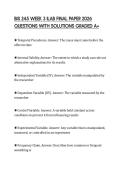
BIS 245 WEEK 3 ILAB FINAL PAPER 2026
QUESTIONS WITH SOLUTIONS GRADED A+
◉ Temporal Precedence. Answer: The cause must come before the
effect in time
◉ Internal Validity. Answer: The extent to which a study can rule out
alternative explanations for its results
◉ Independent Variable (IV). Answer: The variable manipulated by
the researcher
◉ Dependent Variable (DV). Answer: The variable measured by the
researcher
◉ Control Variable. Answer: A variable held constant across
conditions to prevent it from influencing results
◉ Experimental Variable. Answer: Any variable that is manipulated,
measured, or controlled in an experiment
◉ Frequency Claim. Answer: Describes how common or frequent
something is
, ◉ Association Claim. Answer: States that two measured variables
are related
◉ Causal Claim. Answer: States that one variable causes a change in
another variable
◉ Control Group. Answer: A group that does not receive the
treatment or receives a baseline condition
◉ Treatment Group. Answer: A group that receives the manipulated
level of the IV
◉ Placebo Group. Answer: A control group that receives an inert or
inactive treatment
◉ Design Confound. Answer: A flaw in a study that creates
alternative explanations by varying systematically with the IV
◉ Systematic Variability. Answer: Differences between groups that
are consistent and linked to the IV
◉ Unsystematic Variability. Answer: Random differences between
participants that add noise but not bias
QUESTIONS WITH SOLUTIONS GRADED A+
◉ Temporal Precedence. Answer: The cause must come before the
effect in time
◉ Internal Validity. Answer: The extent to which a study can rule out
alternative explanations for its results
◉ Independent Variable (IV). Answer: The variable manipulated by
the researcher
◉ Dependent Variable (DV). Answer: The variable measured by the
researcher
◉ Control Variable. Answer: A variable held constant across
conditions to prevent it from influencing results
◉ Experimental Variable. Answer: Any variable that is manipulated,
measured, or controlled in an experiment
◉ Frequency Claim. Answer: Describes how common or frequent
something is
, ◉ Association Claim. Answer: States that two measured variables
are related
◉ Causal Claim. Answer: States that one variable causes a change in
another variable
◉ Control Group. Answer: A group that does not receive the
treatment or receives a baseline condition
◉ Treatment Group. Answer: A group that receives the manipulated
level of the IV
◉ Placebo Group. Answer: A control group that receives an inert or
inactive treatment
◉ Design Confound. Answer: A flaw in a study that creates
alternative explanations by varying systematically with the IV
◉ Systematic Variability. Answer: Differences between groups that
are consistent and linked to the IV
◉ Unsystematic Variability. Answer: Random differences between
participants that add noise but not bias


