
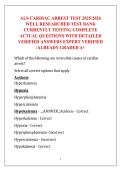
ALS CARDIAC ARREST TEST 2025/2026
WELL RESEARCHED TEST BANK
CURRENTLY TESTING COMPLETE
ACTUAL QUESTIONS WITH DETAILED
VERIFIED ANSWERS EXPERT VERIFIED
/ALREADY GRADED A+
Which of the following are reversible causes of cardiac
arrest?
Select all correct options that apply.
Acidosis
Hyperkalemia
Hypoxia
Hyperphosphatemia
Hypercalcemia
Hypokalemia - ....ANSWER...Acidosis - Correct
Hyperkalemia - Correct
Hypoxia - Correct
Hyperphosphatemia - Incorrect
Hypercalcemia - Incorrect
Hypokalemia - Correct
1
,Current recommendations suggest that hypotension should
be treated in a post-cardiac arrest patient when the
systolic blood pressure is less than 90 mmHg or the mean
arterial pressure (MAP) is less than: - ....ANSWER...65
mmHg
A 28-year-old patient (27 weeks' gestation) was admitted
to the intensive care unit for treatment of pneumonia-
related sepsis. The patient goes into cardiac arrest. When
should resuscitative cesarean delivery (RCD) be
performed? - ....ANSWER...Within 5 minutes from the
time of arrest
Which of the following factors should be taken into
consideration when determining whether to continue the
resuscitation effort?
Select all correct options that apply.
-The initial cardiac arrest rhythm
-Physiologic data
-The skill of the resuscitation team
-The patient's health status prior to cardiac arrest
-The duration of the resuscitation effort
2
, -The underlying cause of the arrest - ....ANSWER...The
initial cardiac arrest rhythm - Correct
Physiologic data - Correct
The skill of the resuscitation team - Incorrect
The patient's health status prior to cardiac arrest - Correct
The duration of the resuscitation effort - Correct
The underlying cause of the arrest - Correct
The pathophysiologic consequences of cardiac arrest
comprise what key areas?
Select all correct options that apply.
-Myocardial dysfunction
-Pulmonary dysfunction
-Systemic dysfunction
-Brain injury - ....ANSWER...Myocardial dysfunction -
Correct
Pulmonary dysfunction - Incorrect
Systemic dysfunction - Correct
Brain injury - Correct
What initial interventions are appropriate for the initial
stabilization of a patient who has achieved return of
spontaneous circulation (ROSC)?
3
WELL RESEARCHED TEST BANK
CURRENTLY TESTING COMPLETE
ACTUAL QUESTIONS WITH DETAILED
VERIFIED ANSWERS EXPERT VERIFIED
/ALREADY GRADED A+
Which of the following are reversible causes of cardiac
arrest?
Select all correct options that apply.
Acidosis
Hyperkalemia
Hypoxia
Hyperphosphatemia
Hypercalcemia
Hypokalemia - ....ANSWER...Acidosis - Correct
Hyperkalemia - Correct
Hypoxia - Correct
Hyperphosphatemia - Incorrect
Hypercalcemia - Incorrect
Hypokalemia - Correct
1
,Current recommendations suggest that hypotension should
be treated in a post-cardiac arrest patient when the
systolic blood pressure is less than 90 mmHg or the mean
arterial pressure (MAP) is less than: - ....ANSWER...65
mmHg
A 28-year-old patient (27 weeks' gestation) was admitted
to the intensive care unit for treatment of pneumonia-
related sepsis. The patient goes into cardiac arrest. When
should resuscitative cesarean delivery (RCD) be
performed? - ....ANSWER...Within 5 minutes from the
time of arrest
Which of the following factors should be taken into
consideration when determining whether to continue the
resuscitation effort?
Select all correct options that apply.
-The initial cardiac arrest rhythm
-Physiologic data
-The skill of the resuscitation team
-The patient's health status prior to cardiac arrest
-The duration of the resuscitation effort
2
, -The underlying cause of the arrest - ....ANSWER...The
initial cardiac arrest rhythm - Correct
Physiologic data - Correct
The skill of the resuscitation team - Incorrect
The patient's health status prior to cardiac arrest - Correct
The duration of the resuscitation effort - Correct
The underlying cause of the arrest - Correct
The pathophysiologic consequences of cardiac arrest
comprise what key areas?
Select all correct options that apply.
-Myocardial dysfunction
-Pulmonary dysfunction
-Systemic dysfunction
-Brain injury - ....ANSWER...Myocardial dysfunction -
Correct
Pulmonary dysfunction - Incorrect
Systemic dysfunction - Correct
Brain injury - Correct
What initial interventions are appropriate for the initial
stabilization of a patient who has achieved return of
spontaneous circulation (ROSC)?
3


