
2026/2027|| Fully Verified AnswersSeparation Science Answer Keyverified
Fully Verified
questions
Solutions
and answers! | Fully Verified Answers
Separation Science
Question 1. (Source – Pre-2020)
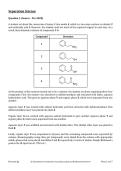
A student set about the conversion of amine 1 into amide 4, which is a two-step reaction via alcohol 2
and carboxylic acid 3. However, the student used too much of the required reagent in each step. As a
result, they obtained a mixture of compounds 1-4.
Compound Structure
1
2
3
4
As the product of this reaction turned out to be a mixture, the student set about separating these four
compounds. First, the mixture was dissolved in dichloromethane and extracted with dilute, aqueous
hydrochloric acid. This gave an aqueous phase V and organic phase X, which were separated from one
another.
Aqueous layer V was treated with sodium hydroxide and then extracted with dichloromethane. This
dichloromethane layer was placed into flask A.
Organic layer X was washed with aqueous sodium hydroxide to give another aqueous phase Y and
organic phase Z, which were separated from one another.
Aqueous layer Y was acidified and extracted with diethyl ether. This diethyl ether layer was placed in
flask B.
Lastly, organic layer Z was evaporated to dryness and the remaining compounds were separated by
column chromatography using silica gel. Compounds were eluted from the column with appropriate
mobile phases that were placed into flasks C and D, respectively, in order of elution. Sample D showed a
peak in the IR spectrum at 1750 cm-1.
PRACTICE QS © DEPARTMENT OF CHEMISTRY AND CHEMICAL BIOLOGY MCMASTER UNIVERSITY PAGE 1 OF 17
. Complete exam prep, practice resources, and updated study guides included
| Fully Verified
for effective
Answers
assessment preparation. Page 1 of 15
, 2026/2027|| Fully Verified AnswersSeparation Science Answer Keyverified
Fully Verified
questions
Solutions
and answers! | Fully Verified Answers
Indicate the NUMBER(S) of the compound(s) that ended up in each flask.
Flask Compound
A 1
B 3
C 2
D 4
PRACTICE QS © DEPARTMENT OF CHEMISTRY AND CHEMICAL BIOLOGY MCMASTER UNIVERSITY PAGE 2 OF 17
. Complete exam prep, practice resources, and updated study guides included
| Fully Verified
for effective
Answers
assessment preparation. Page 2 of 15
Fully Verified
questions
Solutions
and answers! | Fully Verified Answers
Separation Science
Question 1. (Source – Pre-2020)
A student set about the conversion of amine 1 into amide 4, which is a two-step reaction via alcohol 2
and carboxylic acid 3. However, the student used too much of the required reagent in each step. As a
result, they obtained a mixture of compounds 1-4.
Compound Structure
1
2
3
4
As the product of this reaction turned out to be a mixture, the student set about separating these four
compounds. First, the mixture was dissolved in dichloromethane and extracted with dilute, aqueous
hydrochloric acid. This gave an aqueous phase V and organic phase X, which were separated from one
another.
Aqueous layer V was treated with sodium hydroxide and then extracted with dichloromethane. This
dichloromethane layer was placed into flask A.
Organic layer X was washed with aqueous sodium hydroxide to give another aqueous phase Y and
organic phase Z, which were separated from one another.
Aqueous layer Y was acidified and extracted with diethyl ether. This diethyl ether layer was placed in
flask B.
Lastly, organic layer Z was evaporated to dryness and the remaining compounds were separated by
column chromatography using silica gel. Compounds were eluted from the column with appropriate
mobile phases that were placed into flasks C and D, respectively, in order of elution. Sample D showed a
peak in the IR spectrum at 1750 cm-1.
PRACTICE QS © DEPARTMENT OF CHEMISTRY AND CHEMICAL BIOLOGY MCMASTER UNIVERSITY PAGE 1 OF 17
. Complete exam prep, practice resources, and updated study guides included
| Fully Verified
for effective
Answers
assessment preparation. Page 1 of 15
, 2026/2027|| Fully Verified AnswersSeparation Science Answer Keyverified
Fully Verified
questions
Solutions
and answers! | Fully Verified Answers
Indicate the NUMBER(S) of the compound(s) that ended up in each flask.
Flask Compound
A 1
B 3
C 2
D 4
PRACTICE QS © DEPARTMENT OF CHEMISTRY AND CHEMICAL BIOLOGY MCMASTER UNIVERSITY PAGE 2 OF 17
. Complete exam prep, practice resources, and updated study guides included
| Fully Verified
for effective
Answers
assessment preparation. Page 2 of 15


