
Introduction to Professional Nursing Final (NU110)
– Questions With Objective Solutions
Save
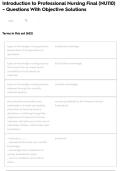
Terms in this set (652)
types of knowledge: nursing practice traditional knowledge
passed down from generation to
generation
types of knowledge: nursing practice authoritative knowledge
that comes from an expert and is
accepted as a truth based on
expertise
types of knowledge: nursing practice scientific knowledge
obtained through the scientific
method/research
the protection, promotion, and nursing (as defined by the American Nurses'
optimization of health and abilities, Association)
prevention of illness and injury,
alleviation of suffering through the
diagnosis and treatment of human
response, and advocacy in the care of
individuals, families, communities, and
populations
nursing as a _____ = profession
- specialized technical and scientific
knowledge
- knowledge and competence of
groups evaluated by peers
- service orientation and code of
ethics
,nursing as a _____ = discipline
- body of knowledge with theoretical
and practical boundaries
- clinical practice questions drive
research, which results in evidence
that helps to guide safe practice
nursing as a _____ = occupation
- job in which the nurse is employed
- employer determines practice
conditions and job responsibilities
what does QSEN stand for? quality and safety education for nurses
what does KSAs stand for? knowledge, skills, and attitudes
who created KSAs? QSEN
_____ needed for continuous KSAs
improvement in safety and quality
include:
- patient-centered care
- teamwork / collaboration
- evidence-based practice
- quality improvement
- safety
- informatics
Carper's Fundamental Patterns of empirics, esthetics, personal knowledge, ethics
Knowing in Nursing (4)
Carper's Fundamental Patterns of empirics
Knowing in Nursing: the science of
nursing (aimed at developing
abstract/theoretical explanations
about the health and illness of
humans)
,Carper's Fundamental Patterns of esthetics
Knowing in Nursing: the art of nursing
(perception that goes beyond
recognition of human experiences;
emphasis on empathy)
Carper's Fundamental Patterns of personal knowledge
Knowing in Nursing: self-knowledge
(nurse must understand self in order
to understand/accept the client)
Carper's Fundamental Patterns of ethics
Knowing in Nursing: moral knowledge
(ability to make choices within
concrete situations)
what does NANDA stand for? North American Nursing Diagnosis Association
who created the nursing process? NANDA
the nursing process (ADPIE) assessment, diagnosis, planning, implementation,
evaluation
steps in the nursing process: looking assessment
at the whole person
steps in the nursing process: analysis diagnosis
of data taken during assessment
(identify patient strengths and health
problems, formulate/validate
conclusions made)
steps in the nursing process: forming a planning
plan based upon assessment and
diagnosis
steps in the nursing process: carrying implementation
out the plan that was made
, steps in the nursing process: evaluation
measuring patient progress following
implementation of the plan (did the
plan work?)
blended competencies (4) cognitive, technical, interpersonal, ethical/legal
blended competencies: critical cognitive
thinking (ability to reason and identify
scientific rationale to achieve goals of
care)
blended competencies: hands-on technical
skills (skill use of equipment and the
ability to adapt to meet patient needs
as not all are treated the same)
blended competencies: interpersonal
communication (development of
caring relationships through effective
communication and collaboration)
blended competencies: informs ethical/legal
nursing practice (following personal
and professional moral codes)
nursing during ancient civilization: theory of animism
theory that elements of nature are
alive and possess power (attempted
to explain the causes of mysterious
health changes)
nursing during ancient civilization: the medicine man
physician was considered the _____ _____
nursing during ancient civilization: the separate and distinct
roles of the physician and the nurse
were _____ and _____
– Questions With Objective Solutions
Save
Terms in this set (652)
types of knowledge: nursing practice traditional knowledge
passed down from generation to
generation
types of knowledge: nursing practice authoritative knowledge
that comes from an expert and is
accepted as a truth based on
expertise
types of knowledge: nursing practice scientific knowledge
obtained through the scientific
method/research
the protection, promotion, and nursing (as defined by the American Nurses'
optimization of health and abilities, Association)
prevention of illness and injury,
alleviation of suffering through the
diagnosis and treatment of human
response, and advocacy in the care of
individuals, families, communities, and
populations
nursing as a _____ = profession
- specialized technical and scientific
knowledge
- knowledge and competence of
groups evaluated by peers
- service orientation and code of
ethics
,nursing as a _____ = discipline
- body of knowledge with theoretical
and practical boundaries
- clinical practice questions drive
research, which results in evidence
that helps to guide safe practice
nursing as a _____ = occupation
- job in which the nurse is employed
- employer determines practice
conditions and job responsibilities
what does QSEN stand for? quality and safety education for nurses
what does KSAs stand for? knowledge, skills, and attitudes
who created KSAs? QSEN
_____ needed for continuous KSAs
improvement in safety and quality
include:
- patient-centered care
- teamwork / collaboration
- evidence-based practice
- quality improvement
- safety
- informatics
Carper's Fundamental Patterns of empirics, esthetics, personal knowledge, ethics
Knowing in Nursing (4)
Carper's Fundamental Patterns of empirics
Knowing in Nursing: the science of
nursing (aimed at developing
abstract/theoretical explanations
about the health and illness of
humans)
,Carper's Fundamental Patterns of esthetics
Knowing in Nursing: the art of nursing
(perception that goes beyond
recognition of human experiences;
emphasis on empathy)
Carper's Fundamental Patterns of personal knowledge
Knowing in Nursing: self-knowledge
(nurse must understand self in order
to understand/accept the client)
Carper's Fundamental Patterns of ethics
Knowing in Nursing: moral knowledge
(ability to make choices within
concrete situations)
what does NANDA stand for? North American Nursing Diagnosis Association
who created the nursing process? NANDA
the nursing process (ADPIE) assessment, diagnosis, planning, implementation,
evaluation
steps in the nursing process: looking assessment
at the whole person
steps in the nursing process: analysis diagnosis
of data taken during assessment
(identify patient strengths and health
problems, formulate/validate
conclusions made)
steps in the nursing process: forming a planning
plan based upon assessment and
diagnosis
steps in the nursing process: carrying implementation
out the plan that was made
, steps in the nursing process: evaluation
measuring patient progress following
implementation of the plan (did the
plan work?)
blended competencies (4) cognitive, technical, interpersonal, ethical/legal
blended competencies: critical cognitive
thinking (ability to reason and identify
scientific rationale to achieve goals of
care)
blended competencies: hands-on technical
skills (skill use of equipment and the
ability to adapt to meet patient needs
as not all are treated the same)
blended competencies: interpersonal
communication (development of
caring relationships through effective
communication and collaboration)
blended competencies: informs ethical/legal
nursing practice (following personal
and professional moral codes)
nursing during ancient civilization: theory of animism
theory that elements of nature are
alive and possess power (attempted
to explain the causes of mysterious
health changes)
nursing during ancient civilization: the medicine man
physician was considered the _____ _____
nursing during ancient civilization: the separate and distinct
roles of the physician and the nurse
were _____ and _____


