
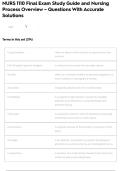
NURS 1110 Final Exam Study Guide and Nursing
Process Overview – Questions With Accurate
Solutions
Save
Terms in this set (374)
Cryptorchidism refers to failure of the testicles to descend into the
scrotum.
PSA (Prostate-Specific Antigen) is a blood test to screen for prostate cancer.
Sterility refers to a woman's inability to become pregnant or a
man's inability to impregnate a woman.
Anorchism Congenital absence of one or both testes.
Candidiasis is a vaginal fungal infection caused by Candida
albicans and marked by a curdy discharge and
extreme itching.
Chlamydia is caused by infection with the bacterium Chlamydia
trachomatis and occurs in both sexes.
Circumcision is surgical removal of the foreskin or prepuce of the
penis.
Cerclage is an obstetric procedure to prevent spontaneous
abortion in a woman who has an incompetent cervix.
Lumpectomy is excision of a small primary breast tumor and some
of the normal surrounding tissue.
,Endometriosis is a condition in which endometrial tissue is found in
various abnormal sites throughout the pelvis or in the
abdominal wall.
Mammography refers to x-ray of the breast; used to diagnose benign
and malignant tumors.
Gonorrhea is a sexually transmitted infection (STI) caused by the
bacterium Neisseria gonorrhoeae that most
commonly affects the genitourinary tract.
Syphilis is an STI characterized initially by a skin lesion
(chancre).
TSS (Toxic Shock Syndrome) is a rare, sometimes fatal staphylococcal infection
that occurs in menstruating women who use vaginal
tampons.
Trichomoniasis is a protozoal infestation of the vagina, urethra, or
prostate.
D&C (Dilation and Curettage) refers to widening of the uterine cervix so that the
surface lining of the uterus can be scraped.
Phimosis means stenosis of the preputial orifice so that the
foreskin does not retract over the glans penis.
Impotence refers to the inability of a man to achieve a penile
erection.
Preeclampsia is a nonconvulsive form of gestational hypertension.
Fistula is an abnormal passageway between two body
cavities.
Total Calcium A blood test to detect bone and parathyroid
abnormalities.
,Type 1 Diabetes An autoimmune disease caused by failure of the
pancreas to produce insulin.
Cretinism is a congenital condition characterized by severe
hypothyroidism commonly associated with other
endocrine disorders.
Exophthalmos is a condition characterized by protrusion of the
eyeball.
Insulinoma A tumor of the pancreas.
Myxedema A severe form of hypothyroidism in adults.
TFT (Thyroid Function Test) Measures thyroid hormone levels in the blood.
Cushing Syndrome is caused by excessive amounts of cortisol or
adrenocorticotropic hormone (ACTH) circulating in
blood.
Panhypopituitarism brings about progressive and general loss of
hormone activity.
HRT (Hormone Replacement Therapy) is used to correct hormone deficiencies.
Addison Disease is caused by deficiency of cortical hormones as a
result of hypofunctioning of the adrenal cortex.
FBG (Fasting Blood Glucose) measures blood glucose levels after fasting at least 8
hours.
Pheochromocytoma is a rare adrenal gland tumor that induces severe
blood pressure elevation.
Pancreatitis is most commonly caused by alcoholism and biliary
tract disease.
, Type 2 Diabetes usually appears in middle age and is caused by
deficiency of insulin production.
Osteoporosis means decrease in bone density and an increase in
porosity, causing the risk of fractures.
Tendinitis Inflammation of a tendon.
Sprain refers to trauma to a joint, causing injury to the
surrounding ligament.
Strain refers to muscular trauma that results from overuse or
excessive, forcible stretch.
Kyphosis means hunchback or humpback.
Ewing sarcoma A malignant tumor that develops from bone marrow,
usually in the long bones or the pelvis, and occurs
most commonly in adolescent boys.
torticollis Also called wryneck.
gout A disease characterized by excessive uric acid in
blood and around the joints.
RA (Rheumatoid Arthritis) A disease characterized by inflammatory changes in
joints and related structures that result in crippling
deformities.
Paget disease Refers to abnormal bone destruction that results in
deformity; also called osteitis deformans.
sequestrum A fragment of necrosed bone that has become
separated from surrounding tissue.
arthroplasty Means repair or replacement of a joint.
Process Overview – Questions With Accurate
Solutions
Save
Terms in this set (374)
Cryptorchidism refers to failure of the testicles to descend into the
scrotum.
PSA (Prostate-Specific Antigen) is a blood test to screen for prostate cancer.
Sterility refers to a woman's inability to become pregnant or a
man's inability to impregnate a woman.
Anorchism Congenital absence of one or both testes.
Candidiasis is a vaginal fungal infection caused by Candida
albicans and marked by a curdy discharge and
extreme itching.
Chlamydia is caused by infection with the bacterium Chlamydia
trachomatis and occurs in both sexes.
Circumcision is surgical removal of the foreskin or prepuce of the
penis.
Cerclage is an obstetric procedure to prevent spontaneous
abortion in a woman who has an incompetent cervix.
Lumpectomy is excision of a small primary breast tumor and some
of the normal surrounding tissue.
,Endometriosis is a condition in which endometrial tissue is found in
various abnormal sites throughout the pelvis or in the
abdominal wall.
Mammography refers to x-ray of the breast; used to diagnose benign
and malignant tumors.
Gonorrhea is a sexually transmitted infection (STI) caused by the
bacterium Neisseria gonorrhoeae that most
commonly affects the genitourinary tract.
Syphilis is an STI characterized initially by a skin lesion
(chancre).
TSS (Toxic Shock Syndrome) is a rare, sometimes fatal staphylococcal infection
that occurs in menstruating women who use vaginal
tampons.
Trichomoniasis is a protozoal infestation of the vagina, urethra, or
prostate.
D&C (Dilation and Curettage) refers to widening of the uterine cervix so that the
surface lining of the uterus can be scraped.
Phimosis means stenosis of the preputial orifice so that the
foreskin does not retract over the glans penis.
Impotence refers to the inability of a man to achieve a penile
erection.
Preeclampsia is a nonconvulsive form of gestational hypertension.
Fistula is an abnormal passageway between two body
cavities.
Total Calcium A blood test to detect bone and parathyroid
abnormalities.
,Type 1 Diabetes An autoimmune disease caused by failure of the
pancreas to produce insulin.
Cretinism is a congenital condition characterized by severe
hypothyroidism commonly associated with other
endocrine disorders.
Exophthalmos is a condition characterized by protrusion of the
eyeball.
Insulinoma A tumor of the pancreas.
Myxedema A severe form of hypothyroidism in adults.
TFT (Thyroid Function Test) Measures thyroid hormone levels in the blood.
Cushing Syndrome is caused by excessive amounts of cortisol or
adrenocorticotropic hormone (ACTH) circulating in
blood.
Panhypopituitarism brings about progressive and general loss of
hormone activity.
HRT (Hormone Replacement Therapy) is used to correct hormone deficiencies.
Addison Disease is caused by deficiency of cortical hormones as a
result of hypofunctioning of the adrenal cortex.
FBG (Fasting Blood Glucose) measures blood glucose levels after fasting at least 8
hours.
Pheochromocytoma is a rare adrenal gland tumor that induces severe
blood pressure elevation.
Pancreatitis is most commonly caused by alcoholism and biliary
tract disease.
, Type 2 Diabetes usually appears in middle age and is caused by
deficiency of insulin production.
Osteoporosis means decrease in bone density and an increase in
porosity, causing the risk of fractures.
Tendinitis Inflammation of a tendon.
Sprain refers to trauma to a joint, causing injury to the
surrounding ligament.
Strain refers to muscular trauma that results from overuse or
excessive, forcible stretch.
Kyphosis means hunchback or humpback.
Ewing sarcoma A malignant tumor that develops from bone marrow,
usually in the long bones or the pelvis, and occurs
most commonly in adolescent boys.
torticollis Also called wryneck.
gout A disease characterized by excessive uric acid in
blood and around the joints.
RA (Rheumatoid Arthritis) A disease characterized by inflammatory changes in
joints and related structures that result in crippling
deformities.
Paget disease Refers to abnormal bone destruction that results in
deformity; also called osteitis deformans.
sequestrum A fragment of necrosed bone that has become
separated from surrounding tissue.
arthroplasty Means repair or replacement of a joint.


