Organic Chemistry 32-235
Practice Questions for Exam #2
Part 1: (Circle only ONE choice, circling more than one will be counted as wrong!)
4 points each
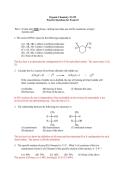
1. The correct IUPAC name for the following compound is:
(A) (1R, 3R)-1-chloro-3-methylcyclohexane H CH3
(B) (1R, 3S)-1-chloro-3-methylcyclohexane Cl H
(C) (1S, 3S)-1-chloro-3-methylcyclohexane
(D) (1S, 3R)-1-chloro-3-methylcyclohexane
(E) None of the above.
The Key here is to determine the configuration R or S for each chiral carbon. The answer here is 1S,
2S.
2. Consider the SN1 reaction of tert-butyl chloride with iodide ion:
(CH3)3C Cl + I (CH3)3C I + Cl
If the concentration of iodide ion is doubled, the rate of forming tert-butyl iodide will:
(hint: consider mechanism, i.e. how is the product formed?)
(A) Double. (B) Increase 4 times. (C) Remain the same.
(D) Decrease. (E) None of the above.
In SN1 reaction, the rate is independent of the nucleophile involved since the nucleophile is not
involved in the rate determining step. Thus the anwer is C.
3. The relationship between the following two structures is:
CH3 CH3
H OH HO H
H OH H OH
CH3 CH3
(A) enantiomers (B) diastereomers (C) structural isomers
(D) identical (E) none of the above
The key here is to know the definition of all terms and then determine R or S configuration for each
chiral carbon. The answer is (B) (by definition)
4. The specific rotation of pure (R)-2-butanol is -13.5°. What % of a mixture of the two
enantiomeric forms is (S)-2-butanol if the specific rotation of this mixture is -5.4° ?
(A) 40% (B) 30% (C) 60% (D) 70% (E) None of the above
The answer is B since e.e. is 40% favoring R. (5.4/13.5=40%)
, 5. Which of the following alkyl halides would undergo SN2 reaction most rapidly?
(A) CH3CH2-Br (B) CH3CH2- Cl (C) CH3CH2-I
(D) CH3CH2-F (E) they react at the same rate
In Sn2 reaction, the nucleophile attacks from the back of the leaving group. The better the leaving
group, the easier it is to leave (faster rate). The answer is C since iodide ion is the best leaving
group.
6. Which of the following molecules is chiral ?
CH3 CH3 CH3 H OH
H H H CH3 CH3
(A) (B) (C)
CH3 CH3 CH3 H
C C C C
H H H CH3
(D) (E)
Go by definition or look for plane of symmetry/point of inversion. The answer is B.
7. The relationship between (A) and (B) structures in the previous question is:
A) identical
B) structural isomers
C) diastereomers
D) enantiomers
E) None of the above
Again need to know terms and how to apply them. The answer is C.
Page 2/9
Practice Questions for Exam #2
Part 1: (Circle only ONE choice, circling more than one will be counted as wrong!)
4 points each
1. The correct IUPAC name for the following compound is:
(A) (1R, 3R)-1-chloro-3-methylcyclohexane H CH3
(B) (1R, 3S)-1-chloro-3-methylcyclohexane Cl H
(C) (1S, 3S)-1-chloro-3-methylcyclohexane
(D) (1S, 3R)-1-chloro-3-methylcyclohexane
(E) None of the above.
The Key here is to determine the configuration R or S for each chiral carbon. The answer here is 1S,
2S.
2. Consider the SN1 reaction of tert-butyl chloride with iodide ion:
(CH3)3C Cl + I (CH3)3C I + Cl
If the concentration of iodide ion is doubled, the rate of forming tert-butyl iodide will:
(hint: consider mechanism, i.e. how is the product formed?)
(A) Double. (B) Increase 4 times. (C) Remain the same.
(D) Decrease. (E) None of the above.
In SN1 reaction, the rate is independent of the nucleophile involved since the nucleophile is not
involved in the rate determining step. Thus the anwer is C.
3. The relationship between the following two structures is:
CH3 CH3
H OH HO H
H OH H OH
CH3 CH3
(A) enantiomers (B) diastereomers (C) structural isomers
(D) identical (E) none of the above
The key here is to know the definition of all terms and then determine R or S configuration for each
chiral carbon. The answer is (B) (by definition)
4. The specific rotation of pure (R)-2-butanol is -13.5°. What % of a mixture of the two
enantiomeric forms is (S)-2-butanol if the specific rotation of this mixture is -5.4° ?
(A) 40% (B) 30% (C) 60% (D) 70% (E) None of the above
The answer is B since e.e. is 40% favoring R. (5.4/13.5=40%)
, 5. Which of the following alkyl halides would undergo SN2 reaction most rapidly?
(A) CH3CH2-Br (B) CH3CH2- Cl (C) CH3CH2-I
(D) CH3CH2-F (E) they react at the same rate
In Sn2 reaction, the nucleophile attacks from the back of the leaving group. The better the leaving
group, the easier it is to leave (faster rate). The answer is C since iodide ion is the best leaving
group.
6. Which of the following molecules is chiral ?
CH3 CH3 CH3 H OH
H H H CH3 CH3
(A) (B) (C)
CH3 CH3 CH3 H
C C C C
H H H CH3
(D) (E)
Go by definition or look for plane of symmetry/point of inversion. The answer is B.
7. The relationship between (A) and (B) structures in the previous question is:
A) identical
B) structural isomers
C) diastereomers
D) enantiomers
E) None of the above
Again need to know terms and how to apply them. The answer is C.
Page 2/9