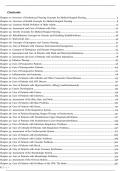
, CHAPTER LIST
Chapter 1: Neuroanatomy (Paul Johns & Gemma Northam)
Chapter 2: Neurophysiology (Pedro F. Viana & Nandini Mullatti)
Chapter 3: Neuropharmacology and Neurochemistry (David Cunningham
Owens & Katie Marwick)
Chapter 4: Structural and Functional Neuroimaging in Psychiatry (Sukhi
Sherghill & Raka Maitra)
Chapter 5: Neuropsychology (Martin van den Broek)
Chapter 6: Neurodevelopment (Norman A. Poole)
Chapter 7: Neurogenetics (David Curtis)
Chapter 8: Neurophilosophy: Neuroscience, Non-reductionism and
Psychiatry (Norman A. Poole & Derek B. Bolton)
Chapter 9: Neuroimmunology (Adam Al-Diwani, Toby Pillinger, Alasdair Coles
& Belinda Lennox)
Chapter 10: Neuroendocrinology (Andrea Nani & Andrea E. Cavanna)
Chapter 11: Neuroscience of Sleep (Valentina Gnoni, Danielle Wasserman,
Hugh Selsick & Ivana Rosenzweig)
Chapter 12: Basic Human Behaviours: Eating and Addiction (Samantha
Scholtz)
,Chapter 1: Neuroanatomy
Question 1
A patient with traumatic brain injury exhibits impulsivity, poor judgment,
emotional lability, and socially inappropriate behavior. Which cortical region is
most likely affected?
A. Primary somatosensory cortex
B. Dorsolateral prefrontal cortex
C. Orbitofrontal cortex
D. Posterior parietal cortex
Answer: C
Rationale:
The orbitofrontal cortex (OFC) integrates emotional signals from the limbic
system with decision-making and social behavior. Damage leads to
disinhibition, impulsivity, and poor social judgment, classic in psychiatric
presentations such as personality change after frontal injury. The dorsolateral
prefrontal cortex is more involved in executive planning and working memory.
Key words: Orbitofrontal cortex, disinhibition, frontal lobe, social behavior,
impulsivity
Question 2
Which limbic structure is most directly responsible for assigning emotional
salience to sensory stimuli and is hyperactive in anxiety disorders?
A. Hippocampus
B. Amygdala
C. Mammillary bodies
D. Anterior cingulate cortex
Answer: B
,Rationale:
The amygdala plays a central role in fear conditioning, threat detection, and
emotional salience. Hyperactivity is well documented in anxiety disorders,
PTSD, and phobias. The hippocampus is more involved in contextual memory,
while the anterior cingulate regulates emotional conflict.
Key words: Amygdala, fear processing, anxiety, emotional salience, PTSD
Question 3
A patient presents with apathy, reduced motivation, and diminished goal-
directed behavior following a stroke. Damage to which circuit best explains
these symptoms?
A. Corticospinal tract
B. Mesolimbic dopaminergic pathway
C. Nigrostriatal pathway
D. Spinothalamic tract
Answer: B
Rationale:
The mesolimbic dopamine pathway (ventral tegmental area → nucleus
accumbens) mediates reward, motivation, and reinforcement. Disruption
results in apathy and anhedonia, frequently seen in depression and frontal–
subcortical syndromes.
Key words: Mesolimbic pathway, motivation, apathy, dopamine, reward
Question 4
Which basal ganglia structure primarily modulates movement initiation and is
implicated in psychomotor retardation seen in depression?
A. Subthalamic nucleus
B. Globus pallidus interna
C. Caudate nucleus
D. Putamen
Answer: C
,Rationale:
The caudate nucleus integrates cognitive and emotional input with motor
planning. Dysfunction contributes to psychomotor slowing in depression and
executive deficits in psychiatric disorders. The putamen is more purely motor-
related.
Key words: Caudate nucleus, psychomotor retardation, basal ganglia,
depression
Question 5
Which thalamic nucleus is most involved in relaying limbic information to the
prefrontal cortex?
A. Ventral posterolateral nucleus
B. Mediodorsal nucleus
C. Lateral geniculate nucleus
D. Ventral anterior nucleus
Answer: B
Rationale:
The mediodorsal thalamic nucleus connects limbic structures (amygdala,
hippocampus) to the prefrontal cortex and is critical for emotional regulation
and cognition. Damage can cause affective flattening and executive
dysfunction.
Key words: Mediodorsal thalamus, limbic relay, emotion regulation, cognition
Question 6
Which brainstem structure is the primary source of serotonergic projections
implicated in mood and anxiety regulation?
A. Locus coeruleus
B. Raphe nuclei
C. Substantia nigra
D. Ventral tegmental area
Answer: B
,Rationale:
The raphe nuclei are the main source of serotonin in the CNS. Serotonergic
dysfunction is central to depression, anxiety disorders, and the mechanism of
action of SSRIs.
Key words: Raphe nuclei, serotonin, mood disorders, anxiety
Question 7
Damage to the hippocampus would most directly impair which psychiatric
function?
A. Fear conditioning
B. Emotional regulation
C. Formation of new declarative memories
D. Reward processing
Answer: C
Rationale:
The hippocampus is essential for encoding new declarative memories.
Hippocampal atrophy is observed in chronic depression and PTSD,
contributing to memory deficits and impaired contextual processing.
Key words: Hippocampus, memory formation, PTSD, depression
Question 8
Which cortical region is most strongly associated with working memory deficits
in schizophrenia?
A. Orbitofrontal cortex
B. Primary motor cortex
C. Dorsolateral prefrontal cortex
D. Insular cortex
Answer: C
Rationale:
The dorsolateral prefrontal cortex (DLPFC) supports working memory,
,planning, and executive control. Hypofrontality in schizophrenia explains
cognitive deficits and poor goal-directed behavior.
Key words: DLPFC, working memory, schizophrenia, executive function
Question 9
A lesion affecting the anterior cingulate cortex would most likely result in:
A. Loss of pain sensation
B. Severe amnesia
C. Impaired emotional regulation and motivation
D. Visual field defects
Answer: C
Rationale:
The anterior cingulate cortex integrates emotion, motivation, and attention.
Damage results in apathy, emotional blunting, and reduced initiative,
commonly seen in frontal lobe syndromes.
Key words: Anterior cingulate cortex, motivation, emotional regulation
Question 10
Which neurotransmitter system arising from the locus coeruleus is primarily
involved in arousal and stress responses?
A. Dopamine
B. Serotonin
C. Norepinephrine
D. Acetylcholine
Answer: C
Rationale:
The locus coeruleus provides widespread noradrenergic projections,
regulating arousal, vigilance, and stress. Hyperactivity contributes to anxiety
and PTSD symptoms.
Key words: Locus coeruleus, norepinephrine, arousal, stress
, Question 11
Which structure links the hypothalamus to the hippocampus and plays a role
in emotional memory?
A. Fornix
B. Internal capsule
C. Corpus callosum
D. Mammillothalamic tract
Answer: A
Rationale:
The fornix is a major output pathway of the hippocampus connecting to the
hypothalamus, crucial for emotional memory processing. Damage is
associated with memory impairment.
Key words: Fornix, hippocampus, emotional memory
Question 12
Which basal ganglia pathway is associated with motor inhibition and is
overactive in Parkinson disease?
A. Direct pathway
B. Indirect pathway
C. Mesolimbic pathway
D. Corticospinal pathway
Answer: B
Rationale:
The indirect pathway suppresses movement. In Parkinson disease, dopamine
depletion leads to overactivity of the indirect pathway, resulting in
bradykinesia and rigidity.
Key words: Indirect pathway, basal ganglia, Parkinson disease
Question 13
Chapter 1: Neuroanatomy (Paul Johns & Gemma Northam)
Chapter 2: Neurophysiology (Pedro F. Viana & Nandini Mullatti)
Chapter 3: Neuropharmacology and Neurochemistry (David Cunningham
Owens & Katie Marwick)
Chapter 4: Structural and Functional Neuroimaging in Psychiatry (Sukhi
Sherghill & Raka Maitra)
Chapter 5: Neuropsychology (Martin van den Broek)
Chapter 6: Neurodevelopment (Norman A. Poole)
Chapter 7: Neurogenetics (David Curtis)
Chapter 8: Neurophilosophy: Neuroscience, Non-reductionism and
Psychiatry (Norman A. Poole & Derek B. Bolton)
Chapter 9: Neuroimmunology (Adam Al-Diwani, Toby Pillinger, Alasdair Coles
& Belinda Lennox)
Chapter 10: Neuroendocrinology (Andrea Nani & Andrea E. Cavanna)
Chapter 11: Neuroscience of Sleep (Valentina Gnoni, Danielle Wasserman,
Hugh Selsick & Ivana Rosenzweig)
Chapter 12: Basic Human Behaviours: Eating and Addiction (Samantha
Scholtz)
,Chapter 1: Neuroanatomy
Question 1
A patient with traumatic brain injury exhibits impulsivity, poor judgment,
emotional lability, and socially inappropriate behavior. Which cortical region is
most likely affected?
A. Primary somatosensory cortex
B. Dorsolateral prefrontal cortex
C. Orbitofrontal cortex
D. Posterior parietal cortex
Answer: C
Rationale:
The orbitofrontal cortex (OFC) integrates emotional signals from the limbic
system with decision-making and social behavior. Damage leads to
disinhibition, impulsivity, and poor social judgment, classic in psychiatric
presentations such as personality change after frontal injury. The dorsolateral
prefrontal cortex is more involved in executive planning and working memory.
Key words: Orbitofrontal cortex, disinhibition, frontal lobe, social behavior,
impulsivity
Question 2
Which limbic structure is most directly responsible for assigning emotional
salience to sensory stimuli and is hyperactive in anxiety disorders?
A. Hippocampus
B. Amygdala
C. Mammillary bodies
D. Anterior cingulate cortex
Answer: B
,Rationale:
The amygdala plays a central role in fear conditioning, threat detection, and
emotional salience. Hyperactivity is well documented in anxiety disorders,
PTSD, and phobias. The hippocampus is more involved in contextual memory,
while the anterior cingulate regulates emotional conflict.
Key words: Amygdala, fear processing, anxiety, emotional salience, PTSD
Question 3
A patient presents with apathy, reduced motivation, and diminished goal-
directed behavior following a stroke. Damage to which circuit best explains
these symptoms?
A. Corticospinal tract
B. Mesolimbic dopaminergic pathway
C. Nigrostriatal pathway
D. Spinothalamic tract
Answer: B
Rationale:
The mesolimbic dopamine pathway (ventral tegmental area → nucleus
accumbens) mediates reward, motivation, and reinforcement. Disruption
results in apathy and anhedonia, frequently seen in depression and frontal–
subcortical syndromes.
Key words: Mesolimbic pathway, motivation, apathy, dopamine, reward
Question 4
Which basal ganglia structure primarily modulates movement initiation and is
implicated in psychomotor retardation seen in depression?
A. Subthalamic nucleus
B. Globus pallidus interna
C. Caudate nucleus
D. Putamen
Answer: C
,Rationale:
The caudate nucleus integrates cognitive and emotional input with motor
planning. Dysfunction contributes to psychomotor slowing in depression and
executive deficits in psychiatric disorders. The putamen is more purely motor-
related.
Key words: Caudate nucleus, psychomotor retardation, basal ganglia,
depression
Question 5
Which thalamic nucleus is most involved in relaying limbic information to the
prefrontal cortex?
A. Ventral posterolateral nucleus
B. Mediodorsal nucleus
C. Lateral geniculate nucleus
D. Ventral anterior nucleus
Answer: B
Rationale:
The mediodorsal thalamic nucleus connects limbic structures (amygdala,
hippocampus) to the prefrontal cortex and is critical for emotional regulation
and cognition. Damage can cause affective flattening and executive
dysfunction.
Key words: Mediodorsal thalamus, limbic relay, emotion regulation, cognition
Question 6
Which brainstem structure is the primary source of serotonergic projections
implicated in mood and anxiety regulation?
A. Locus coeruleus
B. Raphe nuclei
C. Substantia nigra
D. Ventral tegmental area
Answer: B
,Rationale:
The raphe nuclei are the main source of serotonin in the CNS. Serotonergic
dysfunction is central to depression, anxiety disorders, and the mechanism of
action of SSRIs.
Key words: Raphe nuclei, serotonin, mood disorders, anxiety
Question 7
Damage to the hippocampus would most directly impair which psychiatric
function?
A. Fear conditioning
B. Emotional regulation
C. Formation of new declarative memories
D. Reward processing
Answer: C
Rationale:
The hippocampus is essential for encoding new declarative memories.
Hippocampal atrophy is observed in chronic depression and PTSD,
contributing to memory deficits and impaired contextual processing.
Key words: Hippocampus, memory formation, PTSD, depression
Question 8
Which cortical region is most strongly associated with working memory deficits
in schizophrenia?
A. Orbitofrontal cortex
B. Primary motor cortex
C. Dorsolateral prefrontal cortex
D. Insular cortex
Answer: C
Rationale:
The dorsolateral prefrontal cortex (DLPFC) supports working memory,
,planning, and executive control. Hypofrontality in schizophrenia explains
cognitive deficits and poor goal-directed behavior.
Key words: DLPFC, working memory, schizophrenia, executive function
Question 9
A lesion affecting the anterior cingulate cortex would most likely result in:
A. Loss of pain sensation
B. Severe amnesia
C. Impaired emotional regulation and motivation
D. Visual field defects
Answer: C
Rationale:
The anterior cingulate cortex integrates emotion, motivation, and attention.
Damage results in apathy, emotional blunting, and reduced initiative,
commonly seen in frontal lobe syndromes.
Key words: Anterior cingulate cortex, motivation, emotional regulation
Question 10
Which neurotransmitter system arising from the locus coeruleus is primarily
involved in arousal and stress responses?
A. Dopamine
B. Serotonin
C. Norepinephrine
D. Acetylcholine
Answer: C
Rationale:
The locus coeruleus provides widespread noradrenergic projections,
regulating arousal, vigilance, and stress. Hyperactivity contributes to anxiety
and PTSD symptoms.
Key words: Locus coeruleus, norepinephrine, arousal, stress
, Question 11
Which structure links the hypothalamus to the hippocampus and plays a role
in emotional memory?
A. Fornix
B. Internal capsule
C. Corpus callosum
D. Mammillothalamic tract
Answer: A
Rationale:
The fornix is a major output pathway of the hippocampus connecting to the
hypothalamus, crucial for emotional memory processing. Damage is
associated with memory impairment.
Key words: Fornix, hippocampus, emotional memory
Question 12
Which basal ganglia pathway is associated with motor inhibition and is
overactive in Parkinson disease?
A. Direct pathway
B. Indirect pathway
C. Mesolimbic pathway
D. Corticospinal pathway
Answer: B
Rationale:
The indirect pathway suppresses movement. In Parkinson disease, dopamine
depletion leads to overactivity of the indirect pathway, resulting in
bradykinesia and rigidity.
Key words: Indirect pathway, basal ganglia, Parkinson disease
Question 13