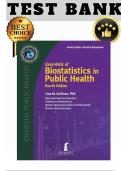
ALL CHAPTERS TEST BANK - Essentials of Biostatistics for Public Health 4th Edition Sullivan
, ALL CHAPTERS TEST BANK - Essentials of Biostatistics for Public Health 4th Edition Sullivan
CONTENT
Chapter 1 – Introduction
Chapter 2 – Study Designs
Chapter 3 – Quantifying the Extent of Disease
Chapter 4 – Summarizing Data Collected in the Sample
Chapter 5 – The Role of Probability
Chapter 6 – Confidence Interval Estimates
Chapter 7 – Hypothesis Testing Procedures
Chapter 8 – Power and Sample Size Determination
Chapter 9 – Multivariable Methods
Chapter 10 – Nonparametric Tests
Chapter 11 – Survival Analysis
Chapter 12 – Data Visualization
Chapter 13 – Careers in Biostatistics
, ALL CHAPTERS TEST BANK - Essentials of Biostatistics for Public Health 4th Edition Sullivan
Chapter 1 – Introduction
Question 1
A public health researcher is studying the prevalence of hypertension in a
small community of 5,000 adults. They select 500 adults randomly to collect
blood pressure measurements. What is the term used to describe the 500
adults selected for the study?
A) Population
B) Parameter
C) Sample
D) Variable
✅ Correct Answer: C) Sample
Rationale: A sample is a subset of the population selected for analysis. The
full population is the 5,000 adults, while the 500 selected individuals
represent the sample. Understanding the distinction between population
and sample is fundamental in biostatistics.
Keywords: sample, population, subset, study design
Question 2
A study records the smoking status (current smoker, former smoker, never
smoked) of patients visiting a clinic. Which type of variable is smoking
status?
A) Continuous
B) Categorical
, ALL CHAPTERS TEST BANK - Essentials of Biostatistics for Public Health 4th Edition Sullivan
C) Ratio
D) Interval
✅ Correct Answer: B) Categorical
Rationale: Smoking status is categorical because it classifies individuals
into distinct groups without numerical ordering or meaningful arithmetic
operations. Recognizing variable types informs statistical analysis choices.
Keywords: categorical variable, qualitative, nominal
Question 3
A public health team wants to measure the average BMI of adults in a city.
They collect BMI data from 1,000 randomly selected adults. Which
statement best describes the population parameter in this context?
A) The average BMI of the 1,000 adults sampled
B) The average BMI of all adults in the city
C) The BMI range in the sample
D) The median BMI of the sample
✅ Correct Answer: B) The average BMI of all adults in the city
Rationale: A population parameter refers to a characteristic (e.g., mean,
proportion) of the entire population. The sample mean estimates the
population parameter, but the true parameter is based on the full
population.
Keywords: population parameter, mean, estimate, sample
Question 4
, ALL CHAPTERS TEST BANK - Essentials of Biostatistics for Public Health 4th Edition Sullivan
A researcher is conducting a study on exercise habits. They record the
number of hours each participant exercises per week. Which type of
variable is represented by exercise hours?
A) Categorical
B) Nominal
C) Continuous
D) Ordinal
✅ Correct Answer: C) Continuous
Rationale: Exercise hours are continuous because they can take any
numerical value within a range and allow meaningful arithmetic
calculations such as mean and standard deviation.
Keywords: continuous variable, quantitative, measurement
Question 5
In a public health survey, participants’ age is recorded. The mean age in the
sample is 42 years with a standard deviation of 8 years. What does the
standard deviation indicate?
A) The average age of participants
B) The spread or variability of age in the sample
C) The highest age recorded
D) The total number of participants
✅ Correct Answer: B) The spread or variability of age in the sample
Rationale: Standard deviation measures how much individual values
deviate from the mean. It provides insight into variability within the
sample, essential for data interpretation.
Keywords: standard deviation, variability, spread, mean
, ALL CHAPTERS TEST BANK - Essentials of Biostatistics for Public Health 4th Edition Sullivan
Question 6
A study examines the prevalence of diabetes in two towns. Town A has 150
cases among 5,000 residents, and Town B has 80 cases among 2,000
residents. Which measure should the researcher calculate to compare
disease frequency?
A) Mean
B) Proportion or prevalence
C) Standard deviation
D) Confidence interval
✅ Correct Answer: B) Proportion or prevalence
Rationale: Prevalence is a measure of disease frequency, representing the
proportion of individuals with a condition in a population at a given time.
This allows meaningful comparison between towns of different sizes.
Keywords: prevalence, proportion, disease frequency
Question 7
A researcher collects data on the number of cigarettes smoked per day by
participants. The data are skewed to the right. Which summary measure is
least affected by skewed data?
A) Mean
B) Median
C) Range
D) Standard deviation
✅ Correct Answer: B) Median
Rationale: The median is the middle value and is robust to skewness or
extreme values, unlike the mean, which can be influenced by outliers.
Keywords: median, skewed distribution, robustness
, ALL CHAPTERS TEST BANK - Essentials of Biostatistics for Public Health 4th Edition Sullivan
CONTENT
Chapter 1 – Introduction
Chapter 2 – Study Designs
Chapter 3 – Quantifying the Extent of Disease
Chapter 4 – Summarizing Data Collected in the Sample
Chapter 5 – The Role of Probability
Chapter 6 – Confidence Interval Estimates
Chapter 7 – Hypothesis Testing Procedures
Chapter 8 – Power and Sample Size Determination
Chapter 9 – Multivariable Methods
Chapter 10 – Nonparametric Tests
Chapter 11 – Survival Analysis
Chapter 12 – Data Visualization
Chapter 13 – Careers in Biostatistics
, ALL CHAPTERS TEST BANK - Essentials of Biostatistics for Public Health 4th Edition Sullivan
Chapter 1 – Introduction
Question 1
A public health researcher is studying the prevalence of hypertension in a
small community of 5,000 adults. They select 500 adults randomly to collect
blood pressure measurements. What is the term used to describe the 500
adults selected for the study?
A) Population
B) Parameter
C) Sample
D) Variable
✅ Correct Answer: C) Sample
Rationale: A sample is a subset of the population selected for analysis. The
full population is the 5,000 adults, while the 500 selected individuals
represent the sample. Understanding the distinction between population
and sample is fundamental in biostatistics.
Keywords: sample, population, subset, study design
Question 2
A study records the smoking status (current smoker, former smoker, never
smoked) of patients visiting a clinic. Which type of variable is smoking
status?
A) Continuous
B) Categorical
, ALL CHAPTERS TEST BANK - Essentials of Biostatistics for Public Health 4th Edition Sullivan
C) Ratio
D) Interval
✅ Correct Answer: B) Categorical
Rationale: Smoking status is categorical because it classifies individuals
into distinct groups without numerical ordering or meaningful arithmetic
operations. Recognizing variable types informs statistical analysis choices.
Keywords: categorical variable, qualitative, nominal
Question 3
A public health team wants to measure the average BMI of adults in a city.
They collect BMI data from 1,000 randomly selected adults. Which
statement best describes the population parameter in this context?
A) The average BMI of the 1,000 adults sampled
B) The average BMI of all adults in the city
C) The BMI range in the sample
D) The median BMI of the sample
✅ Correct Answer: B) The average BMI of all adults in the city
Rationale: A population parameter refers to a characteristic (e.g., mean,
proportion) of the entire population. The sample mean estimates the
population parameter, but the true parameter is based on the full
population.
Keywords: population parameter, mean, estimate, sample
Question 4
, ALL CHAPTERS TEST BANK - Essentials of Biostatistics for Public Health 4th Edition Sullivan
A researcher is conducting a study on exercise habits. They record the
number of hours each participant exercises per week. Which type of
variable is represented by exercise hours?
A) Categorical
B) Nominal
C) Continuous
D) Ordinal
✅ Correct Answer: C) Continuous
Rationale: Exercise hours are continuous because they can take any
numerical value within a range and allow meaningful arithmetic
calculations such as mean and standard deviation.
Keywords: continuous variable, quantitative, measurement
Question 5
In a public health survey, participants’ age is recorded. The mean age in the
sample is 42 years with a standard deviation of 8 years. What does the
standard deviation indicate?
A) The average age of participants
B) The spread or variability of age in the sample
C) The highest age recorded
D) The total number of participants
✅ Correct Answer: B) The spread or variability of age in the sample
Rationale: Standard deviation measures how much individual values
deviate from the mean. It provides insight into variability within the
sample, essential for data interpretation.
Keywords: standard deviation, variability, spread, mean
, ALL CHAPTERS TEST BANK - Essentials of Biostatistics for Public Health 4th Edition Sullivan
Question 6
A study examines the prevalence of diabetes in two towns. Town A has 150
cases among 5,000 residents, and Town B has 80 cases among 2,000
residents. Which measure should the researcher calculate to compare
disease frequency?
A) Mean
B) Proportion or prevalence
C) Standard deviation
D) Confidence interval
✅ Correct Answer: B) Proportion or prevalence
Rationale: Prevalence is a measure of disease frequency, representing the
proportion of individuals with a condition in a population at a given time.
This allows meaningful comparison between towns of different sizes.
Keywords: prevalence, proportion, disease frequency
Question 7
A researcher collects data on the number of cigarettes smoked per day by
participants. The data are skewed to the right. Which summary measure is
least affected by skewed data?
A) Mean
B) Median
C) Range
D) Standard deviation
✅ Correct Answer: B) Median
Rationale: The median is the middle value and is robust to skewness or
extreme values, unlike the mean, which can be influenced by outliers.
Keywords: median, skewed distribution, robustness