
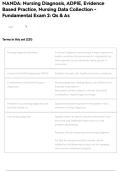
NANDA: Nursing Diagnosis, ADPIE, Evidence
Based Practice, Nursing Data Collection -
Fundamental Exam 2: Qs & As
Save
Terms in this set (231)
Nursing diagnosis definition A clinical judgment concerning a human response to
health conditions/life processes/or vulnerability for
that response, by an individual, family, group, or
community
4 types of NANDA diagnoses (PRHS) Problem focused, risk, health promotion, syndrome.
Components of problem focused Nursing diagnosis, relating factors, as evidenced by
diagnoses Example of problems:
Decreased cardiac output it, chronic functional
constipation, impaired gas exchange.
Problem focus nursing diagnoses are Signs and symptoms present in the patient. Most
typically based on common nursing Diagnoses.
risk nursing diagnosis Applies when risk factors require intervention from
the nurse and healthcare team prior to a real
problem developing.
Requires clinical reasoning and nursing judgment
Ex) Risk for imbalanced fluid volume, risk for
ineffective childbearing process, risk for impaired
oral mucous membrane integrity.
,Health promotion Diagnosis To improve the overall well-being of an
individual/family or community
Examples: readiness for enhanced family processes,
readiness for enhanced hope, sedentary lifestyle
syndrome diagnosis refers to A cluster of nursing diagnoses that occur and a
pattern or can we all be addressed through the same
or similar nursing interventions
Examples: decreased cardiac output, decreased
cardiac tissue perfusion, ineffective cerebral tissue
perfusion, ineffective peripheral tissue perfusion.
written problem focus Diagnosis Problem focused Diagnosis______R/T:_____ AEB:____
Risk Diagnosis written Risk for_____aeb_____(risk factors)
13 domains of nursing diagnosis 1. health promotion
2. nutrition
3. elimination slash exchange
4. activity/ rest
5. perception/cognition
6. self perception
7. role relationship
8. sexuality
9. coping/stress tolerance
10. life principles
11. safety and protection
12. comfort
13. growth and development
Classes of Health promotion Health awareness, health management
classes of nutrition Indigestion, digestion, absorption, metabolism,
hydration
, Classes of Elimination and exchange Urinary function, Gastrointestinal function,
Integumentary function, respiratory function
Classes of activity/rest Sleep/rest, activity/exercise, energy balance,
cardiovascular and pulmonary responses, self-care.
Classes of perception/cognition Attention, orientation, sensation/perception,
cognition, communication
Classes of self perception Self-esteem, self-concept, body image
Classes of role relationship Caregiving rules, family relationships, role
performance
Classes of sexuality Sexual identity, sexual function, reproduction
Classes of coping/stress techniques Post trauma responses, coping responses,
neurobehavioral stress
Classes of life principles Values, beliefs, value and belief of action
congruence.
Classes of safety/protection Infection, physical injury, violence, environmental
hazards, defensive processes, thermoregulation
Classes of comfort Physical comfort, environmental, and social comfort
Classes of growth and development Growth, development-Risk for delayed development
Where/When do you start to collect As soon as you meet your pt you should start your
data? assessment.
Define Assessing The systematic and continuous collection, validation,
analysis, and communication of pt data
Based Practice, Nursing Data Collection -
Fundamental Exam 2: Qs & As
Save
Terms in this set (231)
Nursing diagnosis definition A clinical judgment concerning a human response to
health conditions/life processes/or vulnerability for
that response, by an individual, family, group, or
community
4 types of NANDA diagnoses (PRHS) Problem focused, risk, health promotion, syndrome.
Components of problem focused Nursing diagnosis, relating factors, as evidenced by
diagnoses Example of problems:
Decreased cardiac output it, chronic functional
constipation, impaired gas exchange.
Problem focus nursing diagnoses are Signs and symptoms present in the patient. Most
typically based on common nursing Diagnoses.
risk nursing diagnosis Applies when risk factors require intervention from
the nurse and healthcare team prior to a real
problem developing.
Requires clinical reasoning and nursing judgment
Ex) Risk for imbalanced fluid volume, risk for
ineffective childbearing process, risk for impaired
oral mucous membrane integrity.
,Health promotion Diagnosis To improve the overall well-being of an
individual/family or community
Examples: readiness for enhanced family processes,
readiness for enhanced hope, sedentary lifestyle
syndrome diagnosis refers to A cluster of nursing diagnoses that occur and a
pattern or can we all be addressed through the same
or similar nursing interventions
Examples: decreased cardiac output, decreased
cardiac tissue perfusion, ineffective cerebral tissue
perfusion, ineffective peripheral tissue perfusion.
written problem focus Diagnosis Problem focused Diagnosis______R/T:_____ AEB:____
Risk Diagnosis written Risk for_____aeb_____(risk factors)
13 domains of nursing diagnosis 1. health promotion
2. nutrition
3. elimination slash exchange
4. activity/ rest
5. perception/cognition
6. self perception
7. role relationship
8. sexuality
9. coping/stress tolerance
10. life principles
11. safety and protection
12. comfort
13. growth and development
Classes of Health promotion Health awareness, health management
classes of nutrition Indigestion, digestion, absorption, metabolism,
hydration
, Classes of Elimination and exchange Urinary function, Gastrointestinal function,
Integumentary function, respiratory function
Classes of activity/rest Sleep/rest, activity/exercise, energy balance,
cardiovascular and pulmonary responses, self-care.
Classes of perception/cognition Attention, orientation, sensation/perception,
cognition, communication
Classes of self perception Self-esteem, self-concept, body image
Classes of role relationship Caregiving rules, family relationships, role
performance
Classes of sexuality Sexual identity, sexual function, reproduction
Classes of coping/stress techniques Post trauma responses, coping responses,
neurobehavioral stress
Classes of life principles Values, beliefs, value and belief of action
congruence.
Classes of safety/protection Infection, physical injury, violence, environmental
hazards, defensive processes, thermoregulation
Classes of comfort Physical comfort, environmental, and social comfort
Classes of growth and development Growth, development-Risk for delayed development
Where/When do you start to collect As soon as you meet your pt you should start your
data? assessment.
Define Assessing The systematic and continuous collection, validation,
analysis, and communication of pt data


