Basic Dysrhythmia-Relias
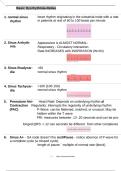
1. normal sinus heart rhythm originating in the sinoatrial node with a rate
rhythm in patients at rest of 60 to 100 beats per minute
2. Sinus Arrhyth- Appearance is ALMOST NORMAL:
mia Respiratory - Circulatory interaction
Rate INCREASES with INSPIRATION (IN=IN)
3. Sinus Bradycar- <60
dia normal sinus rhythm
4. Sinus Tachycar- >100 (100-150)
dia normal sinus rhythm
5. Premature Atri- Heart Rate: Depends on underlying rhythm al
Contraction Regularity: Interrupts the regularity of underlying rhythm
(PAC) P-Wave: can be flattened, notched, or unusual. May be
hidden within the T wave
PRI: measures between .12-.20 seconds and can be pro-
longed;QRS: <.12 can seconds be different from other complexes
6. Sinus Ar- - SA node doesn't fire rest/Pause - notice absence of P-wave for
a complete cycle (a missed cycle)
length of pause ` multiple of normal rate (block)
1/6 Basic Dysrhythmia-Relias
, Basic Dysrhythmia-Relias
7. Atrial Fibrillation an irregular and often very fast heart rate originating from
(A-Fib) abnormal conduction in the atria
8. Atrial Flutter irregular beating of the atria; often described as "a-flutter
with 2 to 1 block or 3 to 1 block"
9. Junctional 40-60 Regular!
Rhythm -impulse from AV node w/ retro/antegrade transmission
- P wave often inverted/buried/follow QRS
- slow rate
- narrow QRS (not wide like ventricular)
10. Junctional Tachy- >60 bpm (ms. K; 150-250) cardia - KEY: will be regular
(consistent)
- AV junction produces a rapid sequence of QRS-T cycles - p-wave often
inverted/buried/follow QRS
11. Premature Junc- Inverted p wave or hidden p wave tional Contrac-
PRI<0.12 or none tion Normal QRS
2/6 Basic Dysrhythmia-Relias
1. normal sinus heart rhythm originating in the sinoatrial node with a rate
rhythm in patients at rest of 60 to 100 beats per minute
2. Sinus Arrhyth- Appearance is ALMOST NORMAL:
mia Respiratory - Circulatory interaction
Rate INCREASES with INSPIRATION (IN=IN)
3. Sinus Bradycar- <60
dia normal sinus rhythm
4. Sinus Tachycar- >100 (100-150)
dia normal sinus rhythm
5. Premature Atri- Heart Rate: Depends on underlying rhythm al
Contraction Regularity: Interrupts the regularity of underlying rhythm
(PAC) P-Wave: can be flattened, notched, or unusual. May be
hidden within the T wave
PRI: measures between .12-.20 seconds and can be pro-
longed;QRS: <.12 can seconds be different from other complexes
6. Sinus Ar- - SA node doesn't fire rest/Pause - notice absence of P-wave for
a complete cycle (a missed cycle)
length of pause ` multiple of normal rate (block)
1/6 Basic Dysrhythmia-Relias
, Basic Dysrhythmia-Relias
7. Atrial Fibrillation an irregular and often very fast heart rate originating from
(A-Fib) abnormal conduction in the atria
8. Atrial Flutter irregular beating of the atria; often described as "a-flutter
with 2 to 1 block or 3 to 1 block"
9. Junctional 40-60 Regular!
Rhythm -impulse from AV node w/ retro/antegrade transmission
- P wave often inverted/buried/follow QRS
- slow rate
- narrow QRS (not wide like ventricular)
10. Junctional Tachy- >60 bpm (ms. K; 150-250) cardia - KEY: will be regular
(consistent)
- AV junction produces a rapid sequence of QRS-T cycles - p-wave often
inverted/buried/follow QRS
11. Premature Junc- Inverted p wave or hidden p wave tional Contrac-
PRI<0.12 or none tion Normal QRS
2/6 Basic Dysrhythmia-Relias