
NUR 3065- EXAM 2 REVIEW - RESPIRATORY
OBJECTIVES QUIZ & VALID ANSWERS
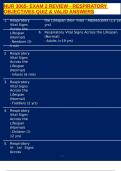
1. Respiratory the Lifespan (Nor- mal) - Adolescents (13-18
Vital Signs yrs)
Across the
Lifespan 6. Respiratory Vital Signs Across the Lifespan
(Normal) (Normal)
- Newborn (0- - Adults (>19 yrs)
1 mt)
2. Respiratory
Vital Signs
Across the
Lifespan
(Normal)
- Infants (6 mts)
3. Respiratory
Vital Signs
Across the
Lifespan
(Normal)
- Toddlers (2 yrs)
4. Respiratory
Vital Signs
Across the
Lifespan
(Normal)
- Children (3-
12 yrs)
5. Respiratory
Vi- tal Signs
Across
,NUR 3065- EXAM 2 REVIEW - RESPIRATORY
OBJECTIVES QUIZ & VALID ANSWERS
30-60 breaths per min inspiration)
(diaphragmatic / abdominal
breathing, irregular pattern)
30-50 breaths per min
25-32 breaths per min
20-30 breaths per min
16-20 breaths per min
12-20 breaths per min
(costal/chest breathing,
expiration slower than
,NUR 3065- EXAM 2 REVIEW - RESPIRATORY
OBJECTIVES QUIZ & VALID ANSWERS
7. Respiratory Lifespan (ABNOR- MAL) - Bradypnea
Vi- tal Signs
Across 11. Respiratory Vital Signs Across the Lifespan
the Lifespan (ABNOR-
(Nor- mal) -
Elderly/Old- er
Adult
8. Respiratory
Vital Signs
Across the
Lifespan
(ABNOR- MAL) -
Tachypnea
9. Respiratory
Vital Signs
Across the
Lifespan
(ABNOR- MAL) -
Tachypnea
(Causes)
10. Respiratory
Vital Signs
Across the
, NUR 3065- EXAM 2 REVIEW - RESPIRATORY
OBJECTIVES QUIZ & VALID ANSWERS
Lung compliance decreases, r exercise
breath sounds may be anxiety
diminished due to reduced exercise
ventilation in lower lung hypoxia
fields Costal cartilages <12 breaths per min
calcify, leading to a less
mobile thorax
respiratory depression
Lungs become more rigid
and harder to inflate drug overdose (opioids,
Increased airway closure sedatives) neurological
reduces ventilation in lung
bases issues
>20 breaths per min
f
e
v
e
OBJECTIVES QUIZ & VALID ANSWERS
1. Respiratory the Lifespan (Nor- mal) - Adolescents (13-18
Vital Signs yrs)
Across the
Lifespan 6. Respiratory Vital Signs Across the Lifespan
(Normal) (Normal)
- Newborn (0- - Adults (>19 yrs)
1 mt)
2. Respiratory
Vital Signs
Across the
Lifespan
(Normal)
- Infants (6 mts)
3. Respiratory
Vital Signs
Across the
Lifespan
(Normal)
- Toddlers (2 yrs)
4. Respiratory
Vital Signs
Across the
Lifespan
(Normal)
- Children (3-
12 yrs)
5. Respiratory
Vi- tal Signs
Across
,NUR 3065- EXAM 2 REVIEW - RESPIRATORY
OBJECTIVES QUIZ & VALID ANSWERS
30-60 breaths per min inspiration)
(diaphragmatic / abdominal
breathing, irregular pattern)
30-50 breaths per min
25-32 breaths per min
20-30 breaths per min
16-20 breaths per min
12-20 breaths per min
(costal/chest breathing,
expiration slower than
,NUR 3065- EXAM 2 REVIEW - RESPIRATORY
OBJECTIVES QUIZ & VALID ANSWERS
7. Respiratory Lifespan (ABNOR- MAL) - Bradypnea
Vi- tal Signs
Across 11. Respiratory Vital Signs Across the Lifespan
the Lifespan (ABNOR-
(Nor- mal) -
Elderly/Old- er
Adult
8. Respiratory
Vital Signs
Across the
Lifespan
(ABNOR- MAL) -
Tachypnea
9. Respiratory
Vital Signs
Across the
Lifespan
(ABNOR- MAL) -
Tachypnea
(Causes)
10. Respiratory
Vital Signs
Across the
, NUR 3065- EXAM 2 REVIEW - RESPIRATORY
OBJECTIVES QUIZ & VALID ANSWERS
Lung compliance decreases, r exercise
breath sounds may be anxiety
diminished due to reduced exercise
ventilation in lower lung hypoxia
fields Costal cartilages <12 breaths per min
calcify, leading to a less
mobile thorax
respiratory depression
Lungs become more rigid
and harder to inflate drug overdose (opioids,
Increased airway closure sedatives) neurological
reduces ventilation in lung
bases issues
>20 breaths per min
f
e
v
e


