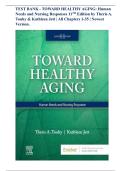
TEST BANK - TOWARD HEALTHY AGING: Human
Needs and Nursing Responses 11TH Edition by Theris A.
Touhy & Kathleen Jett | All Chapters 1-35 | Newest
Version.
,Chapter 01: Gerontological Nursing Across the Continuum of Care
Touhy: Toward Healthy Aging, 11th Edition
MULTIPLE CHOICE
1. When did serious and well-controlled research studies on aging first become available? a.
Only in the past 60 years.
b. Since the turn of the 20th century.
c. Following the Great Depression.
d. Since the year 2000.
ACCURATE ANSWER:-
A
REASONING:->>>Only in the past 60 years have serious and carefully controlled research
studies flourished. Before that, anecdotal evidence was used to illustrate issues assumed to be
universal, making all the remaining options incorrect.
DIF: Cognitive Level: Remembering TOPIC: Integrated Process:
Teaching/Learning MSC: Patient Needs: Health Promotion and Maintenance
2. The son of a nursing home resident asks a nursing attendant: “What is the significance of
being certified in gerontology? I see that you are, but not all of the nursing attendants are.”
What response best answers the family member’s question?
a. “National certification as a gerontological nursing attendant is a way to demonstrate
special knowledge in caring for older adults.”
b. “National certification in gerontology is required for all nursing attendants who
have worked in this setting for 2 or more years.”
c. “National certification is only available to nursing attendants who have a
Baccalaureate degree in nursing.”
d. “Only advanced practice nursing attendants, like nursing attendant practitioners, are
certified in gerontology.”
ACCURATE ANSWER:-
A
REASONING:->>>National certification is a way to demonstrate special expertise in caring
for older adults. It is not required for practice in any setting across the continuum of care, and
it is not exclusive to nursing attendants with Baccalaureate degrees. There is both a generalist
and a specialist gerontological nursing certification. The generalist functions in a variety of
settings providing care to older adults and their families. The specialist has advanced
gerontological education at a master’s level.
DIF: Cognitive Level: Understanding
TOPIC: Integrated Process: Communication and Documentation MSC:
Patient Needs: Management of Care
3. The major goal of the NICHE (Nursing attendants Improving Care for Healthsystem Elders)
program includes which of the following?
a. Improve outcomes for hospitalized older adults.
b. Increase the number of older adults cared for in hospitals.
c. Increase the number of iatrogenic complications that occur in hospitalized older adults.
, d. Decrease 30-day readmission rates for hospitalized older adults.
ACCURATE ANSWER:-A
REASONING:->>>The goal of NICHE is to improve outcomes for hospitalized older adults.
Although option D is a good outcome for hospitalized older adults, it is not one of the major
goals of NICHE, which are broader. Options B and C are not goals that would improve care
for older adults but would be negative outcomes themselves.
DIF: Cognitive Level: Understanding TOPIC: Integrated Process:
Teaching/Learning MSC: Patient Needs: Health Promotion and Maintenance
MULTIPLE RESPONSE
1. What is the impact of the Hospital Readmission Reduction Program (HRRP) on avoidable
readmissions? (Choose all that apply.)
a. Readmission rates for the selected conditions have dropped nationwide.
b. Many hospitals have instituted system-wide interventions to prevent readmissions.
c. Hospitals are keeping hospital patients longer to avoid readmissions.
d. Potentially avoidable hospitalizations among nursing home residents is increasing.
e. Hospitals have a financial incentive to develop programs to reduce readmissions.
ACCURATE ANSWER:-A, B, E
REASONING:->>>The Hospital Readmission Reduction Program (HRRP) was established
as a provision in the Affordable Care Act (ACA) requiring Medicare to reduce payments to
hospitals with relatively high readmission rates for selected conditions for hospital patients in
traditional Medicare. Since the HRRP, readmission rates for the selected conditions have
dropped nationwide but estimates are that in 2018, about 80% of hospitals evaluated by CMS
will face penalties totaling $564 million (Advisory Board, 2017). Additionally, the HRRP has
been the impetus for many hospitals to institute system-wide interventions to prevent
readmissions that have also contributed to the decline in readmission rates. The rate of
potentially avoidable hospitalizations among SNF residents has fallen by nearly a third in
recent years as a result of many quality improvement initiatives.
DIF: Cognitive Level: Understanding TOPIC: Integrated Process:
Teaching/Learning MSC: Patient Needs: Health Promotion and Maintenance
2. Best practice recommendations for nursing education in relation to gerontology include which
of the following? (Choose all that apply.)
a. Provision of a “stand-alone” course in gerontological nursing
b. Integration of gerontological content throughout the curriculum
c. Replacement of acute care pediatric clinical experiences with gerontological clinical
experiences
d. Recruitment of nursing attendants with Master and Doctoral degrees and a specialty
in gerontology to faculty roles
e. Requiring all undergraduate nursing students to obtain gerontological certification
as a requirement for graduation
ACCURATE ANSWER:-A, B, D
, REASONING:->>>Best practices include providing a stand-alone gerontological nursing
course as well as integrating gerontology throughout the curriculum. Recruitment of nursing
attendants with a specialty in gerontology and a Master or Doctoral degree to faculty roles is a
critical step in making sure that the next generation of nursing attendants is prepared to care
for older adults. Best practices do not recommend removing pediatric clinical experiences and
replacing them with gerontological experiences. Nursing certification is only available to
practicing nursing attendants who meet specific education and practice requirements. It is not
applicable to nursing students.
DIF: Cognitive Level: Understanding TOPIC: Integrated Process:
Teaching/Learning MSC: Patient Needs: Health Promotion and Maintenance
4. What are the current initiatives being implemented to enhance the specialty of gerontological
nursing? (Choose all that apply.)
a. Mandating of a minimum of a Baccalaureate degree in nursing in order to care for older
adults
b. Geriatric Nursing Leadership Academy (GNLA) project
c. Promotion of geriatric nursing to excellence to the nursing community
d. Requiring a nursing certification specifically required to long-term care
e. Offering scholarships for study and research in geriatric nursing
ACCURATE ANSWER:-B, C, E
REASONING:->>>The most significant influence in enhancing the specialty of
gerontological nursing has been the work of The Hartford Institute for Geriatric Nursing,
established in 1996 and funded by the John A. Hartford Foundation. Initiatives in nursing
education, nursing practice, nursing research, and nursing policy have addressed enhancement
of geriatrics in nursing education programs through curricular reform and faculty
development, creation of the National Hartford Centers of Gerontological Nursing Excellence,
predoctoral and postdoctoral scholarships for study and research in geriatric nursing, and
clinical practice improvement projects to enhance care for older adults. . Mandating minimum
nursing levels or certifications to practice in long-term care are not current initiatives.
DIF: Cognitive Level: Understanding TOPIC: Integrated Process:
Teaching/Learning MSC: Patient Needs: Health Promotion and Maintenance
5. A nursing attendant discusses the “age in place” concept with an older adult patient. The
nursing attendant would provide information related to which facility? (Choose all that apply.)
a. Independent senior housing complexes.
b. A long-term care facility that is affiliated with the hospital.
c. Retirement communities.
d. Adult day health centers.
e. Assisted living facilities.
ACCURATE ANSWER:-A, C, D, E
REASONING:->>>Community-based care occurs through home and hospice care provided
in persons' homes, independent senior housing complexes, retirement communities, residential
care facilities such as assisted living facilities, hospice facilities, and adult day health centers.
Acute care hospitals and long-term care facilities are not considered community based care
facilities.
DIF: Cognitive Level: Applying TOPIC: Integrated Process: N/A MSC:
Patient Needs: Psychosocial Integrity
6. What are the significant factors contributing to the growth of community-based care?:
Needs and Nursing Responses 11TH Edition by Theris A.
Touhy & Kathleen Jett | All Chapters 1-35 | Newest
Version.
,Chapter 01: Gerontological Nursing Across the Continuum of Care
Touhy: Toward Healthy Aging, 11th Edition
MULTIPLE CHOICE
1. When did serious and well-controlled research studies on aging first become available? a.
Only in the past 60 years.
b. Since the turn of the 20th century.
c. Following the Great Depression.
d. Since the year 2000.
ACCURATE ANSWER:-
A
REASONING:->>>Only in the past 60 years have serious and carefully controlled research
studies flourished. Before that, anecdotal evidence was used to illustrate issues assumed to be
universal, making all the remaining options incorrect.
DIF: Cognitive Level: Remembering TOPIC: Integrated Process:
Teaching/Learning MSC: Patient Needs: Health Promotion and Maintenance
2. The son of a nursing home resident asks a nursing attendant: “What is the significance of
being certified in gerontology? I see that you are, but not all of the nursing attendants are.”
What response best answers the family member’s question?
a. “National certification as a gerontological nursing attendant is a way to demonstrate
special knowledge in caring for older adults.”
b. “National certification in gerontology is required for all nursing attendants who
have worked in this setting for 2 or more years.”
c. “National certification is only available to nursing attendants who have a
Baccalaureate degree in nursing.”
d. “Only advanced practice nursing attendants, like nursing attendant practitioners, are
certified in gerontology.”
ACCURATE ANSWER:-
A
REASONING:->>>National certification is a way to demonstrate special expertise in caring
for older adults. It is not required for practice in any setting across the continuum of care, and
it is not exclusive to nursing attendants with Baccalaureate degrees. There is both a generalist
and a specialist gerontological nursing certification. The generalist functions in a variety of
settings providing care to older adults and their families. The specialist has advanced
gerontological education at a master’s level.
DIF: Cognitive Level: Understanding
TOPIC: Integrated Process: Communication and Documentation MSC:
Patient Needs: Management of Care
3. The major goal of the NICHE (Nursing attendants Improving Care for Healthsystem Elders)
program includes which of the following?
a. Improve outcomes for hospitalized older adults.
b. Increase the number of older adults cared for in hospitals.
c. Increase the number of iatrogenic complications that occur in hospitalized older adults.
, d. Decrease 30-day readmission rates for hospitalized older adults.
ACCURATE ANSWER:-A
REASONING:->>>The goal of NICHE is to improve outcomes for hospitalized older adults.
Although option D is a good outcome for hospitalized older adults, it is not one of the major
goals of NICHE, which are broader. Options B and C are not goals that would improve care
for older adults but would be negative outcomes themselves.
DIF: Cognitive Level: Understanding TOPIC: Integrated Process:
Teaching/Learning MSC: Patient Needs: Health Promotion and Maintenance
MULTIPLE RESPONSE
1. What is the impact of the Hospital Readmission Reduction Program (HRRP) on avoidable
readmissions? (Choose all that apply.)
a. Readmission rates for the selected conditions have dropped nationwide.
b. Many hospitals have instituted system-wide interventions to prevent readmissions.
c. Hospitals are keeping hospital patients longer to avoid readmissions.
d. Potentially avoidable hospitalizations among nursing home residents is increasing.
e. Hospitals have a financial incentive to develop programs to reduce readmissions.
ACCURATE ANSWER:-A, B, E
REASONING:->>>The Hospital Readmission Reduction Program (HRRP) was established
as a provision in the Affordable Care Act (ACA) requiring Medicare to reduce payments to
hospitals with relatively high readmission rates for selected conditions for hospital patients in
traditional Medicare. Since the HRRP, readmission rates for the selected conditions have
dropped nationwide but estimates are that in 2018, about 80% of hospitals evaluated by CMS
will face penalties totaling $564 million (Advisory Board, 2017). Additionally, the HRRP has
been the impetus for many hospitals to institute system-wide interventions to prevent
readmissions that have also contributed to the decline in readmission rates. The rate of
potentially avoidable hospitalizations among SNF residents has fallen by nearly a third in
recent years as a result of many quality improvement initiatives.
DIF: Cognitive Level: Understanding TOPIC: Integrated Process:
Teaching/Learning MSC: Patient Needs: Health Promotion and Maintenance
2. Best practice recommendations for nursing education in relation to gerontology include which
of the following? (Choose all that apply.)
a. Provision of a “stand-alone” course in gerontological nursing
b. Integration of gerontological content throughout the curriculum
c. Replacement of acute care pediatric clinical experiences with gerontological clinical
experiences
d. Recruitment of nursing attendants with Master and Doctoral degrees and a specialty
in gerontology to faculty roles
e. Requiring all undergraduate nursing students to obtain gerontological certification
as a requirement for graduation
ACCURATE ANSWER:-A, B, D
, REASONING:->>>Best practices include providing a stand-alone gerontological nursing
course as well as integrating gerontology throughout the curriculum. Recruitment of nursing
attendants with a specialty in gerontology and a Master or Doctoral degree to faculty roles is a
critical step in making sure that the next generation of nursing attendants is prepared to care
for older adults. Best practices do not recommend removing pediatric clinical experiences and
replacing them with gerontological experiences. Nursing certification is only available to
practicing nursing attendants who meet specific education and practice requirements. It is not
applicable to nursing students.
DIF: Cognitive Level: Understanding TOPIC: Integrated Process:
Teaching/Learning MSC: Patient Needs: Health Promotion and Maintenance
4. What are the current initiatives being implemented to enhance the specialty of gerontological
nursing? (Choose all that apply.)
a. Mandating of a minimum of a Baccalaureate degree in nursing in order to care for older
adults
b. Geriatric Nursing Leadership Academy (GNLA) project
c. Promotion of geriatric nursing to excellence to the nursing community
d. Requiring a nursing certification specifically required to long-term care
e. Offering scholarships for study and research in geriatric nursing
ACCURATE ANSWER:-B, C, E
REASONING:->>>The most significant influence in enhancing the specialty of
gerontological nursing has been the work of The Hartford Institute for Geriatric Nursing,
established in 1996 and funded by the John A. Hartford Foundation. Initiatives in nursing
education, nursing practice, nursing research, and nursing policy have addressed enhancement
of geriatrics in nursing education programs through curricular reform and faculty
development, creation of the National Hartford Centers of Gerontological Nursing Excellence,
predoctoral and postdoctoral scholarships for study and research in geriatric nursing, and
clinical practice improvement projects to enhance care for older adults. . Mandating minimum
nursing levels or certifications to practice in long-term care are not current initiatives.
DIF: Cognitive Level: Understanding TOPIC: Integrated Process:
Teaching/Learning MSC: Patient Needs: Health Promotion and Maintenance
5. A nursing attendant discusses the “age in place” concept with an older adult patient. The
nursing attendant would provide information related to which facility? (Choose all that apply.)
a. Independent senior housing complexes.
b. A long-term care facility that is affiliated with the hospital.
c. Retirement communities.
d. Adult day health centers.
e. Assisted living facilities.
ACCURATE ANSWER:-A, C, D, E
REASONING:->>>Community-based care occurs through home and hospice care provided
in persons' homes, independent senior housing complexes, retirement communities, residential
care facilities such as assisted living facilities, hospice facilities, and adult day health centers.
Acute care hospitals and long-term care facilities are not considered community based care
facilities.
DIF: Cognitive Level: Applying TOPIC: Integrated Process: N/A MSC:
Patient Needs: Psychosocial Integrity
6. What are the significant factors contributing to the growth of community-based care?: