GENERAL MEDICINE
HNH-27806
,GP patients, examination and diagnosis
Health:
- 1946: A state of complete physical, mental and social well-being ant not merely the
absence of disease or infirmity
- 2012: the ability to adapt and self-manage in the face of social, physical and
emotional challenges
o Individual health, Ability to cope with chronic diseases and disabilities
o Difference: Acceptance that health is not static
The GP-practice
• Three most common conditions in NL:
o Hypertension, urinary tract infections, diabetes
• The GP is part of primary care: first point of consultation
• ICE: medical history
o Ideas: What does the patient think that is going on?
o Concerns: Are they anxious about the symptoms? Why?
o Expectations: what are patients hoping from this consultation?
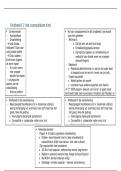
Diagnostic process
1. History/Anamnesis: Everything the patient can tell you
a. Duration and severity of symptoms, localization of pain, family history,
smoking, medication, past medical history, height & weight
2. Examination: what you can see, hear, feel, smell
a. Inspection: Take a look at skin, problems with posture, tremors – look
b. Auscultation: listening with stethoscope, heart/breathing sounds – hear
c. Percussion: drumming with finger on abdomen or chest – tap
d. Palpation: pressing on painful parts, lumps, firmness, nodules – feel
3. Investigation: imaging or sampling
a. Laboratory (blood/urine), tissue biopsy
b. Spirometry (lung function), ECG
c. Imaging techniques
Differential diagnosis: the distinguishing of a certain disease or situation from others that
present similar signs or symptoms
,Imaging techniques
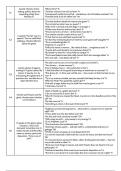
Name Principle Used for imaging what? Resolution Risk
X-rays Electromagnetic Dense organs: + (bone) +/-
radiation, Bones (fractures), soft - (soft tissue) (radiation)
radiograph, dense tissue, organs
area’s with high
atom density show
white, 2D
CT-scan Multiple angles & X- Structural level: Tumor + (bone) +/-
rays divide patient position & shape, blood - (soft tissue) (radiation
in ‘coupes’, cross- cloths, infections, bones,
sectional, 3D organs
PET-scan 3D by using Disease at - +
radioactive contrast metabolic/cellular level: (radiation)
tracers, isotopes, Cancer, cellular function,
glucose metabolism, brain
activity, Blood flow, oxygen
use
MRI Cross-sectional, no Structural level & soft tissue: + -
radiation but breast cancer, injuries or
magnetic fields. abnormalities of joints,
Magnets produce heart problems, abdominal
strong magnetic organs, brain
field that forces
protons in the body
to align with that
field. When a radio
wave is then pulsed
through the patient,
the protons spin out
of equilibrium,
which is visible on
screen. Dense areas
show dark. 3D
Ultrasound Propagate through Organs, blood vessels, fetus - -
different tissues
and then return the
transducer as
reflected echoes.
Ultrasound waves
are reflected at the
surfaces between
the tissues of
different density.
2D
, Glossary
Term Description
Auscultation Listening with stethoscope – hear
Colo- Colon
Dys- Dysfunction, abnormal, impaired
-emia In the blood
Endo- Inside, within
Eu- Good, well
Gastro- GI-tract
Haem- Blood
Hyper High
Hypo Low
Infirmity Physical or mental weakness
-itis Inflammation
Palpitation Pressing on painful parts
Percussion Drumming with finger
-pnea Air
-poly A lot
Ury/uro- Urine
HNH-27806
,GP patients, examination and diagnosis
Health:
- 1946: A state of complete physical, mental and social well-being ant not merely the
absence of disease or infirmity
- 2012: the ability to adapt and self-manage in the face of social, physical and
emotional challenges
o Individual health, Ability to cope with chronic diseases and disabilities
o Difference: Acceptance that health is not static
The GP-practice
• Three most common conditions in NL:
o Hypertension, urinary tract infections, diabetes
• The GP is part of primary care: first point of consultation
• ICE: medical history
o Ideas: What does the patient think that is going on?
o Concerns: Are they anxious about the symptoms? Why?
o Expectations: what are patients hoping from this consultation?
Diagnostic process
1. History/Anamnesis: Everything the patient can tell you
a. Duration and severity of symptoms, localization of pain, family history,
smoking, medication, past medical history, height & weight
2. Examination: what you can see, hear, feel, smell
a. Inspection: Take a look at skin, problems with posture, tremors – look
b. Auscultation: listening with stethoscope, heart/breathing sounds – hear
c. Percussion: drumming with finger on abdomen or chest – tap
d. Palpation: pressing on painful parts, lumps, firmness, nodules – feel
3. Investigation: imaging or sampling
a. Laboratory (blood/urine), tissue biopsy
b. Spirometry (lung function), ECG
c. Imaging techniques
Differential diagnosis: the distinguishing of a certain disease or situation from others that
present similar signs or symptoms
,Imaging techniques
Name Principle Used for imaging what? Resolution Risk
X-rays Electromagnetic Dense organs: + (bone) +/-
radiation, Bones (fractures), soft - (soft tissue) (radiation)
radiograph, dense tissue, organs
area’s with high
atom density show
white, 2D
CT-scan Multiple angles & X- Structural level: Tumor + (bone) +/-
rays divide patient position & shape, blood - (soft tissue) (radiation
in ‘coupes’, cross- cloths, infections, bones,
sectional, 3D organs
PET-scan 3D by using Disease at - +
radioactive contrast metabolic/cellular level: (radiation)
tracers, isotopes, Cancer, cellular function,
glucose metabolism, brain
activity, Blood flow, oxygen
use
MRI Cross-sectional, no Structural level & soft tissue: + -
radiation but breast cancer, injuries or
magnetic fields. abnormalities of joints,
Magnets produce heart problems, abdominal
strong magnetic organs, brain
field that forces
protons in the body
to align with that
field. When a radio
wave is then pulsed
through the patient,
the protons spin out
of equilibrium,
which is visible on
screen. Dense areas
show dark. 3D
Ultrasound Propagate through Organs, blood vessels, fetus - -
different tissues
and then return the
transducer as
reflected echoes.
Ultrasound waves
are reflected at the
surfaces between
the tissues of
different density.
2D
, Glossary
Term Description
Auscultation Listening with stethoscope – hear
Colo- Colon
Dys- Dysfunction, abnormal, impaired
-emia In the blood
Endo- Inside, within
Eu- Good, well
Gastro- GI-tract
Haem- Blood
Hyper High
Hypo Low
Infirmity Physical or mental weakness
-itis Inflammation
Palpitation Pressing on painful parts
Percussion Drumming with finger
-pnea Air
-poly A lot
Ury/uro- Urine