Biology 213 Final Exams 2021
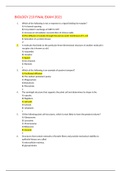
Which of the following is not a response to a signal binding its receptor? A) A channel opening B) A G protein's exchange of GDP for GTP C) Increase in intracellular concentration of nitrous oxide D) The diffusion of solutes through the porous outer membrane of E. coli E) Activation of a protein kinase A molecule that binds to the particular three-dimensional structure of another molecule's receptor site is known as a(n) A) responder. B) receptor. C) ligand. D) ion channel. E) filament. Which of the following is an example of passive transport? A) Facilitated diffusion B) The sodium-potassium pump C) Phagocytosis D) Exocytosis E) Pinocytosis The semirigid structure that supports the plant cell and determines its shape is the A) capsule. B) flagellum. C) cell wall. D) cytosol. E) cytoplasm Of the following plant cell structures, which is most likely to have the greatest volume? A) Glyoxysome B) Lysosome C) Chromosome D) Ribosome E) Vacuole Structures that contain networks of keratin fibers and provide mechanical stability to epithelial tissues are called A) extracellular matrices. B) glycoproteins. C) gap junctions. D) desmosomes. E) phospholipid bilayers. A general function of all cellular membranes is to A) regulate which materials can cross the membrane. B) support the cell and determine its shape. C) produce energy for the cell. D) produce proteins for the cell. E) move the cell. Active transport usually moves molecules A) in the same direction as diffusion moves them. B) in a direction opposite to the one in which diffusion moves them. C) in a direction that tends to bring about equilibrium. D) toward higher pH. E) blank response. do not choose this. Which of the following organelles is found at the base of every eukaryotic cilium and flagellum? A) Centriole B) Basal body C) Nucleolus D) Flagellum E) Microvillus Which of the following statements about diffusion is false? A) Diffusion depends on the intrinsic kinetic energy of molecules. B) Diffusion continues until the concentrations are in equilibrium. C) In diffusion, molecules move from areas of greater concentration to areas of lesser concentration. D) Diffusion is a random process. E) Simple diffusion depends upon specific carrier proteins.
Document information
- Uploaded on
- March 3, 2021
- Number of pages
- 27
- Written in
- 2020/2021
- Type
- Exam (elaborations)
- Contains
- Questions & answers