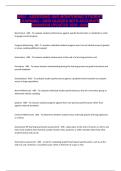
WGU - ASSESSING AND MONITORING STUDENT
LEARNING - D659 QUIZZES WITH ACCURATE
ANSWERS UPDATED 2025 -2026
Benchmark ANS - To evaluate student performance against specific benchmarks or standards in order
to gauge overall progress
Progress Monitoring ANS - To monitor individual student progress over time to identify areas of growth
or areas needing additional support
Summative ANS - To measure student achievement at the end of a learning period or unit
Formative ANS - To assess student understanding during the learning process to guide instruction and
provide feedback
Standardized ANS - To evaluate student performance against a predetermined standard to compare
across a larger population
Norm-Referenced ANS - To compare individual student performance to that of a normative group to
determine relative standing
Ipsative ANS - To measure student progress against their own previous performance rather than
against external standards.
Criterion-Referenced ANS - To determine whether students have achieved specific learning objectives
or criteria.
Assessment OF learning (summative assessment) ANS - takes place at the end of a lesson or unit to see
how much students have learned; usually involves tests, projects, or other activities that show what
students know and can do
Summative assessment ANS - a tool for evaluating student learning at specific points, such as at the
end of a unit, semester, or academic year; often in the form of a quiz or test
, Assessment FOR learning (formative assessment) ANS - a way for teachers to understand how well
students learn as they teach; helps teachers decide what to teach next and how to teach it better
Formative assessment ANS - used during the learning process to gauge student understanding and
guide further learning
Assessment ANS - mechanism for gauging students' understanding, progress, and achievement in
various subject areas
Assessment AS learning (formative or diagnostic) ANS - a way for students to actively assess their
learning progress
Formal assessments ANS - structured evaluations that adhere to predetermined criteria and are often
standardized
Informal assessments ANS - more flexible and spontaneous, occurring during everyday classroom
activities
Formative Assessments ANS - Formative assessments are ongoing evaluations conducted during the
learning process to provide feedback and guide instruction. They help teachers understand student
comprehension and adjust teaching strategies accordingly.
Performance Tasks ANS - Performance tasks are hands-on activities that assess students' ability to
apply their knowledge and skills to real-world scenarios. These tasks often involve problem-solving,
critical thinking, and creativity.
Portfolio Assessment ANS - Portfolio assessment involves the collection and evaluation of student work
samples over time. It provides a holistic view of student progress and achievement across various
learning activities and subjects.
Digital Assessment Tools ANS - Digital assessment tools leverage technology to create interactive
assessments that engage students and provide immediate feedback. These tools encompass a wide
range of digital platforms and applications.
LEARNING - D659 QUIZZES WITH ACCURATE
ANSWERS UPDATED 2025 -2026
Benchmark ANS - To evaluate student performance against specific benchmarks or standards in order
to gauge overall progress
Progress Monitoring ANS - To monitor individual student progress over time to identify areas of growth
or areas needing additional support
Summative ANS - To measure student achievement at the end of a learning period or unit
Formative ANS - To assess student understanding during the learning process to guide instruction and
provide feedback
Standardized ANS - To evaluate student performance against a predetermined standard to compare
across a larger population
Norm-Referenced ANS - To compare individual student performance to that of a normative group to
determine relative standing
Ipsative ANS - To measure student progress against their own previous performance rather than
against external standards.
Criterion-Referenced ANS - To determine whether students have achieved specific learning objectives
or criteria.
Assessment OF learning (summative assessment) ANS - takes place at the end of a lesson or unit to see
how much students have learned; usually involves tests, projects, or other activities that show what
students know and can do
Summative assessment ANS - a tool for evaluating student learning at specific points, such as at the
end of a unit, semester, or academic year; often in the form of a quiz or test
, Assessment FOR learning (formative assessment) ANS - a way for teachers to understand how well
students learn as they teach; helps teachers decide what to teach next and how to teach it better
Formative assessment ANS - used during the learning process to gauge student understanding and
guide further learning
Assessment ANS - mechanism for gauging students' understanding, progress, and achievement in
various subject areas
Assessment AS learning (formative or diagnostic) ANS - a way for students to actively assess their
learning progress
Formal assessments ANS - structured evaluations that adhere to predetermined criteria and are often
standardized
Informal assessments ANS - more flexible and spontaneous, occurring during everyday classroom
activities
Formative Assessments ANS - Formative assessments are ongoing evaluations conducted during the
learning process to provide feedback and guide instruction. They help teachers understand student
comprehension and adjust teaching strategies accordingly.
Performance Tasks ANS - Performance tasks are hands-on activities that assess students' ability to
apply their knowledge and skills to real-world scenarios. These tasks often involve problem-solving,
critical thinking, and creativity.
Portfolio Assessment ANS - Portfolio assessment involves the collection and evaluation of student work
samples over time. It provides a holistic view of student progress and achievement across various
learning activities and subjects.
Digital Assessment Tools ANS - Digital assessment tools leverage technology to create interactive
assessments that engage students and provide immediate feedback. These tools encompass a wide
range of digital platforms and applications.