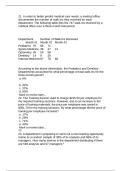
21. In order to better predict medical care needs, a medical office
documented the number of walk-ins they received for each
department. The following table lists the 747 walk-ins received by a
medical office over a three-month trial period.
Department Number of Walk-Ins Received
Month #1 Month #2 Month #3
Pediatrics 76 89 71
Sports Medicine 38 27 41
Optometry 45 53 58
Dentistry 14 9 20
Internal Medicine 67 79 60
According to the above information, the Pediatrics and Dentistry
Departments accounted for what percentage of total walk-ins for the
three-month period?
a. 6%
b. 32%
c. 37%
d. 60%
Mark to review later...
22. The Training division used to charge $215.50 per employee for
the required training sessions. However, due to an increase in the
price of training materials, the price per employee was raised to
$301.70 for the training sessions. By what percentage did the price of
training per employee increase?
a. 17%
b. 29%
c. 71%
d. 40%
Mark to review later...
??
23. A department is preparing to send out a new training opportunity
memo to a random sample of 39% of its analysts and 58% of its
managers. How many memos is the department distributing if there
are 548 analysts and 57 managers?
, a. 214
b. 247
c. 340
d. 587
Mark to review later...
Mathematical Computations
Use the following table to answer questions 24 and 25.
The management of a banking organization anticipates losing a
number of their supervisory employees in four departments to
retirement within the coming 12 months. The table reflects the
number of employees and supervisors currently employed in each
department as well as the number of supervisors who plan to retire in
the coming year.
Unit
Number of Employees
Number of Supervisors
Number of Supervisors Planning to Retire
Centralized Licensing 67 8 5
Consumer Protection Services 27 5 3
Budget/Finance 58 9.5 3
Employee Relations 7 4 1
24. According to the table above, what is the ratio of supervisors to
employees across departments represented by the pre-retirement
figures?
a. 1:5
b. 1:6
c. 1:7
documented the number of walk-ins they received for each
department. The following table lists the 747 walk-ins received by a
medical office over a three-month trial period.
Department Number of Walk-Ins Received
Month #1 Month #2 Month #3
Pediatrics 76 89 71
Sports Medicine 38 27 41
Optometry 45 53 58
Dentistry 14 9 20
Internal Medicine 67 79 60
According to the above information, the Pediatrics and Dentistry
Departments accounted for what percentage of total walk-ins for the
three-month period?
a. 6%
b. 32%
c. 37%
d. 60%
Mark to review later...
22. The Training division used to charge $215.50 per employee for
the required training sessions. However, due to an increase in the
price of training materials, the price per employee was raised to
$301.70 for the training sessions. By what percentage did the price of
training per employee increase?
a. 17%
b. 29%
c. 71%
d. 40%
Mark to review later...
??
23. A department is preparing to send out a new training opportunity
memo to a random sample of 39% of its analysts and 58% of its
managers. How many memos is the department distributing if there
are 548 analysts and 57 managers?
, a. 214
b. 247
c. 340
d. 587
Mark to review later...
Mathematical Computations
Use the following table to answer questions 24 and 25.
The management of a banking organization anticipates losing a
number of their supervisory employees in four departments to
retirement within the coming 12 months. The table reflects the
number of employees and supervisors currently employed in each
department as well as the number of supervisors who plan to retire in
the coming year.
Unit
Number of Employees
Number of Supervisors
Number of Supervisors Planning to Retire
Centralized Licensing 67 8 5
Consumer Protection Services 27 5 3
Budget/Finance 58 9.5 3
Employee Relations 7 4 1
24. According to the table above, what is the ratio of supervisors to
employees across departments represented by the pre-retirement
figures?
a. 1:5
b. 1:6
c. 1:7