
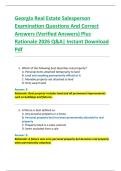
Georgia Real Estate Salesperson
Examination Questions And Correct
Answers (Verified Answers) Plus
Rationale 2026 Q&A| Instant Download
Pdf
1. Which of the following best describes real property?
A. Personal items attached temporarily to land
B. Land and anything permanently affixed to it
C. Movable property not attached to land
D. Only vacant land
Answer: B
Rationale: Real property includes land and all permanent improvements
such as buildings and fixtures.
2. A fixture is best defined as:
A. Any personal property in a home
B. Personal property that has been permanently attached to real
property
C. Property listed in a sales contract
D. Items excluded from a sale
Answer: B
Rationale: A fixture was once personal property but becomes real property
when permanently attached.
, 3. Which test is commonly used to determine whether an item is a
fixture?
A. Price test
B. Size test
C. MARIA test
D. Color test
Answer: C
Rationale: MARIA stands for Method of attachment, Adaptation,
Relationship of the parties, Intention, and Agreement.
4. Freehold estates are best described as:
A. Estates with a fixed duration
B. Estates of indefinite duration
C. Leasehold interests
D. Tenancies at will
Answer: B
Rationale: Freehold estates such as fee simple and life estates have no
fixed ending date.
5. The most complete form of ownership in real estate is:
A. Life estate
B. Fee simple defeasible
C. Fee simple absolute
D. Leasehold estate
Answer: C
Rationale: Fee simple absolute provides the highest level of ownership
rights allowed by law.
, 6. A life estate is an interest that lasts:
A. For a fixed number of years
B. Until the owner sells it
C. For the lifetime of a specified person
D. Until mortgage payoff
Answer: C
Rationale: A life estate terminates upon the death of the measuring life.
7. The person who receives property after a life estate ends is called the:
A. Grantor
B. Lessee
C. Remainderman
D. Trustee
Answer: C
Rationale: The remainderman gains full ownership after the life estate
ends.
8. Leasehold estates are considered:
A. Freehold interests
B. Ownership interests
C. Personal property interests
D. Fee interests
Answer: C
Rationale: Leasehold interests are classified as personal property.
, 9. Which leasehold estate has a definite beginning and ending date?
A. Estate at will
B. Estate at sufferance
C. Estate for years
D. Periodic tenancy
Answer: C
Rationale: An estate for years has a clearly defined term.
10. An estate at sufferance occurs when:
A. A tenant breaks the lease early
B. A tenant remains after the lease expires without permission
C. A tenant pays rent monthly
D. A lease automatically renews
Answer: B
Rationale: Estate at sufferance is a “holdover” tenancy without landlord
consent.
11. Which of the following is a form of co-ownership?
A. Life estate
B. Leasehold estate
C. Tenancy in common
D. Fee simple defeasible
Answer: C
Rationale: Tenancy in common allows two or more owners with undivided
interests.
12. A key characteristic of tenancy in common is:
A. Equal ownership shares required
Examination Questions And Correct
Answers (Verified Answers) Plus
Rationale 2026 Q&A| Instant Download
1. Which of the following best describes real property?
A. Personal items attached temporarily to land
B. Land and anything permanently affixed to it
C. Movable property not attached to land
D. Only vacant land
Answer: B
Rationale: Real property includes land and all permanent improvements
such as buildings and fixtures.
2. A fixture is best defined as:
A. Any personal property in a home
B. Personal property that has been permanently attached to real
property
C. Property listed in a sales contract
D. Items excluded from a sale
Answer: B
Rationale: A fixture was once personal property but becomes real property
when permanently attached.
, 3. Which test is commonly used to determine whether an item is a
fixture?
A. Price test
B. Size test
C. MARIA test
D. Color test
Answer: C
Rationale: MARIA stands for Method of attachment, Adaptation,
Relationship of the parties, Intention, and Agreement.
4. Freehold estates are best described as:
A. Estates with a fixed duration
B. Estates of indefinite duration
C. Leasehold interests
D. Tenancies at will
Answer: B
Rationale: Freehold estates such as fee simple and life estates have no
fixed ending date.
5. The most complete form of ownership in real estate is:
A. Life estate
B. Fee simple defeasible
C. Fee simple absolute
D. Leasehold estate
Answer: C
Rationale: Fee simple absolute provides the highest level of ownership
rights allowed by law.
, 6. A life estate is an interest that lasts:
A. For a fixed number of years
B. Until the owner sells it
C. For the lifetime of a specified person
D. Until mortgage payoff
Answer: C
Rationale: A life estate terminates upon the death of the measuring life.
7. The person who receives property after a life estate ends is called the:
A. Grantor
B. Lessee
C. Remainderman
D. Trustee
Answer: C
Rationale: The remainderman gains full ownership after the life estate
ends.
8. Leasehold estates are considered:
A. Freehold interests
B. Ownership interests
C. Personal property interests
D. Fee interests
Answer: C
Rationale: Leasehold interests are classified as personal property.
, 9. Which leasehold estate has a definite beginning and ending date?
A. Estate at will
B. Estate at sufferance
C. Estate for years
D. Periodic tenancy
Answer: C
Rationale: An estate for years has a clearly defined term.
10. An estate at sufferance occurs when:
A. A tenant breaks the lease early
B. A tenant remains after the lease expires without permission
C. A tenant pays rent monthly
D. A lease automatically renews
Answer: B
Rationale: Estate at sufferance is a “holdover” tenancy without landlord
consent.
11. Which of the following is a form of co-ownership?
A. Life estate
B. Leasehold estate
C. Tenancy in common
D. Fee simple defeasible
Answer: C
Rationale: Tenancy in common allows two or more owners with undivided
interests.
12. A key characteristic of tenancy in common is:
A. Equal ownership shares required


