
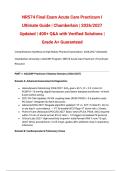
NR574 Final Exam Acute Care Practicum I
Ultimate Guide | Chamberlain | 2026/2027
Updated | 400+ Q&A with Verified Solutions |
Grade A+ Guaranteed
Comprehensive Synthesis & High-Stakes Practice Examination | 2026/2027 Standards
Chamberlain University | AGACNP Program | NR574 Acute Care Practicum I Final Exam
Resource
PART 1: AGACNP Practicum I Mastery Domains (2026/2027)
Domain A: Advanced Assessment & Diagnostics
● Hemodynamic Monitoring 2026/2027: SvO₂ goal ≥ 65 %, CI > 2.2 L/min/m²,
PCWP 8–15 mmHg; digital transducers auto-detect damped waveforms—re-level
& zero before acting.
● 2027 PA Cath Updates: RV-PA coupling index (RVEF/PASP) < 0.6 predicts early
RV failure—integrate into MCS decisions.
● Advanced EKG 2027: Brugada algorithm updated—VT vs. SVT: if initial R > 40 ms
in any lead + concordance → VT; AI-enabled ECG flags VT storm risk ≥ 3 beats.
● Point-of-Care Ultrasound (POCUS) 2027: Basic views (PLAX, PSAX, A4C) required
within 10 min of shock arrival; RV/LV ratio > 1.0 triggers immediate PE protocol.
● Critical Labs 2027: High-sensitivity troponin-I male/female 99th % now 15 ng/L
(2027 AHA); procalcitonin ≥ 0.25 mcg/L guides 48-h antibiotic stop in respiratory
infections.
Domain B: Cardiovascular & Pulmonary Crises
, ● ACS 2027: Zero-delay cath lab (< 60 min door-to-device) for STEMI; tenecteplase
preferred if PCI > 60 min; early PCSK-9 initiation (evolocumab) within 24 h for LDL
> 70 mg/dL.
● Cardiogenic Shock 2027: MCS algorithm—Impella CP if SBP < 70 mmHg & CI <
2.2 & PCWP > 18; IABP only if logistics delay > 90 min.
● ARDS 2027: Driving pressure (ΔP) target ≤ 14 cmH₂O; RP ratio (RR/ΔP) > 0.8 →
escalate to prone within 6 h; ECMO if Murray ≥ 3 & PF < 80 mmHg on FiO₂ 1.0.
● Severe Asthma 2027: Magnesium 2 g IV remains adjunct; early heliox 70:30 if PF
< 150 L/min; biologic benralizumab considered on discharge if eosinophilic
phenotype.
Domain C: Multisystem Complexities
● Sepsis-4 2027: 1-hour bundle—ABX within 45 min, 30 mL/kg crystalloid, lactate &
cultures; qSOFA ≥ 2 + SOFA ≥ 2 triggers bundle.
● CRRT Indications 2027: AKI Stage 2 + life-threatening complication (K⁺ > 6.0, pH
< 7.1, pulmonary edema) OR UOP < 100 mL/8 h despite resuscitation.
● Hepatic Failure 2027: MELD 3.0 (2027) ≥ 20 → transplant evaluation; grade III
encephalopathy → intubate; ammonia > 200 µmol/L → ICP monitor (epidural
fiberoptic).
Domain D: Procedures & Management
● Airway 2027: Video-laryngoscopy first-pass success mandate > 95 %; VL failure ×
2 → SGA rescue → surgical airway standby.
● Ventilator 2027: Auto-PEEP protocol—↓ RR, ↑ expiratory time, bronchodilate;
POCUS diaphragm 10 mm excursion predicts extubation success.
● Ethics 2027: REMAP framework for goals-of-care; palliative extubation—fentanyl
50 mcg + midazolam 2 mg pre-medicate; anticipate death within 30 min.
PART 2: Cumulative Final Practice Examination
Verified Practice Questions & Grade A Solutions
Instructions: This examination synthesizes the entire scope of Acute Care Practicum I.
Approach each complex case as the lead AGACNP. Apply advanced clinical judgment
and current (2026/2027) evidence-based guidelines. Select the SINGLE BEST answer.
, 1. A 64-year-old male presents with 2 hours of crushing chest pain, ST-segment
elevation in V2-V4, BP 88/50 mmHg, HR 110 bpm, SpO₂ 88 % on NRB.
Point-of-care echo shows EF 25 %, akinetic anterior wall, moderate MR, RV
dilated. Which is the IMMEDIATE priority?
A. Start dobutamine 5 mcg/kg/min
B. *Activate catheterization lab and prepare for mechanical circulatory support
(Impella CP)
C. Administer 2 L normal saline bolus
D. Initiate IABP
Rationale: Tests cardiogenic shock recognition. 2027 AHA/ACC: STEMI + CS
(SBP < 90, CI < 2.2) → immediate MCS (Impella CP) if PCI within 90 min; fluids
may worsen pulmonary edema.
2. Same patient now on Impella CP at P-8, flow 3.1 L/min, MAP 55 mmHg on
norepinephrine 0.4 mcg/kg/min. Which is the NEXT step?
A. Increase Impella to P-9
B. *Add vasopressin 0.04 units/min to achieve MAP ≥ 65 mmHg per 2027
guideline
C. Decrease Impella speed to allow pulsatility
D. Start dopamine
Rationale: Tests MCS management. 2027 protocol: MAP ≥ 65 mmHg to ensure
organ perfusion; add vasopressin if NE > 0.25 mcg/kg/min.
3. A 58-year-old woman with asthma is intubated for ARDS (COVID-27). Vent:
VC-AC, TV 6 mL/kg, PEEP 12 cmH₂O, FiO₂ 0.8, Pplat 32 cmH₂O, driving pressure
20 cmH₂O, RR 35, PaCO₂ 55 mmHg, pH 7.22, PaO₂ 58 mmHg. Which is the
PRIORITY intervention?
A. Increase PEEP to 16 cmH₂O
B. *Initiate prone positioning and cis-atracurium neuromuscular blockade
C. Increase TV to 8 mL/kg
D. Start inhaled nitric oxide only
Rationale: Tests severe ARDS management. 2027 Berlin-plus: PF < 100 + driving
pressure 20 → prone within 6 h; NMBA facilitates ventilation.
4. A 70-year-old intubated ARDS patient is proned; after 2 h, SpO₂ drops from 96 %
to 85 %, ETCO₂ falls to 15 mmHg, trachea deviates right, absent left breath
sounds. Needle decompression performed with hiss and BP improvement. Next
step?
A. *Insert left-sided chest tube (28 Fr) and connect to suction
B. Remove needle and observe
C. Start heparin drip
D. Chest CT only
Ultimate Guide | Chamberlain | 2026/2027
Updated | 400+ Q&A with Verified Solutions |
Grade A+ Guaranteed
Comprehensive Synthesis & High-Stakes Practice Examination | 2026/2027 Standards
Chamberlain University | AGACNP Program | NR574 Acute Care Practicum I Final Exam
Resource
PART 1: AGACNP Practicum I Mastery Domains (2026/2027)
Domain A: Advanced Assessment & Diagnostics
● Hemodynamic Monitoring 2026/2027: SvO₂ goal ≥ 65 %, CI > 2.2 L/min/m²,
PCWP 8–15 mmHg; digital transducers auto-detect damped waveforms—re-level
& zero before acting.
● 2027 PA Cath Updates: RV-PA coupling index (RVEF/PASP) < 0.6 predicts early
RV failure—integrate into MCS decisions.
● Advanced EKG 2027: Brugada algorithm updated—VT vs. SVT: if initial R > 40 ms
in any lead + concordance → VT; AI-enabled ECG flags VT storm risk ≥ 3 beats.
● Point-of-Care Ultrasound (POCUS) 2027: Basic views (PLAX, PSAX, A4C) required
within 10 min of shock arrival; RV/LV ratio > 1.0 triggers immediate PE protocol.
● Critical Labs 2027: High-sensitivity troponin-I male/female 99th % now 15 ng/L
(2027 AHA); procalcitonin ≥ 0.25 mcg/L guides 48-h antibiotic stop in respiratory
infections.
Domain B: Cardiovascular & Pulmonary Crises
, ● ACS 2027: Zero-delay cath lab (< 60 min door-to-device) for STEMI; tenecteplase
preferred if PCI > 60 min; early PCSK-9 initiation (evolocumab) within 24 h for LDL
> 70 mg/dL.
● Cardiogenic Shock 2027: MCS algorithm—Impella CP if SBP < 70 mmHg & CI <
2.2 & PCWP > 18; IABP only if logistics delay > 90 min.
● ARDS 2027: Driving pressure (ΔP) target ≤ 14 cmH₂O; RP ratio (RR/ΔP) > 0.8 →
escalate to prone within 6 h; ECMO if Murray ≥ 3 & PF < 80 mmHg on FiO₂ 1.0.
● Severe Asthma 2027: Magnesium 2 g IV remains adjunct; early heliox 70:30 if PF
< 150 L/min; biologic benralizumab considered on discharge if eosinophilic
phenotype.
Domain C: Multisystem Complexities
● Sepsis-4 2027: 1-hour bundle—ABX within 45 min, 30 mL/kg crystalloid, lactate &
cultures; qSOFA ≥ 2 + SOFA ≥ 2 triggers bundle.
● CRRT Indications 2027: AKI Stage 2 + life-threatening complication (K⁺ > 6.0, pH
< 7.1, pulmonary edema) OR UOP < 100 mL/8 h despite resuscitation.
● Hepatic Failure 2027: MELD 3.0 (2027) ≥ 20 → transplant evaluation; grade III
encephalopathy → intubate; ammonia > 200 µmol/L → ICP monitor (epidural
fiberoptic).
Domain D: Procedures & Management
● Airway 2027: Video-laryngoscopy first-pass success mandate > 95 %; VL failure ×
2 → SGA rescue → surgical airway standby.
● Ventilator 2027: Auto-PEEP protocol—↓ RR, ↑ expiratory time, bronchodilate;
POCUS diaphragm 10 mm excursion predicts extubation success.
● Ethics 2027: REMAP framework for goals-of-care; palliative extubation—fentanyl
50 mcg + midazolam 2 mg pre-medicate; anticipate death within 30 min.
PART 2: Cumulative Final Practice Examination
Verified Practice Questions & Grade A Solutions
Instructions: This examination synthesizes the entire scope of Acute Care Practicum I.
Approach each complex case as the lead AGACNP. Apply advanced clinical judgment
and current (2026/2027) evidence-based guidelines. Select the SINGLE BEST answer.
, 1. A 64-year-old male presents with 2 hours of crushing chest pain, ST-segment
elevation in V2-V4, BP 88/50 mmHg, HR 110 bpm, SpO₂ 88 % on NRB.
Point-of-care echo shows EF 25 %, akinetic anterior wall, moderate MR, RV
dilated. Which is the IMMEDIATE priority?
A. Start dobutamine 5 mcg/kg/min
B. *Activate catheterization lab and prepare for mechanical circulatory support
(Impella CP)
C. Administer 2 L normal saline bolus
D. Initiate IABP
Rationale: Tests cardiogenic shock recognition. 2027 AHA/ACC: STEMI + CS
(SBP < 90, CI < 2.2) → immediate MCS (Impella CP) if PCI within 90 min; fluids
may worsen pulmonary edema.
2. Same patient now on Impella CP at P-8, flow 3.1 L/min, MAP 55 mmHg on
norepinephrine 0.4 mcg/kg/min. Which is the NEXT step?
A. Increase Impella to P-9
B. *Add vasopressin 0.04 units/min to achieve MAP ≥ 65 mmHg per 2027
guideline
C. Decrease Impella speed to allow pulsatility
D. Start dopamine
Rationale: Tests MCS management. 2027 protocol: MAP ≥ 65 mmHg to ensure
organ perfusion; add vasopressin if NE > 0.25 mcg/kg/min.
3. A 58-year-old woman with asthma is intubated for ARDS (COVID-27). Vent:
VC-AC, TV 6 mL/kg, PEEP 12 cmH₂O, FiO₂ 0.8, Pplat 32 cmH₂O, driving pressure
20 cmH₂O, RR 35, PaCO₂ 55 mmHg, pH 7.22, PaO₂ 58 mmHg. Which is the
PRIORITY intervention?
A. Increase PEEP to 16 cmH₂O
B. *Initiate prone positioning and cis-atracurium neuromuscular blockade
C. Increase TV to 8 mL/kg
D. Start inhaled nitric oxide only
Rationale: Tests severe ARDS management. 2027 Berlin-plus: PF < 100 + driving
pressure 20 → prone within 6 h; NMBA facilitates ventilation.
4. A 70-year-old intubated ARDS patient is proned; after 2 h, SpO₂ drops from 96 %
to 85 %, ETCO₂ falls to 15 mmHg, trachea deviates right, absent left breath
sounds. Needle decompression performed with hiss and BP improvement. Next
step?
A. *Insert left-sided chest tube (28 Fr) and connect to suction
B. Remove needle and observe
C. Start heparin drip
D. Chest CT only


