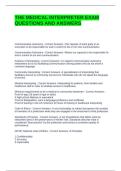
THE MEDICAL INTERPRETER EXAM
QUESTIONS AND ANSWERS
Communicative Autonomy - Correct Answers -The capacity of each party in an
encounter to be responsible for and in control of his or her own communication.
Communicative Autonomy - Correct Answers -Means our capacity to be responsible for
and in control of our own communication.
Purpose of Interpreting - Correct Answers -To support communicative autonomy.
Interpreters do so by facilitating communication among parties who do not share a
common language.
Community Interpreting - Correct Answers -A specialization of interpreting that
facilitates access to community services for individuals who do not speak the language
of service.
Medical Interpreting - Correct Answers -Interpreting for patients, their families and
healthcare staff in order to facilitate access to healthcare.
Minimum requirements to be a medical or community interpreter - Correct Answers -
Proof of age (18 years of age or older)
A high school diploma or equivalent
Proof of bilingualism, such a language proficiency test certificate
Proof of training in the US minimum 40 hours of training in healthcare interpreting
Code of Ethics - Correct Answers -A set of principles or values that govern the conduct
of members of a profession while they are engaged in the enactment of that profession.
Standards of Practice - Correct Answers -A set of guidelines that define what an
interpreter does in the performance of his/her role. Standards describe what is
considered "best practice" by the profession and ensure a consistent quality of
performance.
NCIHC National code of Ethics - Correct Answers -9 Principles
1 Confidenciality
2 Accuracy
3 Imparciality
, 4 Role Boundaries
5 Cultural Awareness
6 Respect
7 Advocacy
8 Professional Development
9 Professionalism
Three Steps for Managing Conflict of Interest - Correct Answers -1 Disclose the
relationship and the conflict of interest
2 Offer to withdraw
3 If all parties ask you to stay, self-evaluate to see whether you should or shouldn't stay
The Say NO Model - Correct Answers -1 Be Gracious
2 Offer 2-3 choice
3 Give reasons
Three stage of interpreting - Correct Answers -Pre-encounter
Encounter
Post-encounter
Pre-encounter - Correct Answers -1 Preparation
2 Briefing (optional)
Encounter - Correct Answers -1 Professional introduction
2 Interpreting
3 Intervening/mediating (optional)
Post-encounter - Correct Answers -1 Debriefing (optional )
2 Analysis
Four Interpreting Protocols - Correct Answers -Positioning
Professional introduction
Direct speech (first person)
Managing the flow
Cultural Mediation the Goal - Correct Answers -Instead of intervening to explain a
cultural difference, help everyone present to communicate their differences to each
other
Techniques for Culturally responsive mediation - Correct Answers -Follow the five steps
for Strategic Mediation Model
Identify the cultural misunderstanding
Try not to speak about what anyone believes
Avoid over generalizations and stereotypes
QUESTIONS AND ANSWERS
Communicative Autonomy - Correct Answers -The capacity of each party in an
encounter to be responsible for and in control of his or her own communication.
Communicative Autonomy - Correct Answers -Means our capacity to be responsible for
and in control of our own communication.
Purpose of Interpreting - Correct Answers -To support communicative autonomy.
Interpreters do so by facilitating communication among parties who do not share a
common language.
Community Interpreting - Correct Answers -A specialization of interpreting that
facilitates access to community services for individuals who do not speak the language
of service.
Medical Interpreting - Correct Answers -Interpreting for patients, their families and
healthcare staff in order to facilitate access to healthcare.
Minimum requirements to be a medical or community interpreter - Correct Answers -
Proof of age (18 years of age or older)
A high school diploma or equivalent
Proof of bilingualism, such a language proficiency test certificate
Proof of training in the US minimum 40 hours of training in healthcare interpreting
Code of Ethics - Correct Answers -A set of principles or values that govern the conduct
of members of a profession while they are engaged in the enactment of that profession.
Standards of Practice - Correct Answers -A set of guidelines that define what an
interpreter does in the performance of his/her role. Standards describe what is
considered "best practice" by the profession and ensure a consistent quality of
performance.
NCIHC National code of Ethics - Correct Answers -9 Principles
1 Confidenciality
2 Accuracy
3 Imparciality
, 4 Role Boundaries
5 Cultural Awareness
6 Respect
7 Advocacy
8 Professional Development
9 Professionalism
Three Steps for Managing Conflict of Interest - Correct Answers -1 Disclose the
relationship and the conflict of interest
2 Offer to withdraw
3 If all parties ask you to stay, self-evaluate to see whether you should or shouldn't stay
The Say NO Model - Correct Answers -1 Be Gracious
2 Offer 2-3 choice
3 Give reasons
Three stage of interpreting - Correct Answers -Pre-encounter
Encounter
Post-encounter
Pre-encounter - Correct Answers -1 Preparation
2 Briefing (optional)
Encounter - Correct Answers -1 Professional introduction
2 Interpreting
3 Intervening/mediating (optional)
Post-encounter - Correct Answers -1 Debriefing (optional )
2 Analysis
Four Interpreting Protocols - Correct Answers -Positioning
Professional introduction
Direct speech (first person)
Managing the flow
Cultural Mediation the Goal - Correct Answers -Instead of intervening to explain a
cultural difference, help everyone present to communicate their differences to each
other
Techniques for Culturally responsive mediation - Correct Answers -Follow the five steps
for Strategic Mediation Model
Identify the cultural misunderstanding
Try not to speak about what anyone believes
Avoid over generalizations and stereotypes