Page 2 out of 33 results
Sort by
Newest University Physics for the Life Sciences summaries
-
Physics class 12th notes Diffraction
- Class notes • 4 pages • 2025
- $8.49
- + learn more
Diffraction in physics refers to the bending and spreading of waves when they encounter an obstacle or pass through a narrow opening. This phenomenon occurs with all types of waves, including light, sound, and water waves. The extent of diffraction depends on the wavelength and the size of the obstacle or aperture. In optics, diffraction causes patterns of light and dark fringes, as seen in the single-slit experiment. It is crucial in applications like optical instruments, X-ray crystallography,...
-
optical instrument physics class 12th
- Class notes • 4 pages • 2025
- $9.49
- + learn more
Optical instruments are devices that process light to enhance vision or capture images. Common examples include microscopes, telescopes, cameras, and binoculars. These instruments use lenses, mirrors, or prisms to manipulate light, enabling detailed observation of distant or microscopic objects. Microscopes magnify tiny structures, while telescopes bring distant celestial bodies into view. Cameras capture and store images using lenses and sensors. Binoculars provide a wider field of view for dis...

-
Huygens principle physics class 12th
- Class notes • 4 pages • 2025
- $10.49
- + learn more
Huygens’ Principle states that every point on a wavefront acts as a source of secondary wavelets that spread out in all directions at the same speed as the original wave. The new wavefront is formed by the envelope of these secondary wavelets. This principle explains the laws of reflection and refraction and is fundamental in understanding wave propagation, diffraction, and interference. It applies to various types of waves, including light, sound, and water waves. Huygens' Principle is cruci...
Do you also write study notes yourself? Put them up for sale and earn every time your document is purchased.
-
Physics class 12th hand mand Notes
- Class notes • 3 pages • 2025
- $8.49
- + learn more
Interference is a phenomenon in which two or more waves overlap, resulting in a new wave pattern. Thomas Young's double-slit experiment (1801) demonstrated the wave nature of light by showing interference. In the experiment, light passes through two closely spaced slits, creating two wavefronts that overlap and produce an interference pattern of bright and dark fringes on a screen. Constructive interference occurs where waves reinforce each other, forming bright fringes, while destructive inter...
-
Class 12th physics coherent incoherent
- Summary • 3 pages • 2025
- $8.49
- + learn more
Coherent-Incoherent Addition (Fixed) refers to a signal processing concept where two waves or signals are combined either coherently (with a fixed phase relationship) or incoherently (with random phase differences). In coherent addition, amplitudes are summed directly, leading to constructive or destructive interference. In incoherent addition, intensities (squared amplitudes) are summed, resulting in a different outcome. The "fixed" aspect likely refers to ensuring consistency in phase relati...
-
Physics class 12th Reflection
- Class notes • 3 pages • 2025
- $10.99
- + learn more
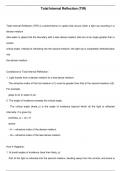
Total Internal Reflection (TIR) occurs when a light ray traveling through a denser medium (e.g., glass or water) hits the boundary with a less dense medium (e.g., air) at an angle greater than the critical angle. Instead of refracting, the light is entirely reflected back into the denser medium. This phenomenon happens because the angle of incidence exceeds the critical angle, and no refraction can occur. TIR is utilized in various applications, including optical fibers for efficient data transm...
-
Physics Reflection and Lenses
- Class notes • 3 pages • 2025
- $11.49
- + learn more
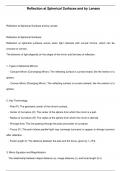
Reflection and lenses are fundamental concepts in optics. Reflection occurs when light bounces off a surface, following the law of reflection: the angle of incidence equals the angle of reflection. It is categorized as specular (smooth surfaces) or diffuse (rough surfaces). Lenses, on the other hand, are transparent objects that refract light to converge or diverge rays. Convex lenses focus light to a point, while concave lenses spread light out. These principles are essential in various applica...
-
Reflection Physics Notes
- Class notes • 3 pages • 2025
- $11.49
- + learn more
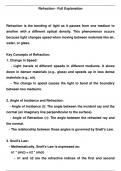
Reflection in physics refers to the bouncing back of light, sound, or other waves when they hit a surface and cannot pass through it. The law of reflection states that the angle of incidence is equal to the angle of reflection, and both angles are measured relative to the normal (a perpendicular line to the surface). Reflection can be of two types: regular reflection, occurring on smooth surfaces like mirrors, and diffuse reflection, occurring on rough surfaces. Reflection is fundamental in opti...
-
Class notes JEE/Neet University Physics for the Life Sciences
- Class notes • 14 pages • 2024
- $6.19
- + learn more
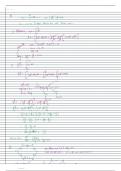
This chapter all about JEE/Neet aspirants Available in hindi language
-
Reflection through a prism physics class 12th
- Class notes • 2 pages • 2025
- $10.49
- + learn more
Refraction through a prism occurs when light enters a transparent, triangular prism and bends due to a change in speed. The light refracts twice—once when entering and again when exiting. Different wavelengths bend at different angles, causing dispersion, which separates white light into its constituent colors (spectrum). This happens because shorter wavelengths (blue, violet) bend more than longer wavelengths (red). The angle of deviation depends on the prism’s material and angle of inciden...