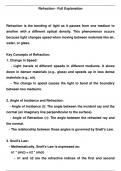
Refraction - Full Explanation
Refraction is the bending of light as it passes from one medium to
another with a different optical density. This phenomenon occurs
because light changes speed when moving between materials like air,
water, or glass.
Key Concepts of Refraction:
1. Change in Speed:
- Light travels at different speeds in different mediums. It slows
down in denser materials (e.g., glass) and speeds up in less dense
materials (e.g., air).
- The change in speed causes the light to bend at the boundary
between two mediums.
2. Angle of Incidence and Refraction:
- Angle of Incidence (i): The angle between the incident ray and the
normal (an imaginary line perpendicular to the surface).
- Angle of Refraction (r): The angle between the refracted ray and
the normal.
- The relationship between these angles is governed by Snell's Law.
3. Snell's Law:
- Mathematically, Snell's Law is expressed as:
n1 * sin(i) = n2 * sin(r)
- n1 and n2 are the refractive indices of the first and second
Refraction is the bending of light as it passes from one medium to
another with a different optical density. This phenomenon occurs
because light changes speed when moving between materials like air,
water, or glass.
Key Concepts of Refraction:
1. Change in Speed:
- Light travels at different speeds in different mediums. It slows
down in denser materials (e.g., glass) and speeds up in less dense
materials (e.g., air).
- The change in speed causes the light to bend at the boundary
between two mediums.
2. Angle of Incidence and Refraction:
- Angle of Incidence (i): The angle between the incident ray and the
normal (an imaginary line perpendicular to the surface).
- Angle of Refraction (r): The angle between the refracted ray and
the normal.
- The relationship between these angles is governed by Snell's Law.
3. Snell's Law:
- Mathematically, Snell's Law is expressed as:
n1 * sin(i) = n2 * sin(r)
- n1 and n2 are the refractive indices of the first and second