

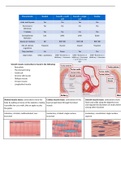
Smooth muscle contraction is found in the following:
- Bronchiole
- The stomach lining
- Gastric pit
- Arrector pili muscle
- Oblique muscle
- Circular muscle
- Longitudinal muscle
Skeletal muscle tissue: contractions move the Cardiac muscle tissue: contractions in the Smooth muscle tissue: contractions move
body by pulling on bones of the skeleton, making heart propel blood through the blood fluids and solids along the digestive tract
it possible for us to walk, bite an apple or play vessels and regulate the diameters of small arteries
among other functions
the guitar
Voluntary, striated, multinucleated, non- Involuntary, striated, single nucleus, Involuntary, nonstriated, single nucleus,
branched branched tapered
, Contractile activity in different smooth muscles: Cross-bridge activation:
CAL = Calmodulin
MLCK = Myosin Light Chain Kinase
Excitation-contraction coupling:
Single-unit smooth muscles: Multi-unit smooth muscles:
- Whole muscle responds as a single unit: numerous gap junctions - Whole muscle responds in individual units: few gap
- Can be innervated by nerves, hormones, spontaneous electrical activity junctions
and local factors - Can be innervated by nerves and hormones
- Ex. intestinal tract, uterus, small blood vessels - Ex. lung airways, large diameter blood vessels
Summary:
- Smooth muscle doesn’t have the same length-tension relationship as skeletal muscle, which allows efficient contraction
under load/stress
- Single unit smooth muscles contract in unison: multiple gap junctions to allow contraction potentials to be passed
along a muscle and spontaneous pacemaker activity (peristalsis in gut)
- Bronchiole
- The stomach lining
- Gastric pit
- Arrector pili muscle
- Oblique muscle
- Circular muscle
- Longitudinal muscle
Skeletal muscle tissue: contractions move the Cardiac muscle tissue: contractions in the Smooth muscle tissue: contractions move
body by pulling on bones of the skeleton, making heart propel blood through the blood fluids and solids along the digestive tract
it possible for us to walk, bite an apple or play vessels and regulate the diameters of small arteries
among other functions
the guitar
Voluntary, striated, multinucleated, non- Involuntary, striated, single nucleus, Involuntary, nonstriated, single nucleus,
branched branched tapered
, Contractile activity in different smooth muscles: Cross-bridge activation:
CAL = Calmodulin
MLCK = Myosin Light Chain Kinase
Excitation-contraction coupling:
Single-unit smooth muscles: Multi-unit smooth muscles:
- Whole muscle responds as a single unit: numerous gap junctions - Whole muscle responds in individual units: few gap
- Can be innervated by nerves, hormones, spontaneous electrical activity junctions
and local factors - Can be innervated by nerves and hormones
- Ex. intestinal tract, uterus, small blood vessels - Ex. lung airways, large diameter blood vessels
Summary:
- Smooth muscle doesn’t have the same length-tension relationship as skeletal muscle, which allows efficient contraction
under load/stress
- Single unit smooth muscles contract in unison: multiple gap junctions to allow contraction potentials to be passed
along a muscle and spontaneous pacemaker activity (peristalsis in gut)


