
Summary BBS1004 Brain, Behaviour and Movement
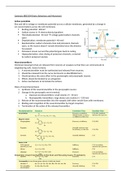
Action potentials
Rise and fall in voltage or membrane potential across a cellular membrane, generated by a change in
ion concentrations across the cell membrane.
Resting potential: -60meV
Sodium moves in electrochemical gradient
Threshold potential: -50 meV voltage gated sodium channels
open
Depolarisation: membrane potential = 40 meV
Repolarisation: sodium channels close and potassium channels
open, so the neuron doesn’t remain stimulated once the stimulus
has passed
Potassium moves out and the potential goes back to resting
Hyperpolarisation: slow closing of potassium channels, corrected
by sodium potassium pumps
Neurotransmitters
Chemical messengers that are released from neurons at synapses so that they can communicate to
neighbouring cells. Several criteria:
1. A neurotransmitter must be synthesized and released from neurons;
2. Should be released from the nerve terminal in an identifiable form;
3. Should produce the same effect in the postsynaptic and presynaptic neuron;
4. Effects should be blocked by an antagonist;
5. Active mechanisms to terminate the actions.
Steps of neurotransmission
1. Synthesis of the neurotransmitter in the presynaptic neuron;
2. Storage in the presynaptic nerve terminal;
a. Classical neurotransmitters: small vesicles (+/- 50 nm)
b. Neuropeptide transmitters: large dense-core vesicles (+/- 100 nm)
3. Release of the neurotransmitter into the synaptic cleft when vesicle fuses with membrane;
4. Binding and recognition of the neurotransmitter by target receptors;
5. Termination of the action of the released transmitter.
Dopamine: reward mechanisms in the brain and focussing issues excitatory
,Norepinephrine: increases alertness of the nervous system excitatory
Epinephrine: stimulation of the sympathetic nervous system (FFF response) excitatory
Serotonin: emotion and mood, carbohydrate cravings, sleep cycle, pain control and digestion
inhibitory, abnormalities in function lead to schizophrenia and depression
Gamma-aminobutyric acid (GABA): low
concentrations lead to anxiety inhibitory
Glutamate and aspartate: intermediary
metabolism and neuronal communication
excitatory
Acetylcholine: chemical neurotransmission
excitatory
Histamine: inflammatory responses,
vasodilation and immune response
excitatory
Release of neurotransmitters
Action potential reaches axon terminal, membrane potential will change and open the
voltage gated calcium channels (IP3 or ryanodine receptor) and calcium flows in;
This causes changes in proteins of the vesicles and the axon terminal;
T- (nerve terminal membrane) and V-SNARE (transport vesicle membrane) proteins = large
protein complex of 24-60 members;
SNARE proteins combine during fusion and form a SNAREpin;
Neurotransmitters will flow into the synaptic cleft;
Frequency of the action potentials will determine the amount of open calcium channels
regulate the neurotransmitter release.
Removal of calcium via pumps
Recycling pathway of vesicles (fundamental neuroscience, page 159)
Reserve pools
Permit a rapid supply of transmembrane neurotransmitter receptors
Recycling endosomes serve as an intracellular reservoir for LTP induction
AMPA receptors at non-synaptic plasma membrane provide an extrasynaptic reserve pool
Receptors
Ionotropic receptors or ligand-activated ion channels
Change shape when neurotransmitter binds open
Ion flow will result in depolarization (excitatory
receptor) or hyperpolarization (inhibitory)
Transmembrane (pore) and extracellular (ligand
binding site) domain
Fast signalling and easy to stop
Metabotropic receptor
Second messengers (G proteins, tyrosine kinases and
guanylyl cyclase)
Slow signalling, terminating takes a while
,G protein cycle
Entyrosine kinase
, IPSP (= inhibitory postsynaptic potential) postsynaptic neuron less likely to generate AP
EPSP (= excitatory postsynaptic potential) postsynaptic neurons more likely to generate AP
Spatial summation: action potentials from multiple neurons
Temporal summation: multiple action potentials from one neuron
Principal neuroscience two pathways
Microstructure skeletal muscle
Costameres connect
sarcomeres to proteins
within the cell membrane
Titin filaments connect the
actin and myosin together
Action potentials
Rise and fall in voltage or membrane potential across a cellular membrane, generated by a change in
ion concentrations across the cell membrane.
Resting potential: -60meV
Sodium moves in electrochemical gradient
Threshold potential: -50 meV voltage gated sodium channels
open
Depolarisation: membrane potential = 40 meV
Repolarisation: sodium channels close and potassium channels
open, so the neuron doesn’t remain stimulated once the stimulus
has passed
Potassium moves out and the potential goes back to resting
Hyperpolarisation: slow closing of potassium channels, corrected
by sodium potassium pumps
Neurotransmitters
Chemical messengers that are released from neurons at synapses so that they can communicate to
neighbouring cells. Several criteria:
1. A neurotransmitter must be synthesized and released from neurons;
2. Should be released from the nerve terminal in an identifiable form;
3. Should produce the same effect in the postsynaptic and presynaptic neuron;
4. Effects should be blocked by an antagonist;
5. Active mechanisms to terminate the actions.
Steps of neurotransmission
1. Synthesis of the neurotransmitter in the presynaptic neuron;
2. Storage in the presynaptic nerve terminal;
a. Classical neurotransmitters: small vesicles (+/- 50 nm)
b. Neuropeptide transmitters: large dense-core vesicles (+/- 100 nm)
3. Release of the neurotransmitter into the synaptic cleft when vesicle fuses with membrane;
4. Binding and recognition of the neurotransmitter by target receptors;
5. Termination of the action of the released transmitter.
Dopamine: reward mechanisms in the brain and focussing issues excitatory
,Norepinephrine: increases alertness of the nervous system excitatory
Epinephrine: stimulation of the sympathetic nervous system (FFF response) excitatory
Serotonin: emotion and mood, carbohydrate cravings, sleep cycle, pain control and digestion
inhibitory, abnormalities in function lead to schizophrenia and depression
Gamma-aminobutyric acid (GABA): low
concentrations lead to anxiety inhibitory
Glutamate and aspartate: intermediary
metabolism and neuronal communication
excitatory
Acetylcholine: chemical neurotransmission
excitatory
Histamine: inflammatory responses,
vasodilation and immune response
excitatory
Release of neurotransmitters
Action potential reaches axon terminal, membrane potential will change and open the
voltage gated calcium channels (IP3 or ryanodine receptor) and calcium flows in;
This causes changes in proteins of the vesicles and the axon terminal;
T- (nerve terminal membrane) and V-SNARE (transport vesicle membrane) proteins = large
protein complex of 24-60 members;
SNARE proteins combine during fusion and form a SNAREpin;
Neurotransmitters will flow into the synaptic cleft;
Frequency of the action potentials will determine the amount of open calcium channels
regulate the neurotransmitter release.
Removal of calcium via pumps
Recycling pathway of vesicles (fundamental neuroscience, page 159)
Reserve pools
Permit a rapid supply of transmembrane neurotransmitter receptors
Recycling endosomes serve as an intracellular reservoir for LTP induction
AMPA receptors at non-synaptic plasma membrane provide an extrasynaptic reserve pool
Receptors
Ionotropic receptors or ligand-activated ion channels
Change shape when neurotransmitter binds open
Ion flow will result in depolarization (excitatory
receptor) or hyperpolarization (inhibitory)
Transmembrane (pore) and extracellular (ligand
binding site) domain
Fast signalling and easy to stop
Metabotropic receptor
Second messengers (G proteins, tyrosine kinases and
guanylyl cyclase)
Slow signalling, terminating takes a while
,G protein cycle
Entyrosine kinase
, IPSP (= inhibitory postsynaptic potential) postsynaptic neuron less likely to generate AP
EPSP (= excitatory postsynaptic potential) postsynaptic neurons more likely to generate AP
Spatial summation: action potentials from multiple neurons
Temporal summation: multiple action potentials from one neuron
Principal neuroscience two pathways
Microstructure skeletal muscle
Costameres connect
sarcomeres to proteins
within the cell membrane
Titin filaments connect the
actin and myosin together


