NR394 Week 3 Discussion, Healthcare Needs of a Specific Minority Group
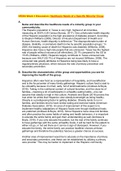
NR394 Week 3 Discussion, Healthcare Needs of a Specific Minority Group A. Name and describe the healthcare needs of a minority group in your community/city. The Hispanic population in Texas is very high, highest of all minorities, measuring at 39.6% (US Census Bureau, 2017). One unfortunate health disparity of the Hispanic population is the high prevalence of diabetes present. According to Stephen Williams (2008), Director of Houston Department of Health and Human Services, health disparity is defined as “The disproportionate burden of disease, disability, or premature death borne by specific population groups.” In 2005, the leading cause of death for Hispanics was diabetes (Williams, 2008). Hispanics also have a high rate people that are uninsured. Texas has the highest rate of people without insurance (all ethnicities), 25.1% compared to the US at 15.9% (Williams, 2008). Hispanics largely contribute to Texas uninsured rate because over HALF (55.7%) of Hispanics are not insured (Williams, 2008). The uninsured rate greatly attributes to Hispanics being less likely to have a regular/primary physician, which reduces the rate of primary prevention and secondary prevention. B. Describe the characteristics of the group and opportunities you see for improving the health of the group. Hispanics often view food as a representation of hospitality, and love/affection and is the focus/center of many family gatherings. Hispanic culture food is said to be unhealthy because it is fried, salty, full of lard/meat/carbs (Andrews & Boyle, 2016). Taking in the nutritional content of cultural favorites, and the close tie of families—meaning a lot of participants in unhealthy eating habits—one can assume that obesity is high in this culture. Andrews and Boyle (2016) proves this true when he writes that Hispanics view obesity/overweight as being healthy. Obesity is a predisposing factor to getting diabetes. Obesity tends to run in families, and families tend to have similar eating and exercise habits (American Diabetes Association, 2019). An area of improvement of this aspect is to implement healthy adaptations of Hispanic foods even though traditional foods are preferred (Andrews & Boyle, 2016). Since Hispanics have close knit families and often practice the same habits of eating and health behaviors, it is important to educate the entire family and gain their understanding as well (Andrews & Boyle, 2016). If you only educate the patient, but the rest of the family continues to have gatherings with the same unhealthy foods, it will be hard for the patient to either not go, or not eat there as it can be a sign of disrespect. However, if you educate the family, the entire family can practice healthier choices at these gatherings and therefore the patient(s) has(ve) a greater chance at success. Another area of improvement would be to educate on the importance of primary and secondary prevention, and these can be established by utilizing a primary care provider. This may be harder to implement in the Hispanic community because they often seek healthcare last because they utilize other healing methods first: such as Home Remedies, Relatives/Neighbors, Herbalists, Massage Therapy, Midwife (can treat children as well), Curandero Total (“lay healer that intervenes in multiple dimensions – physical / spiritual”), Doctor Naturalista (natural only medications), folk remedies (Medina, n.d.). Primary/secondary prevention can also prove difficult to establish due to the high rate of uninsured amongst the Hispanic population. C. How can you use your enhanced communication skills to share your concerns with the "powers that be" in your community to improve their healthcare status? I found an article titled “Community Health Program in Improving Diabetes Knowledge in the Hispanic Population: Salud y Bienestar (Health and Wellness)” that was an experiment in high Hispanic populated areas (Texas included), where they did a one session class in the community that taught many Hispanic (mostly diabetic/pre-diabetic) people about risks, prevention, treatment and management of diabetes (Cruz, Hernandez-Lane, Cohello, & Bautista, 2013). They made the course easier for Hispanic people by eliminating the language barrier and providing tools that they can understand: “(1) a training manual, (2) a flipchart, (3) a diabetes brochure, (4) a bingo game, (5) cups and spoons, and (6) a health basket” (Cruz, Hernandez-Lane, Cohello, & Bautista, 2013). There was a pre and post test that evaluated the effectiveness of the course and it’s numbers showed great improvement in diabetic knowledge among the participants (Cruz, Hernandez-Lane, Cohello, & Bautista, 2013). I believe that showing the efficacy of the program to the “powers that be” in my community would influence them to provide this to improve the diabetic health disparity among the Hispanic population. I’ve also seen primary care offices provide GoodRx (and companies alike) cards at the reception window. These programs offer up to 80% off of prescription medications that could otherwise be unaffordable. I believe that this could be a valuable inclusion to the admission folders we hand out. US Census Bureau (2017) Quick Facts: TEXAS. Retrieved from Williams, S. (2008) A Report on Health Disparities in A Report on Health Disparities in Houston, Texas Houston, Texas. HoustonTX.gov. [PDF File] Retrieved from Andrews, M. M., & Boyle, J. S. (2016). Transcultural concepts in nursing care (7th ed.). Philadelphia, PA: Wolters Kluwer. American Diabetes Association (2019) Learn the genetics of diabetes. Retrieved from Medina, C. (n.d.) Belief and Traditions that impact the Latino Healthcare. DELTA REGION AIDS EDUCATION AND TRAINING CENTER. [PDF File]. Retrieved from Cruz, Y., Hernandez-Lane, M.-E., Cohello, J., & Bautista, C. (2013). The Effectiveness of a Community Health Program in Improving Diabetes Knowledge in the Hispanic Population: Salud y Bienestar (Health and Wellness). Journal of Community Health, 38(6), 1124–1131.
Geschreven voor
Documentinformatie
- Geüpload op
- 21 januari 2021
- Aantal pagina's
- 3
- Geschreven in
- 2020/2021
- Type
- Case uitwerking
- Docent(en)
- Professor
- Cijfer
- A+
Onderwerpen
- nr394 week 3 discussion
- nr394 week 3 discussion
- nr394 week 3 discussion
-
healthcare needs of a specific minority group
-
healthcare needs of a specific minority group a name and describe the healthca

Ook beschikbaar in voordeelbundel