BUL 4421 - Textbook Definitions (Chapters 1-5 and
13, 14)
Save
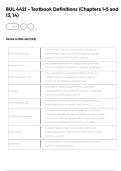
Terms in this set (142)
The collection of rules and decisions made by
Administrative Law administrative agencies to fill in particular details
missing from constitutions and statutes.
the enforceable rules of conduct that govern the
Business Law
actions of buyers and sellers in market exchanges
The collection of legal interpretations made by
Case (Common) Law judges. They are considered to be law unless
otherwise revoked by a statutory law.
the body of laws that governs the rights and
Civil Law responsibilities either between persons or between
persons and their governments
the general limits and powers of a government as
Constitutional Law
interpreted from its written constitution
An economic school of jurisprudence in which all
costs and benefits of a law are given monetary values.
Cost-Benefit Analysis
Those laws with the highest ratios of benefits to costs
are then preferable to those with lower ratios.
a classification of law involving the rights and
Criminal Law responsibilities an individual has with respect to the
public as a whole
a classification of law regulating business activities
Cyberlaw
that are conducted online
, A way of understanding and advancing the evolution
of law by recognizing that law is not made but
Historical School
derived from the habits, traditions, and views of
specific national leaders, e.g., kings.
The school of jurisprudence of pursuing change on
Identification with the
the grounds that some higher law or body of moral
Vulnerable
principles connects all of us in the human community.
The school of jurisprudence which holds that because
society requires authority, a legal and authoritarian
Legal Positivism
hierarchy should exist. When a law is made, therefore,
obedience is expected because authority created it.
The school of jurisprudence which dictates that
context must be considered as well as law. Context
Legal Realism
includes factors such as economic conditions and
social conditions.
a law created to account for variability of laws among
Model (Uniform) Laws states; serves to standardize the otherwise different
interstate laws.
A school of jurisprudence that recognizes the
Natural Law existence of higher law, or law that is morally superior
to human laws.
A tool used by judges to make rulings on cases on the
Precedent
basis of key similarities to previous cases.
law that involves suits between private individuals or
Private Law
groups
law that involves suits between private individuals or
Public Law
groups and their government
Summaries of common law rules in a particular area of
Restatements of the Law the law. __________ do not carry the weight of law but can
be used to guide interpretations of particular cases.
, A theory of applying the law based on concrete
problems to ensure that law is an effective method of
Sociological
ensuring that law is a form of social control that
Jurisprudence
harmonizes the conflicting interest of individuals in
society.
Latin for "standing by the decision"; a principle stating
Stare Decisis that rulings made in higher courts are binding
precedent for lower courts.
the assortment of rules and regulations put forth by
Statutory Law
legislatures
a binding agreement by two nations or international
Treaty
organizations
The use of ethics and principles to solve business
Business Ethics
dilemmas
A question about how a person should behave that
requires the person to reflect about the advantages
Ethical Dilemma
and disadvantages of the optional choices for various
stakeholders.
a simple tool to help determine whether an action is
Ethical Guidelines
moral
the study and practice of decision about what is good
Ethics
and right
The responsibility of firms doing business within a
Social Responsibility of
community to meet the expectations that the
Business
community imposes on them.
Stakeholders the group of people affected by a firm's decisions
positive abstractions that capture our sense of what is
Values
good and desirable
a set of ethical guidelines that urge us to consider
WH process of ethical whom an action affects, the purpose of the action,
decision making and how we view its morality (whether by utilitarian
ethics, deontology, etc.)
13, 14)
Save
Terms in this set (142)
The collection of rules and decisions made by
Administrative Law administrative agencies to fill in particular details
missing from constitutions and statutes.
the enforceable rules of conduct that govern the
Business Law
actions of buyers and sellers in market exchanges
The collection of legal interpretations made by
Case (Common) Law judges. They are considered to be law unless
otherwise revoked by a statutory law.
the body of laws that governs the rights and
Civil Law responsibilities either between persons or between
persons and their governments
the general limits and powers of a government as
Constitutional Law
interpreted from its written constitution
An economic school of jurisprudence in which all
costs and benefits of a law are given monetary values.
Cost-Benefit Analysis
Those laws with the highest ratios of benefits to costs
are then preferable to those with lower ratios.
a classification of law involving the rights and
Criminal Law responsibilities an individual has with respect to the
public as a whole
a classification of law regulating business activities
Cyberlaw
that are conducted online
, A way of understanding and advancing the evolution
of law by recognizing that law is not made but
Historical School
derived from the habits, traditions, and views of
specific national leaders, e.g., kings.
The school of jurisprudence of pursuing change on
Identification with the
the grounds that some higher law or body of moral
Vulnerable
principles connects all of us in the human community.
The school of jurisprudence which holds that because
society requires authority, a legal and authoritarian
Legal Positivism
hierarchy should exist. When a law is made, therefore,
obedience is expected because authority created it.
The school of jurisprudence which dictates that
context must be considered as well as law. Context
Legal Realism
includes factors such as economic conditions and
social conditions.
a law created to account for variability of laws among
Model (Uniform) Laws states; serves to standardize the otherwise different
interstate laws.
A school of jurisprudence that recognizes the
Natural Law existence of higher law, or law that is morally superior
to human laws.
A tool used by judges to make rulings on cases on the
Precedent
basis of key similarities to previous cases.
law that involves suits between private individuals or
Private Law
groups
law that involves suits between private individuals or
Public Law
groups and their government
Summaries of common law rules in a particular area of
Restatements of the Law the law. __________ do not carry the weight of law but can
be used to guide interpretations of particular cases.
, A theory of applying the law based on concrete
problems to ensure that law is an effective method of
Sociological
ensuring that law is a form of social control that
Jurisprudence
harmonizes the conflicting interest of individuals in
society.
Latin for "standing by the decision"; a principle stating
Stare Decisis that rulings made in higher courts are binding
precedent for lower courts.
the assortment of rules and regulations put forth by
Statutory Law
legislatures
a binding agreement by two nations or international
Treaty
organizations
The use of ethics and principles to solve business
Business Ethics
dilemmas
A question about how a person should behave that
requires the person to reflect about the advantages
Ethical Dilemma
and disadvantages of the optional choices for various
stakeholders.
a simple tool to help determine whether an action is
Ethical Guidelines
moral
the study and practice of decision about what is good
Ethics
and right
The responsibility of firms doing business within a
Social Responsibility of
community to meet the expectations that the
Business
community imposes on them.
Stakeholders the group of people affected by a firm's decisions
positive abstractions that capture our sense of what is
Values
good and desirable
a set of ethical guidelines that urge us to consider
WH process of ethical whom an action affects, the purpose of the action,
decision making and how we view its morality (whether by utilitarian
ethics, deontology, etc.)